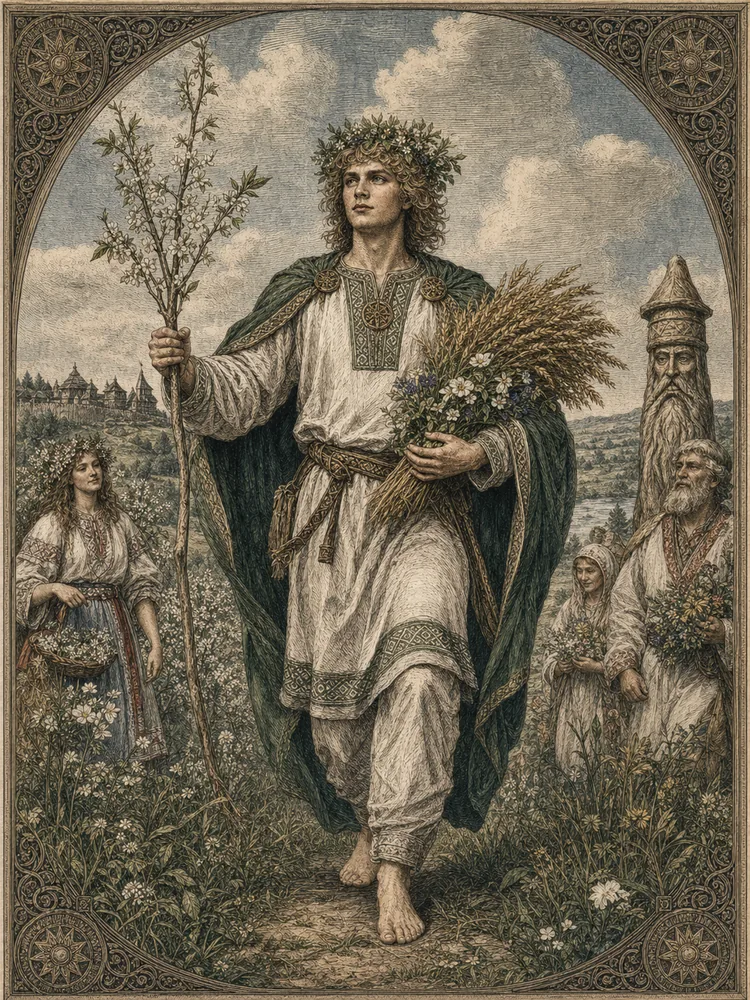
Jarilo (also Jaryło, Jarila, in different Slavic languages, the name from jar-, "spring," "young," "bright") was a Slavic spring-and-fertility god, attested principally in folk-tradition rather than in the medieval external testimony. His seasonal narrative — central to the Ivanov-Toporov reconstruction — was the annual cycle of birth in spring (he came into the world from a winter-quarter, often borne on a horse), his marriage to a goddess (variously Mara, Mokosh, or another spring-and-summer goddess), the conduct of the agricultural year through summer, and his death in autumn (sometimes followed by mourning rituals). The cycle parallels the Greek Adonis and the Mesopotamian Dumuzi closely, and is a clear instance of an Indo-European seasonal-fertility-god pattern. Whether the developed mythological narrative reconstructed by modern scholars accurately reflects pre-Christian Slavic religion or extrapolates beyond the evidence is debated; the underlying ritual cycle is well attested ethnographically.
 Before thisTriglav
 Next on the wallDomovoi
Curator’s note
What the sources say, and what later tradition added. The sources for this bay
The folk-tradition is collected in Afanasyev's Russian Folk Tales and Beliefs (1855–1869) and in subsequent ethnographic work. The Ivanov-Toporov reconstruction (1974) places Jarilo prominently. The skeptical view (e.g., Klejn, Voskreshenie Peruna, 2004) holds that the developed Jarilo-mythology of modern reconstruction is partly a 19th- and 20th-century scholarly construction beyond what the genuine folk-evidence supports.
Kin in the sources
Each tie is quoted from the entry that states it.
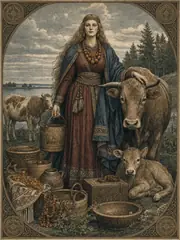 Consort ofMāra
his marriage to a goddess (variously Mara, Mokosh, or another spring-and-summer goddess)
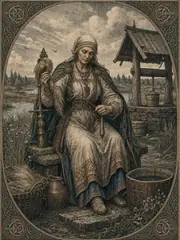 Consort ofMokosh
his marriage to a goddess (variously Mara, Mokosh, or another spring-and-summer goddess)
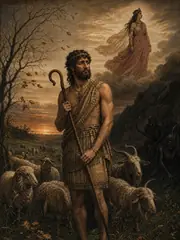 Compared withDumuzi
The cycle parallels the Greek Adonis and the Mesopotamian Dumuzi closely
When the sources speak
Dated witnesses for The Slavic Gods and Spirits. A date marks when the evidence was written down, not when the belief began. The whole timeline
- 2nd–1st millennia BCE
- Indo-European language dispersals and regional Bronze Age cultures provide a remote comparative background, not a recoverable common canon.
- c. 500 BCE–1 CE
- Iron Age material culture, names, sanctuaries, and classical ethnography offer early but external evidence for Celtic and Germanic religions.
- 1st–4th centuries CE
- Roman inscriptions and provincial cults preserve many Celtic, Germanic, and local divine names.
- 4th–8th centuries CE
- Migration-period and early medieval conversion transform ritual institutions while heroic traditions continue.
- 8th–11th centuries CE
- Viking Age poetry, runic evidence, archaeology, and Scandinavian conversion form the core context of Norse myth.
- 9th–12th centuries CE
- Slavic, Baltic, and Finnic traditions enter chronicles and missionary accounts, often through hostile observers.
- 11th–14th centuries CE
- Irish, Welsh, and Icelandic manuscripts preserve major narrative corpora in Christian literary environments.
- 12th–16th centuries CE
- Saxo, saga compilers, Baltic chroniclers, and later antiquarians systematize or reinterpret older material.