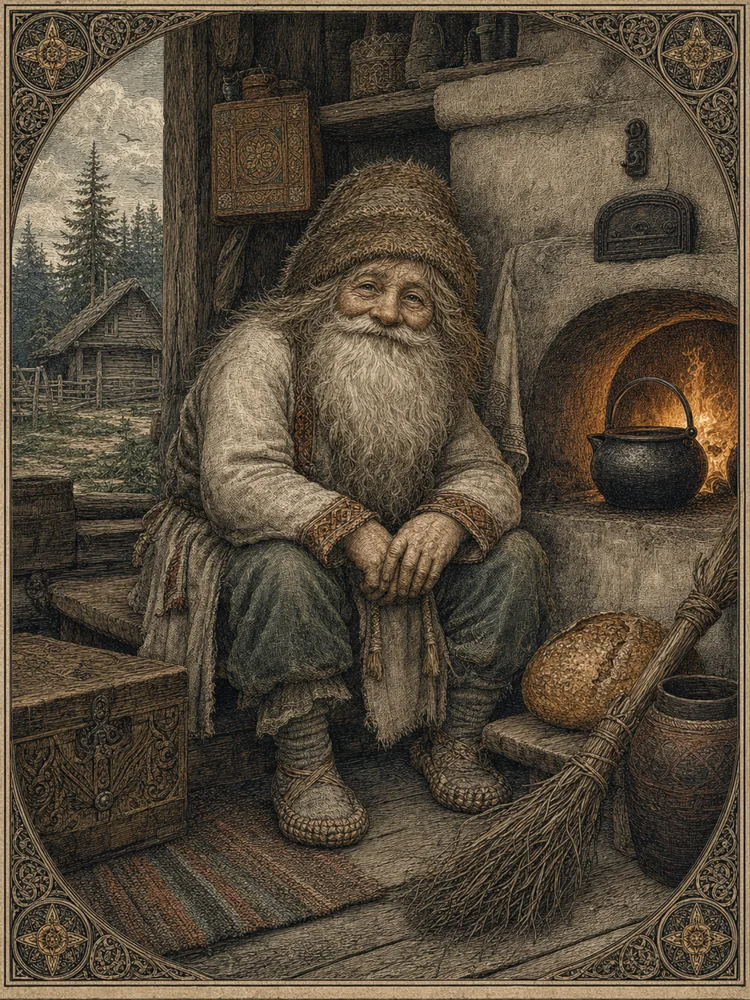
The Domovoi ("belonging to the house," Russian; in other Slavic languages Domovik, Stopan, and similar) was the household spirit of Slavic folk-tradition — a small, hairy, old man who lived behind the stove, who protected the family and their livestock, who could turn helpful or hostile depending on whether the family kept the household properly clean and offered him the small attentions he expected (a saucer of milk, a piece of bread, occasional words of acknowledgment). He was inherited from the family's ancestors; some traditions held that the Domovoi was actually the spirit of the family's first ancestor, watching over his descendants. He could be heard at night in the rustling and creaking of the house; his behavior could be read as omens (a Domovoi who pulled the householder's hair while sleeping was warning of disaster).
When a family moved house, the Domovoi had to be invited to come along; the old hearth was given a piece of bread, the embers were carried in a pot to the new house's hearth, and the formula was spoken: "Welcome, grandfather, to your new home." To leave a Domovoi behind was to court disaster. The figure was extremely persistent in Russian folk-tradition; even into the 20th century, peasant households would observe the small forms of his recognition, and Russian-language phrases for the household spirit (domovoi, stopan, dziadek) survive in modern use.