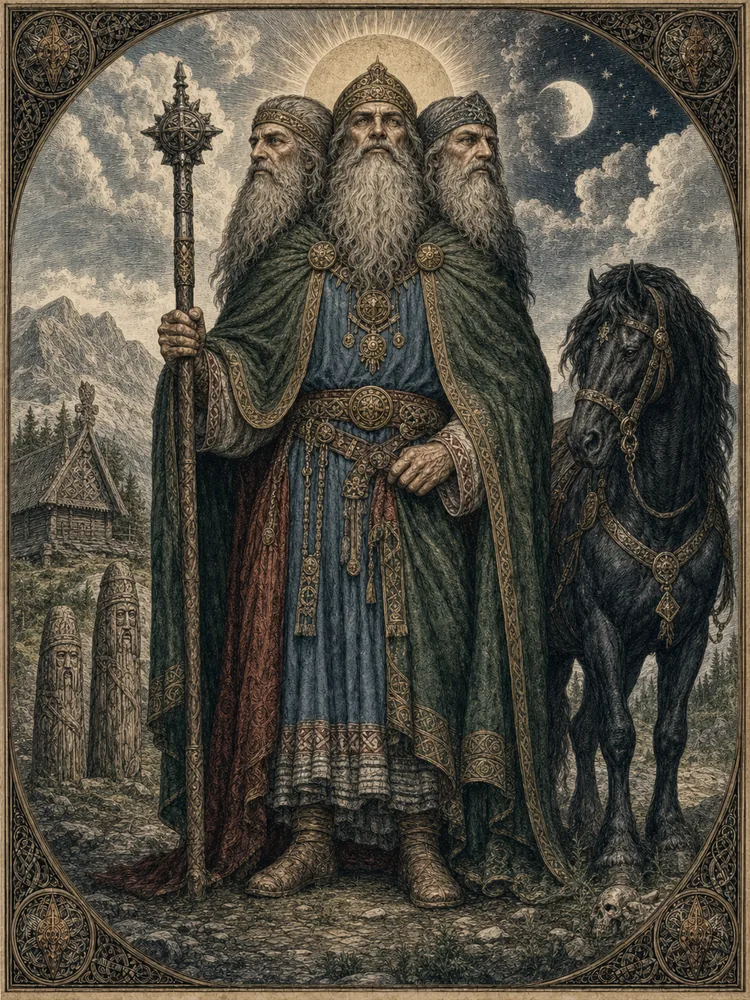
Triglav ("Three-Headed," the name being descriptive) was a god of the Western Slavs, particularly of Pomerania, with major cult-centers at Stettin (Szczecin) and Wollin until their suppression by St. Otto of Bamberg's missionary expedition in 1124–1128. The cult-image was a three-headed god (with a golden veil over the lower part of the faces, that the people might not see his eyes — for, the priests said, the god could not bear to behold the world's sins). He was said to rule three realms (heaven, earth, and the underworld); the three heads have been compared to the three-headed forms of various other Indo-European deities (the Vedic Trimūrti, the Roman Diana Triformis, and others). The cult was thoroughly destroyed at the conversion; little of it survives beyond Otto of Bamberg's biographies' accounts.
 Before thisSvetovid
 Next on the wallJarilo
Curator’s note
What the sources say, and what later tradition added. The sources for this bay
The principal sources are the three biographies of Otto of Bamberg by his contemporaries Ebo, Herbord, and the anonymous monk of Prüfening (all c. 1145–1160). The destruction of the Stettin and Wollin temples is documented in detail. Triglav's actual theological character is harder to recover than his iconographic distinctiveness; the missionary biographers were not interested in giving sympathetic accounts of the cult.
When the sources speak
Dated witnesses for The Slavic Gods and Spirits. A date marks when the evidence was written down, not when the belief began. The whole timeline
- 2nd–1st millennia BCE
- Indo-European language dispersals and regional Bronze Age cultures provide a remote comparative background, not a recoverable common canon.
- c. 500 BCE–1 CE
- Iron Age material culture, names, sanctuaries, and classical ethnography offer early but external evidence for Celtic and Germanic religions.
- 1st–4th centuries CE
- Roman inscriptions and provincial cults preserve many Celtic, Germanic, and local divine names.
- 4th–8th centuries CE
- Migration-period and early medieval conversion transform ritual institutions while heroic traditions continue.
- 8th–11th centuries CE
- Viking Age poetry, runic evidence, archaeology, and Scandinavian conversion form the core context of Norse myth.
- 9th–12th centuries CE
- Slavic, Baltic, and Finnic traditions enter chronicles and missionary accounts, often through hostile observers.
- 11th–14th centuries CE
- Irish, Welsh, and Icelandic manuscripts preserve major narrative corpora in Christian literary environments.
- 12th–16th centuries CE
- Saxo, saga compilers, Baltic chroniclers, and later antiquarians systematize or reinterpret older material.