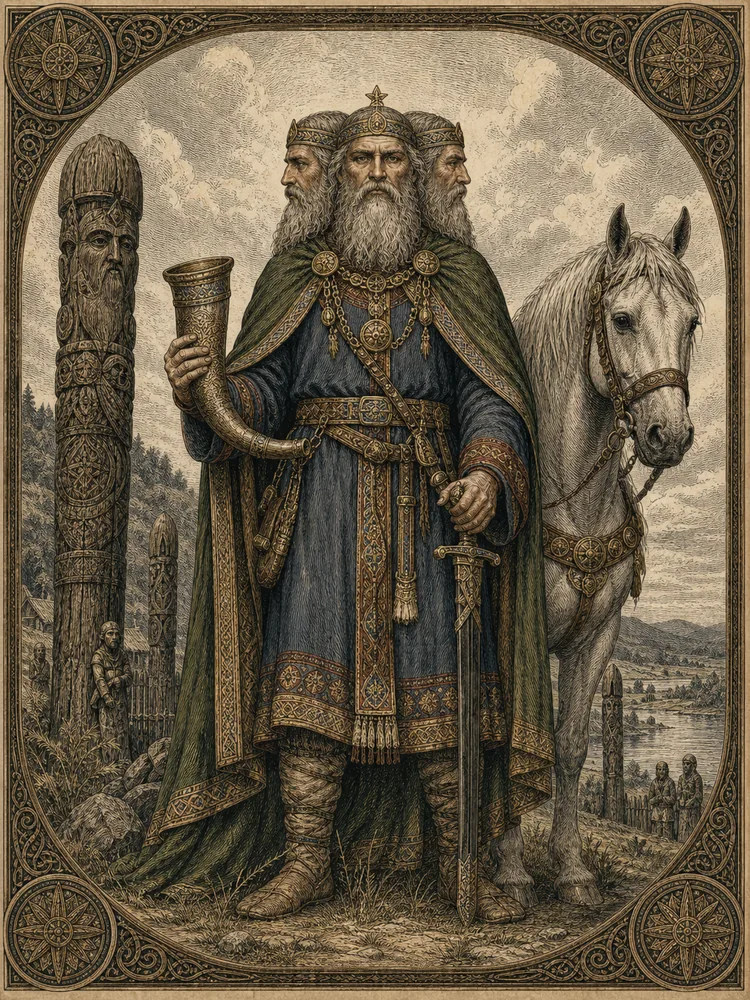
Svetovid (also Svantevit, Sventovit) was the principal god of the Western Slavs, particularly of the Rugians on the island of Rügen in the Baltic, where his great temple at Arkona stood until its destruction by the Danes under Valdemar I in 1168 — the destruction of a major pagan sanctuary attested in detail by Saxo Grammaticus, who wrote his Gesta Danorum a few decades after the event with access to participants' testimony. The temple's cult-image was a four-faced statue, each face looking in a cardinal direction (signifying the god's seeing in all four corners of the world); in one hand the image held a horn of mead, which the priest examined annually for prophecy of the coming year's prosperity (a full horn meant good harvests, an empty horn meant scarcity). A great white horse was kept at the temple as the god's mount; only the priest might ride or feed the horse, and the horse's behavior at certain times was used for divination (horse-divination by stepping over crossed lances). The temple was extraordinarily wealthy; Saxo describes the great quantities of treasure looted by the Danes at its destruction.
Svetovid's name is from the Slavic root meaning "holy" or "strong" (svęt-) plus -vit, of debated etymology ("lord," or "sight," or perhaps simply a noun-suffix). The cult was substantially developed and the figure was one of the most fully attested of the Slavic gods, owing to Saxo's detailed account.