A Compendium of the Ancient Gods
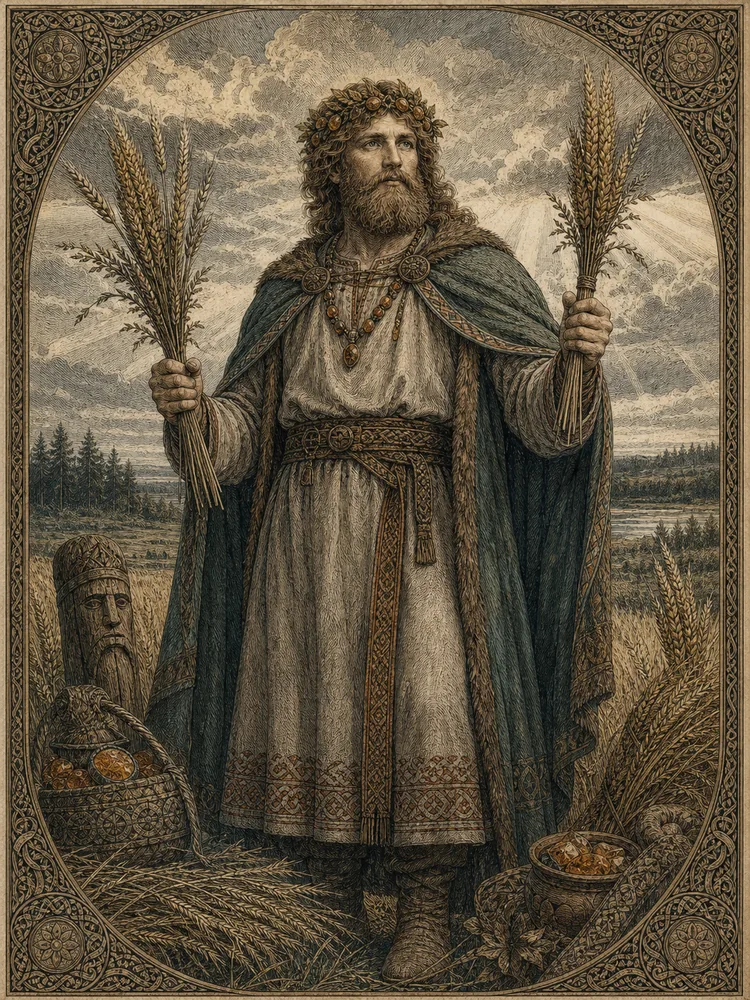
Jumis, plate

Jumis was the Latvian spirit of agricultural plenty, embodied in any unusual doubling found in the field at harvest: a stalk of grain bearing two ears, a pod with twin peas, a pair of fruits joined together. To find such a thing was to find Jumis, and the discovery was an omen of prosperity for the whole household. The double ear was carried home with ceremony and either eaten by the head of the household or saved as a charm for the next year's planting.

The harvest-rite of Jumis was the chase: when the last sheaf was being cut, the reapers held that Jumis was running before them, fleeing from row to row, and at last would be cornered in the final stalks. The youngest reaper would seize the sheaf shouting "Jumis is caught!" and would bind it carefully; this last sheaf, called the Jumis-sheaf, was kept through the winter as a guarantee of next year's crop, and at the next sowing was fed to the horses or scattered upon the field to return Jumis to the soil.

The figure has obvious connections to similar harvest-spirits across northern Europe — the German Roggenwolf ("rye-wolf"), the Russian Polevik (described in the previous book), the English "corn-mother" of older folklore. What is distinctive about the Latvian Jumis is the specific association with the double ear, the visible doubled fertility that gave the spirit his name (jumis from jumī- "twin, doubled"). The same root gives the Latvian word for "twin" (jumtnieks), and there is some scholarly suggestion that Jumis was originally a divine twin-figure, a counterpart to the Dieva Dēli (Sons of God) at the level of the field rather than the heavens.

Curator’s note

What the sources say, and what later tradition added. The sources for this bay

Jumis is documented in nineteenth-century Latvian ethnographic collections, particularly those of Otto Brüning and August Bielenstein. The Latvju Dainas contain numerous Jumis-songs. Haralds Biezais discussed the figure in his various works. The Indo-European twin-divinity background was developed by Donald Ward (The Divine Twins, 1968) and by Jaan Puhvel; Jumis is a possible candidate for a Baltic reflex of the IE divine twins, alongside the more obvious Dieva Dēli. The harvest-customs persisted in Latvian villages into the early twentieth century and are still consciously revived in the Latvian midsummer festivals.

When the sources speak

Dated witnesses for The Baltic Pantheon. A date marks when the evidence was written down, not when the belief began. The whole timeline

2nd–1st millennia BCE
Indo-European language dispersals and regional Bronze Age cultures provide a remote comparative background, not a recoverable common canon.
c. 500 BCE–1 CE
Iron Age material culture, names, sanctuaries, and classical ethnography offer early but external evidence for Celtic and Germanic religions.
1st–4th centuries CE
Roman inscriptions and provincial cults preserve many Celtic, Germanic, and local divine names.
4th–8th centuries CE
Migration-period and early medieval conversion transform ritual institutions while heroic traditions continue.
8th–11th centuries CE
Viking Age poetry, runic evidence, archaeology, and Scandinavian conversion form the core context of Norse myth.
9th–12th centuries CE
Slavic, Baltic, and Finnic traditions enter chronicles and missionary accounts, often through hostile observers.
11th–14th centuries CE
Irish, Welsh, and Icelandic manuscripts preserve major narrative corpora in Christian literary environments.
12th–16th centuries CE
Saxo, saga compilers, Baltic chroniclers, and later antiquarians systematize or reinterpret older material.

Floor plan

The rooms follow one another in the order their peoples first appear in the written record.

  1. The Cradle of Citiesc. 3400 BCE to 395 CE. 115 works
  2. The Gift of the Nilec. 4000 BCE to 395 CE. 73 works
  3. The Olympian Orderc. 1600 BCE to 750 CE. 152 works
  4. The Persian Worldc. 2000 BCE to 1010 CE. 30 works
  5. The Levantine Borderlandsc. 1200 BCE to 500 CE. 20 works
  6. The Edges of Empirec. 2000 BCE to 1500 CE. 33 works
  7. The Etruscan Worldc. 900 BCE to 750 CE. 22 works
  8. The Roman Inheritancec. 1200 BCE to 500 CE. 58 works
  9. The Northern Inheritancec. 2000 BCE to 1600 CE. 131 works