A Compendium of the Ancient Gods
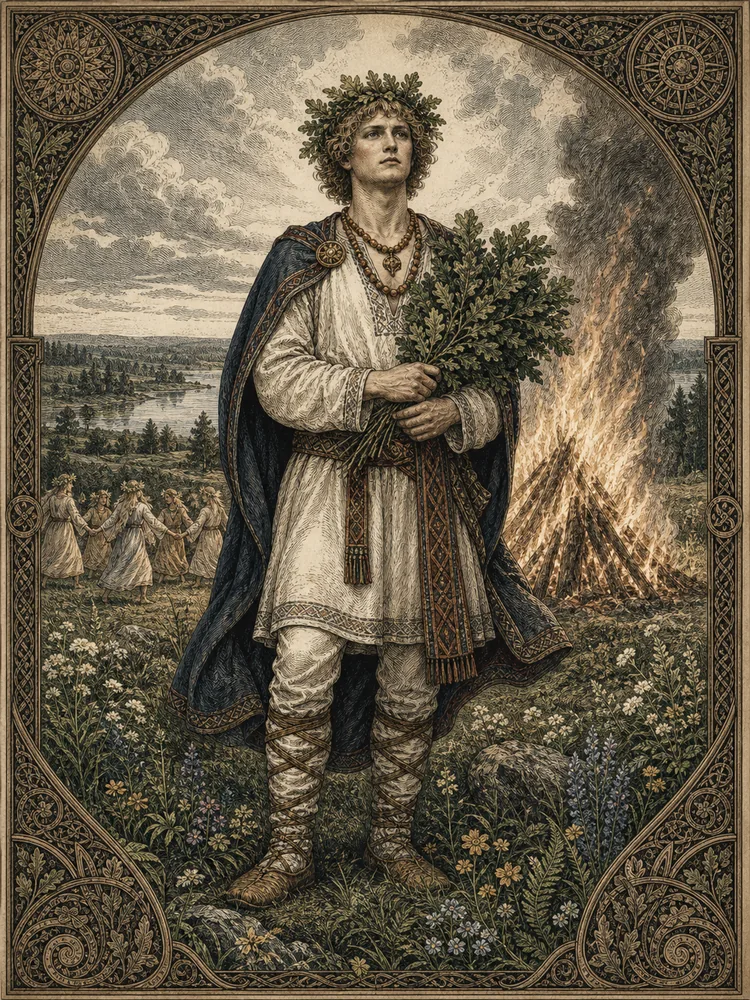
Jānis, plate

Jānis was the patron of the Latvian midsummer festival, the Jāņi or Līgo, kept on the night of June 23 to 24 — the eve of Saint John's Day, but in fact a Christianization of the pre-Christian summer-solstice festival of the Baltic peoples. Jānis was the deified summer, the height of the year, the green abundance of the fields when the days were longest. His emblem was the oak-wreath that men wore on the night, and the bonfire on the hill that was kept burning through the year's shortest darkness.

The Jāņi festival was (and is, where the tradition continues) one of the great moments of the Latvian year. Houses were decorated with garlands of oak-leaves, ferns, and meadow-flowers; women wore wreaths of flowers, men wore wreaths of oak; bonfires were lit on hilltops; the Līgo songs were sung through the night, with their characteristic refrain "līgo, līgo," untranslatable but evocative of the rocking, swinging, dancing rhythm of the festival. Couples leapt through the bonfires for fertility; cattle were driven between two fires for protection from disease; the herbs gathered on Jāņi night had especially strong magical power.

Whether Jānis was a fully personified pre-Christian god, or simply the spirit of the festival itself, has been debated. The name Jānis is from the Latvian form of "John," pointing to the Christian overlay; but the festival is plainly older than Christianity, and the figure of the festival's spirit had an independent life. In the dainas, Jānis appears as a young man visiting each household on his eve, expecting hospitality and giving blessings of fertility and abundance in return; he is a household visitor as much as a calendrical figure.

Curator’s note

What the sources say, and what later tradition added. The sources for this bay

The Jāņi festival is documented from the early modern period onward; the most extensive scholarly treatment is in Latvian ethnographic literature of the late nineteenth and twentieth centuries (Pēteris Šmits, Marja Augšķalne, others). The Christian overlay is straightforward — the festival is on the eve of the Nativity of John the Baptist (June 24), and Jānis is the Latvian form of that saint's name — but the festival itself is plainly the surviving pagan summer-solstice rite, with parallels in Lithuanian Rasos, Russian Ivan Kupala, and Swedish Midsommar. The persistence of the festival through Christian and Soviet periods to its full revival as a national holiday after 1991 is one of the great stories of Latvian cultural continuity.

When the sources speak

Dated witnesses for The Baltic Pantheon. A date marks when the evidence was written down, not when the belief began. The whole timeline

2nd–1st millennia BCE
Indo-European language dispersals and regional Bronze Age cultures provide a remote comparative background, not a recoverable common canon.
c. 500 BCE–1 CE
Iron Age material culture, names, sanctuaries, and classical ethnography offer early but external evidence for Celtic and Germanic religions.
1st–4th centuries CE
Roman inscriptions and provincial cults preserve many Celtic, Germanic, and local divine names.
4th–8th centuries CE
Migration-period and early medieval conversion transform ritual institutions while heroic traditions continue.
8th–11th centuries CE
Viking Age poetry, runic evidence, archaeology, and Scandinavian conversion form the core context of Norse myth.
9th–12th centuries CE
Slavic, Baltic, and Finnic traditions enter chronicles and missionary accounts, often through hostile observers.
11th–14th centuries CE
Irish, Welsh, and Icelandic manuscripts preserve major narrative corpora in Christian literary environments.
12th–16th centuries CE
Saxo, saga compilers, Baltic chroniclers, and later antiquarians systematize or reinterpret older material.

Floor plan

The rooms follow one another in the order their peoples first appear in the written record.

  1. The Cradle of Citiesc. 3400 BCE to 395 CE. 115 works
  2. The Gift of the Nilec. 4000 BCE to 395 CE. 73 works
  3. The Olympian Orderc. 1600 BCE to 750 CE. 152 works
  4. The Persian Worldc. 2000 BCE to 1010 CE. 30 works
  5. The Levantine Borderlandsc. 1200 BCE to 500 CE. 20 works
  6. The Edges of Empirec. 2000 BCE to 1500 CE. 33 works
  7. The Etruscan Worldc. 900 BCE to 750 CE. 22 works
  8. The Roman Inheritancec. 1200 BCE to 500 CE. 58 works
  9. The Northern Inheritancec. 2000 BCE to 1600 CE. 131 works