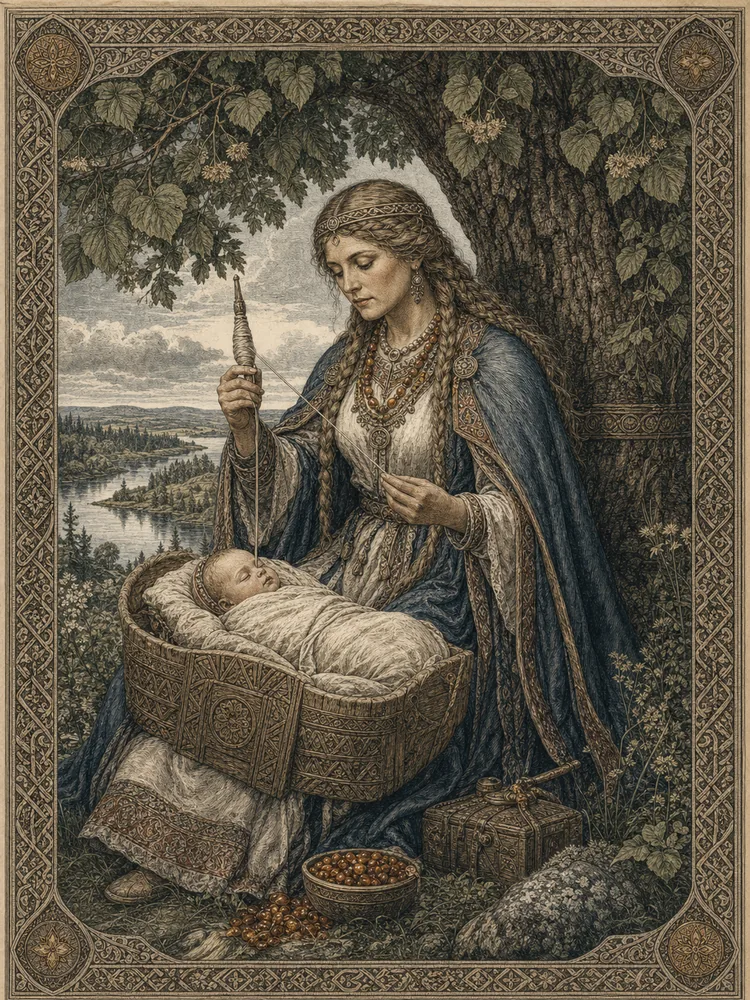
Laima was the Baltic goddess of fate — the determiner of the destinies of human beings, present at every birth to assign the newborn its lot in life, present at every wedding to bless or curse the union, present at every death to receive the dying. She is among the most frequently invoked figures in the Latvian dainas (after Saulė); the Latvians of the pre-modern period, asked about a misfortune, would commonly say "This was Laima's giving" — meaning the working of fate. She had two sisters in some traditions (Kārta and Dēkla in Latvian, making a triad parallel to the Greek Moirai and the Norse Norns, and reflecting the same underlying Indo-European fate-triad pattern); in other traditions she was a single goddess with the various functions herself. She was associated with the linden tree and with the cuckoo (the cuckoo's call being interpreted as her speech), and offered libations at the births of children.
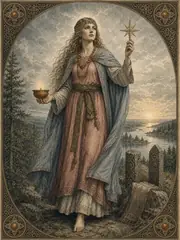 Before thisAušrinė
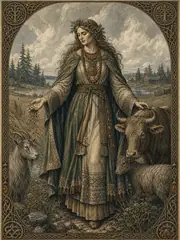 Next on the wallŽemyna
Curator’s note
What the sources say, and what later tradition added. The sources for this bay
The principal sources are the Latvian dainas; Lithuanian folk-tradition. The triad-of-fate pattern is widely attested in Indo-European traditions. Greimas's Of Gods and Men (1979/1992) provides a structural analysis of the figure.
Kin in the sources
Each tie is quoted from the entry that states it.
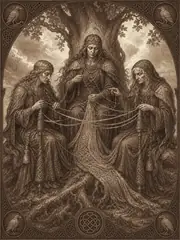 Compared withNorns
making a triad parallel to the Greek Moirai and the Norse Norns
When the sources speak
Dated witnesses for The Baltic Pantheon. A date marks when the evidence was written down, not when the belief began. The whole timeline
- 2nd–1st millennia BCE
- Indo-European language dispersals and regional Bronze Age cultures provide a remote comparative background, not a recoverable common canon.
- c. 500 BCE–1 CE
- Iron Age material culture, names, sanctuaries, and classical ethnography offer early but external evidence for Celtic and Germanic religions.
- 1st–4th centuries CE
- Roman inscriptions and provincial cults preserve many Celtic, Germanic, and local divine names.
- 4th–8th centuries CE
- Migration-period and early medieval conversion transform ritual institutions while heroic traditions continue.
- 8th–11th centuries CE
- Viking Age poetry, runic evidence, archaeology, and Scandinavian conversion form the core context of Norse myth.
- 9th–12th centuries CE
- Slavic, Baltic, and Finnic traditions enter chronicles and missionary accounts, often through hostile observers.
- 11th–14th centuries CE
- Irish, Welsh, and Icelandic manuscripts preserve major narrative corpora in Christian literary environments.
- 12th–16th centuries CE
- Saxo, saga compilers, Baltic chroniclers, and later antiquarians systematize or reinterpret older material.