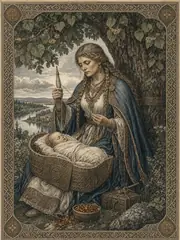
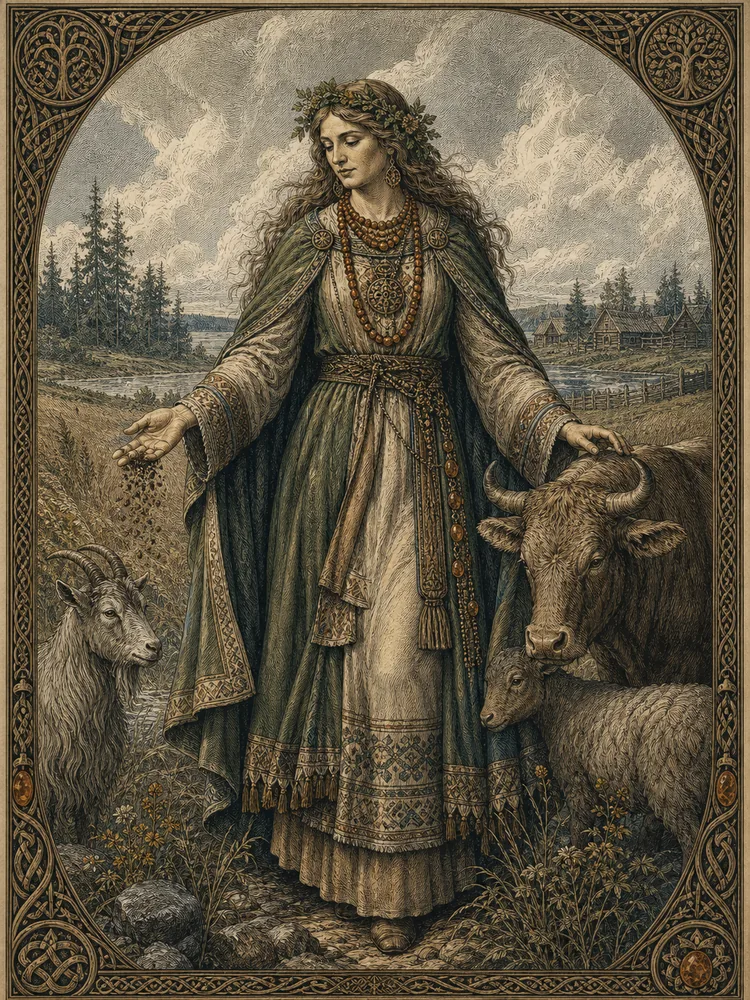
Žemyna (Lithuanian; Latvian Zemes māte, "Mother Earth") was the Baltic mother-earth goddess, the goddess of the cultivated soil, of fertility, of harvest. She was honored at every plowing (the first furrow was libated with beer), at every sowing, at every harvest; her name was invoked at every meal (a small portion was sometimes thrown to the ground for her). The cult was strongly persistent; the medieval and early-modern church complaints record extensive struggles to suppress the household libations to Žemyna among Lithuanian peasants. Her name comes from Indo-European *dhéǵhōm ("earth"), the same root that gave Latin humus and Greek chthōn — making her one of the more clearly inherited Indo-European earth-goddess-names.
She was occasionally treated as a complementary pair to Dievas the sky-god (the marriage of Sky-Father and Earth-Mother being among the oldest Indo-European reconstructions); but the Baltic theology preserved her independence as well, with her own cycle of seasonal observances and her own characteristic offerings.
When the sources speak
Dated witnesses for The Baltic Pantheon. A date marks when the evidence was written down, not when the belief began. The whole timeline
- 2nd–1st millennia BCE
- Indo-European language dispersals and regional Bronze Age cultures provide a remote comparative background, not a recoverable common canon.
- c. 500 BCE–1 CE
- Iron Age material culture, names, sanctuaries, and classical ethnography offer early but external evidence for Celtic and Germanic religions.
- 1st–4th centuries CE
- Roman inscriptions and provincial cults preserve many Celtic, Germanic, and local divine names.
- 4th–8th centuries CE
- Migration-period and early medieval conversion transform ritual institutions while heroic traditions continue.
- 8th–11th centuries CE
- Viking Age poetry, runic evidence, archaeology, and Scandinavian conversion form the core context of Norse myth.
- 9th–12th centuries CE
- Slavic, Baltic, and Finnic traditions enter chronicles and missionary accounts, often through hostile observers.
- 11th–14th centuries CE
- Irish, Welsh, and Icelandic manuscripts preserve major narrative corpora in Christian literary environments.
- 12th–16th centuries CE
- Saxo, saga compilers, Baltic chroniclers, and later antiquarians systematize or reinterpret older material.