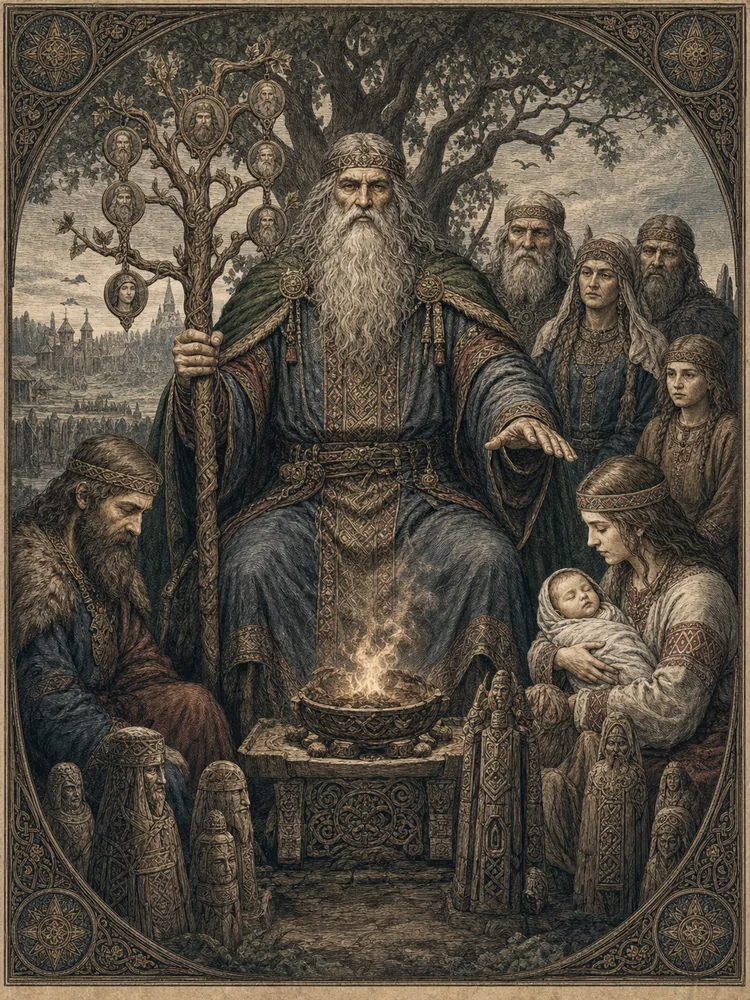
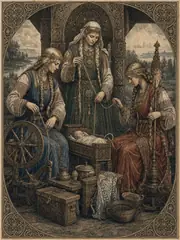
Among the East Slavs of the early medieval period there was a god called Rod — "Family," "Kindred," "Generation" — who was held to be the eldest of the gods and the maker of the world. His name is the same word that in modern Russian means "family" or "clan" (rod), and his function was to oversee the continuity of human kindreds: he gave life to the unborn, fixed the destinies of the newly-born, watched over the bloodline as it descended from generation to generation.
Rod was worshipped together with goddesses called the Rozhanitsy — the "Birth-Givers" — who were two or three female figures associated with fate and childbirth. Their cult was a domestic and feminine one: the women of the household made offerings of bread, cheese, and honey to Rod and the Rozhanitsy at the birth of a child, that the child's destiny might be favorable. The cult was so persistent that Christian writers of the eleventh and twelfth centuries had to specifically denounce it; the chronicle of the Kievan period repeatedly attacks the persistence of "feasts to Rod and the Rozhanitsy" among Christianized but still folk-believing populations.
Of Rod's mythology beyond his name and function, little has survived. He had no temple of which we have record, no priesthood, no festival in the official calendar; he was a god of the household and the lineage rather than the public cult. Some scholars have tried to identify him with various other Slavic gods (Stribog, Svarog) of the public pantheon; others have argued that he was a domestic counterpart of the warrior pantheon, a god of the women's hearth as opposed to the men's altar. The matter is unresolved, and probably will remain so in the absence of new sources.