A Compendium of the Ancient Gods
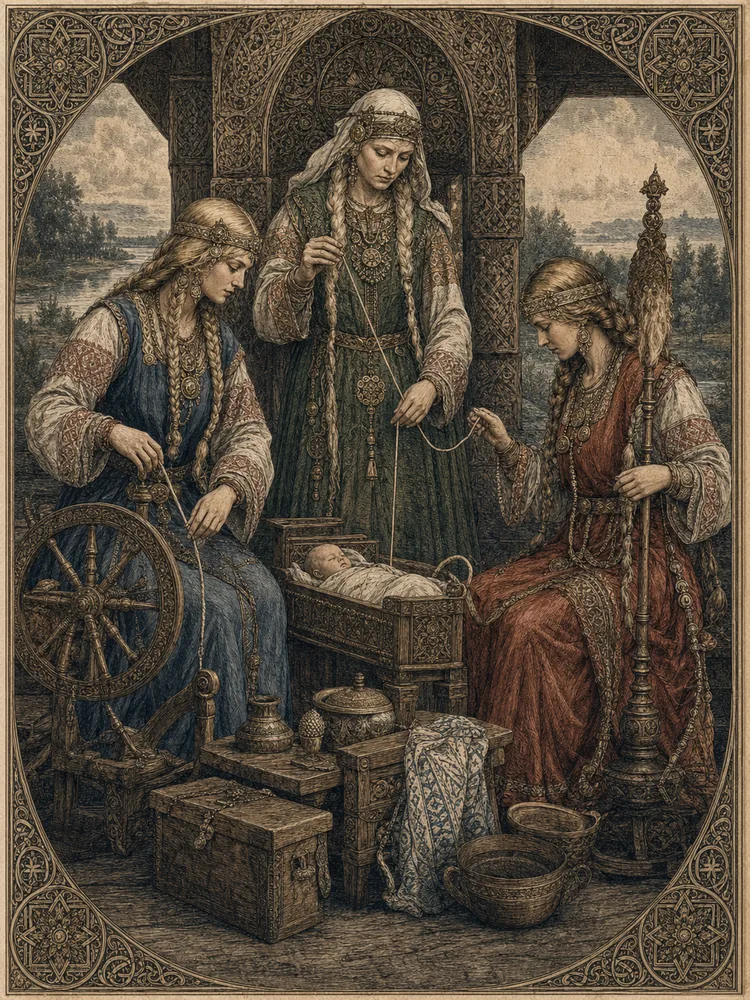
The Rozhanitsy, plate

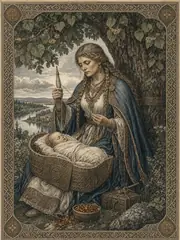
The Rozhanitsy — "the Birth-Givers," from the Slavic root rod ("birth, kindred") — were a group of female fate-figures in early Slavic religion, two or three in number depending on the source, who attended every childbirth and determined the destiny of the newborn. Their cult was a household one, conducted by women, with offerings of bread and cheese and honey at the time of a child's birth. They were imagined as old women who came invisibly to the cradle; what they spoke at the birth was the unalterable fate of the child for the whole of his life.

The Rozhanitsy belong to the wider Indo-European family of fate-goddesses — the Greek Moirai (Clotho, Lachesis, Atropos), the Roman Parcae, the Norse Norns (Urd, Verdandi, Skuld), the Lithuanian Laima — all groups of two or three female figures who attended birth and pronounced fate. The Slavic case is unusual chiefly in the difficulty of distinguishing the Rozhanitsy as a group from individual fate-figures (Suđenice in South Slavic, Roganice in Polish) who appear in the folk traditions of various regions.

The Christian church regarded the Rozhanitsy with great suspicion, and the polemical texts of the early Russian period repeatedly denounced the practice of "feasting the Rozhanitsy" — the household meal at which the women set out food for the unseen visitors at a child's birth. The cult was nevertheless persistent, and survived in folk practice until modern times, often Christianized as offerings to the Virgin Mary or to specific female saints (Saint Paraskeva-Friday in particular).
Curator’s note

What the sources say, and what later tradition added. The sources for this bay

The Rozhanitsy are mentioned alongside Rod in the same Russian polemical texts. The South Slavic Suđenice (or Sudbinice, Sudičky in Czech) are documented from the late medieval period through nineteenth-century folk collection. The Polish Roganice and the Bulgarian Narečnitsi are regional variants. Roman Jakobson's classic essay "Slavic Gods and Demons" (1949) summarizes the comparative material. The continuity from pagan Rozhanitsy to Christian female saints is one of the better-documented cases of religious-functional substitution in Slavic folk Christianity.

Kin in the sources

Each tie is quoted from the entry that states it.

When the sources speak

Dated witnesses for The Slavic Gods and Spirits. A date marks when the evidence was written down, not when the belief began. The whole timeline

2nd–1st millennia BCE
Indo-European language dispersals and regional Bronze Age cultures provide a remote comparative background, not a recoverable common canon.
c. 500 BCE–1 CE
Iron Age material culture, names, sanctuaries, and classical ethnography offer early but external evidence for Celtic and Germanic religions.
1st–4th centuries CE
Roman inscriptions and provincial cults preserve many Celtic, Germanic, and local divine names.
4th–8th centuries CE
Migration-period and early medieval conversion transform ritual institutions while heroic traditions continue.
8th–11th centuries CE
Viking Age poetry, runic evidence, archaeology, and Scandinavian conversion form the core context of Norse myth.
9th–12th centuries CE
Slavic, Baltic, and Finnic traditions enter chronicles and missionary accounts, often through hostile observers.
11th–14th centuries CE
Irish, Welsh, and Icelandic manuscripts preserve major narrative corpora in Christian literary environments.
12th–16th centuries CE
Saxo, saga compilers, Baltic chroniclers, and later antiquarians systematize or reinterpret older material.

Floor plan

The rooms follow one another in the order their peoples first appear in the written record.

  1. The Cradle of Citiesc. 3400 BCE to 395 CE. 115 works
  2. The Gift of the Nilec. 4000 BCE to 395 CE. 73 works
  3. The Olympian Orderc. 1600 BCE to 750 CE. 152 works
  4. The Persian Worldc. 2000 BCE to 1010 CE. 30 works
  5. The Levantine Borderlandsc. 1200 BCE to 500 CE. 20 works
  6. The Edges of Empirec. 2000 BCE to 1500 CE. 33 works
  7. The Etruscan Worldc. 900 BCE to 750 CE. 22 works
  8. The Roman Inheritancec. 1200 BCE to 500 CE. 58 works
  9. The Northern Inheritancec. 2000 BCE to 1600 CE. 131 works