A Compendium of the Ancient Gods
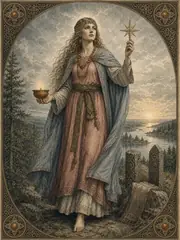
The Zoryas, plate

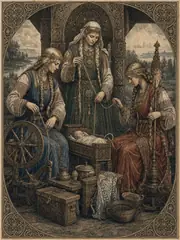
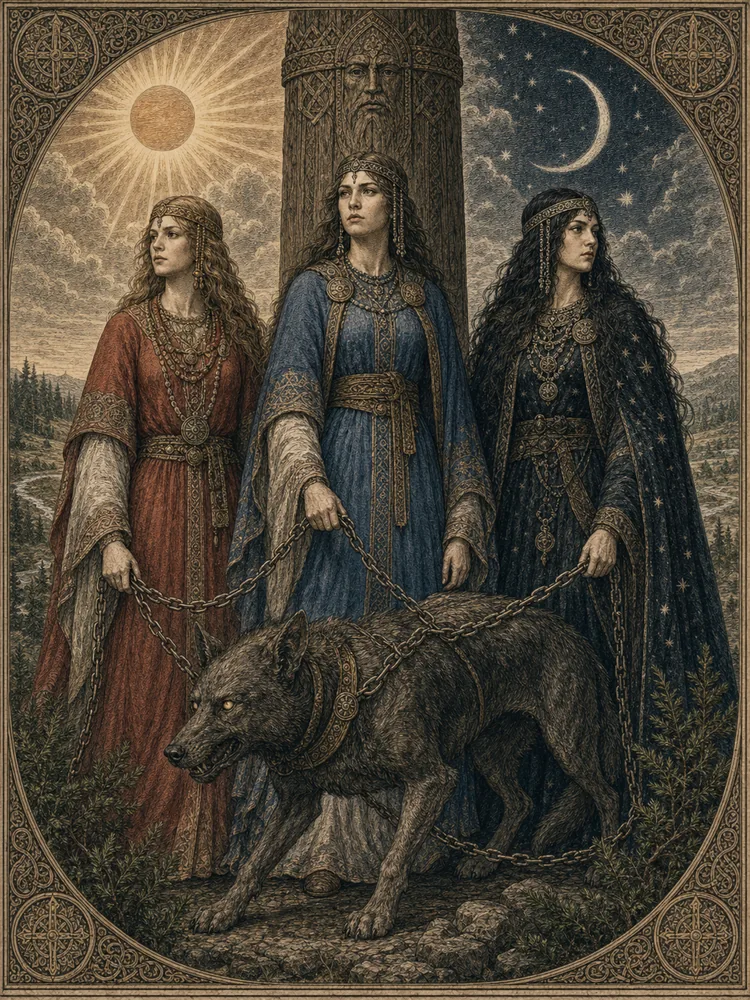
The Zoryas were the dawn-maidens of the Slavic sky — three sisters, in the most common East Slavic accounts, who attended the sun's daily journey. Zorya Utrennyaya was the morning star, who opened the gates of heaven each dawn for the sun's chariot to come forth; Zorya Vechernyaya was the evening star, who closed the gates again at sunset; and a third sister, Zorya Polunochnaya, watched at midnight while the sun was beneath the earth. They were the daughters (in some versions) of Dazhbog the sun-god and the consorts of various warrior figures of the heroic legends.

The Zoryas had also a darker function. There was at the constellation Ursa Minor — the Little Bear — a great hound, chained by an iron chain to the celestial pole; this hound was constantly trying to break free, gnawing at the chain. If the chain ever broke, the hound would devour the constellation Ursa Major, and after it the sun, and the world would end in a great darkness. The Zoryas were charged with watching this hound and with keeping the chain mended; their nightly vigil at the pole was a cosmological necessity, by which the world's continuance depended on their watchfulness.

The figure of the Zoryas is one of the most distinctively Slavic divine groupings — the function (dawn-maidens), the number (three), the relationship to the sun, are all paralleled in other Indo-European pantheons (the Vedic Ushas, the Baltic Aušrinė), but the specific cosmological role of guarding the chained doomsday-hound is, so far as we know, uniquely Slavic.
Curator’s note

What the sources say, and what later tradition added. The sources for this bay

The Zoryas are documented in folk songs and tales collected from the eighteenth century onward, particularly in Ukraine, Russia, and Poland. The chained hound and the cosmic guard duty are mentioned in collections from southern Russia (compiled in the mid-nineteenth century) and in some Ukrainian texts. The fullest scholarly discussion is in Mikhail Popov's Description of the Ancient Slavonic Pagan Mythology (1768) and in subsequent treatments by Afanasyev. The Zoryas were treated extensively by Neil Gaiman in American Gods (2001), which is the source through which most English-speaking readers have encountered them; Gaiman's treatment is largely faithful to the Slavic sources.

Kin in the sources

Each tie is quoted from the entry that states it.

When the sources speak

Dated witnesses for The Slavic Gods and Spirits. A date marks when the evidence was written down, not when the belief began. The whole timeline

2nd–1st millennia BCE
Indo-European language dispersals and regional Bronze Age cultures provide a remote comparative background, not a recoverable common canon.
c. 500 BCE–1 CE
Iron Age material culture, names, sanctuaries, and classical ethnography offer early but external evidence for Celtic and Germanic religions.
1st–4th centuries CE
Roman inscriptions and provincial cults preserve many Celtic, Germanic, and local divine names.
4th–8th centuries CE
Migration-period and early medieval conversion transform ritual institutions while heroic traditions continue.
8th–11th centuries CE
Viking Age poetry, runic evidence, archaeology, and Scandinavian conversion form the core context of Norse myth.
9th–12th centuries CE
Slavic, Baltic, and Finnic traditions enter chronicles and missionary accounts, often through hostile observers.
11th–14th centuries CE
Irish, Welsh, and Icelandic manuscripts preserve major narrative corpora in Christian literary environments.
12th–16th centuries CE
Saxo, saga compilers, Baltic chroniclers, and later antiquarians systematize or reinterpret older material.

Floor plan

The rooms follow one another in the order their peoples first appear in the written record.

  1. The Cradle of Citiesc. 3400 BCE to 395 CE. 115 works
  2. The Gift of the Nilec. 4000 BCE to 395 CE. 73 works
  3. The Olympian Orderc. 1600 BCE to 750 CE. 152 works
  4. The Persian Worldc. 2000 BCE to 1010 CE. 30 works
  5. The Levantine Borderlandsc. 1200 BCE to 500 CE. 20 works
  6. The Edges of Empirec. 2000 BCE to 1500 CE. 33 works
  7. The Etruscan Worldc. 900 BCE to 750 CE. 22 works
  8. The Roman Inheritancec. 1200 BCE to 500 CE. 58 works
  9. The Northern Inheritancec. 2000 BCE to 1600 CE. 131 works