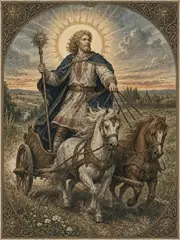
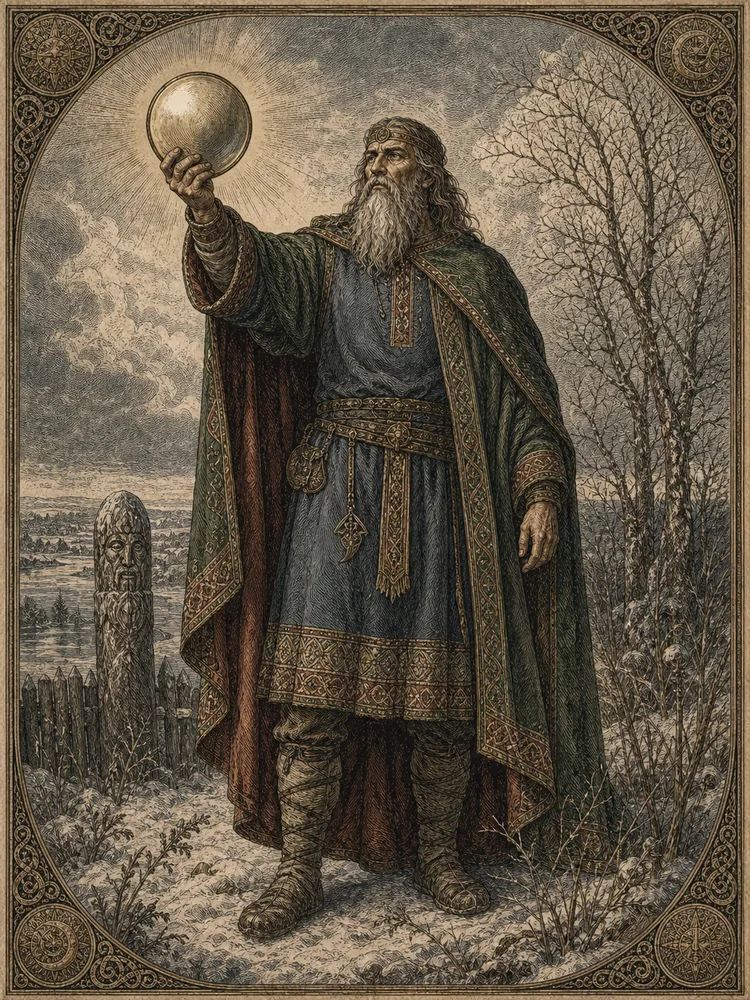
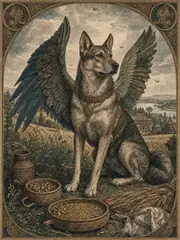
Khors was a sun-god of the East Slavic pantheon, listed among the gods of Vladimir's official cult at Kiev in 980 CE alongside Perun, Dazhbog, Stribog, Mokosh, and Simargl. His function evidently overlapped with that of Dazhbog, who was also a sun-god, and the relation between the two has been much debated. Some scholars (notably Vladimir Toporov) argue that Khors and Dazhbog were paired aspects of one solar cult — Khors the sun-disc itself, Dazhbog the sun-god in his beneficent function — while others see Khors as an Iranian loan-god (compare Persian xvar, "sun") imported through the Khazars and never fully integrated into the Slavic pantheon.
Khors's name has the sole peculiarity in the Vladimirite pantheon of not having a clear Slavic etymology, which has made the Iranian-loan hypothesis attractive. The Igor Tale of the late twelfth century mentions Khors in a famous passage: Prince Vseslav, in a magical journey, "crossed the path of great Khors" — a phrase that clearly identifies Khors with the daily course of the sun across the sky.
After Vladimir's conversion to Christianity in 988, Khors's cult, like the others of the official pantheon, was actively suppressed; the wooden idols on the hill above Kiev were thrown into the Dnieper and the temple-site converted to a church. Folk traditions in eastern Russia and Ukraine preserved Khors's name in some sayings about the sun, but the public cult disappeared rapidly under the Christian regime. The figure illustrates the success of Vladimir's conversion: a god in the official pantheon in 980 was, three centuries later, scarcely remembered.