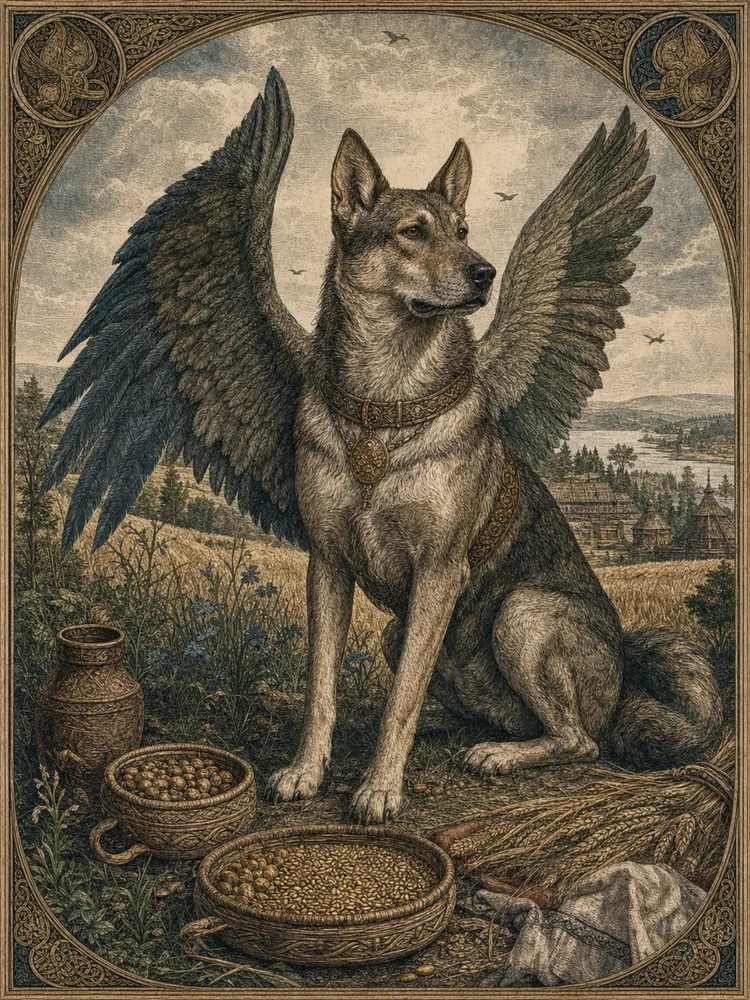
Simargl was one of the gods named in Vladimir's pantheon at Kiev in 980, and one of the strangest. His name appears to be a borrowing from the Iranian Saēna mərəga (Avestan), which became in Persian the Sēnmurv or Simurgh — a great winged dog-bird, a creature of cosmic significance, who in some Persian traditions sits upon the cosmic tree and shakes its seeds down upon the earth as the source of all plants. The Slavic Simargl preserves the name and probably the form of the original Iranian figure, brought across the steppe by the Sarmatians or other Iranian-speaking peoples and absorbed into the East Slavic pantheon.
What Simargl did in Slavic religion is unclear. He may have been the bringer of crops (taking over the tree-shaking function of the Iranian original), or a guardian of seedlings, or a winged messenger of some kind. The name is sometimes split in the Russian sources into two — Sim and Rgl — as if two gods were meant; this may be a scribal error or may reflect a doubling that had taken place in transmission.
After the conversion, Simargl disappeared without trace from East Slavic religion. Unlike Khors, no folk-saying preserved his name; unlike Mokosh, no Christian saint took over his function. He stands in the historical record as the most clearly foreign of the gods of Vladimir's pantheon, a figure whose Iranian background was probably already obscure to the Kievans of 980 and who failed to make any deep impression on the Slavic religious imagination.