A Compendium of the Ancient Gods
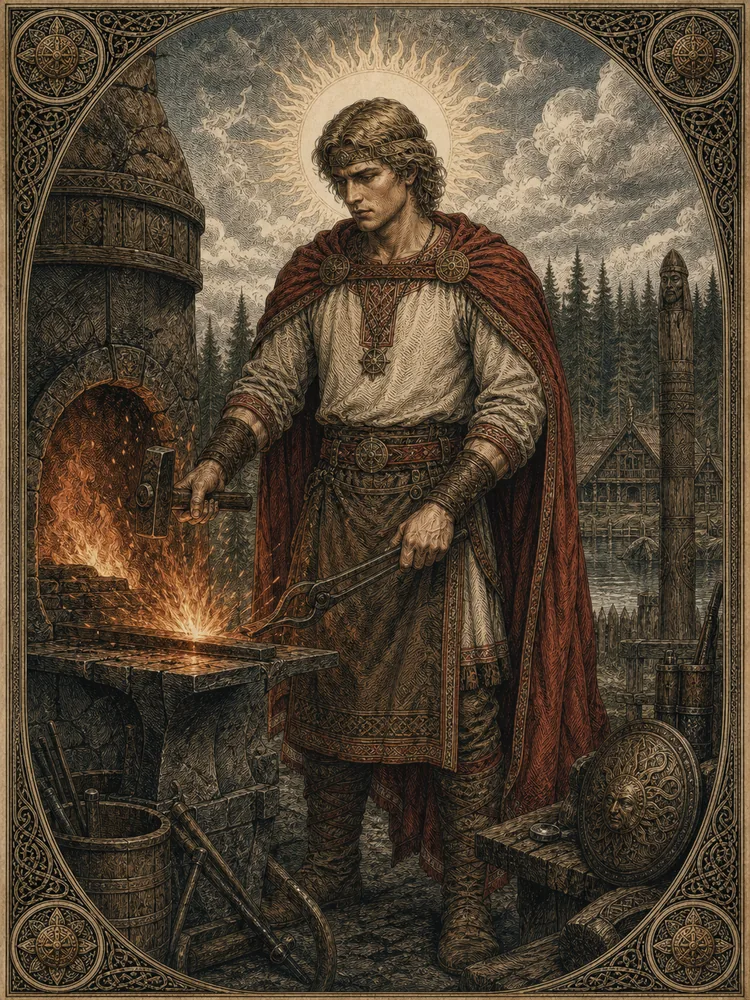
Svarozhich, plate

Svarozhich — "Son of Svarog" — was the East Slavic god of fire, particularly of sacred fire and of the hearth-flame, regarded as the son of the sky-smith Svarog. He was worshipped both as a domestic protector (the hearth-fire of the household) and as a public deity (the sacred fires that burnt on certain holy days). The cult was widespread among East and West Slavs.

Among the Polabian Slavs of the lower Elbe — the westernmost branch of the Slavic peoples, who held out against German Christianization until the twelfth century — Svarozhich was worshipped under the name Radegast, at the great temple of Rethra. There a wooden statue of Radegast stood with breastplate and helmet, holding a buckler upon which was depicted a bull's head; near him stood other gods of the Polabian pantheon. The Christian chronicler Adam of Bremen, writing about 1075, describes the temple of Rethra in detail and lists Radegast as its principal god. The temple was destroyed by Christianized Saxon armies in the twelfth century; its location has not been securely identified but lay somewhere east of the Elbe in modern Mecklenburg.

The cult of Radegast at Rethra was a celebrated pagan sanctuary. Captives of war were sacrificed there, with their heads displayed on poles around the temple precinct. The Christian sources viewed it with horror, but it was a major institution of West Slavic public religion, surviving for several generations after the Slavs of the lower Elbe had been militarily conquered. The conflation of Radegast with Svarozhich is generally accepted on the basis of the cognate functions (god of fire, of the hearth, of warfare) and the linguistic continuity, though the matter is complicated by the variety of West Slavic deity-names.
Curator’s note

What the sources say, and what later tradition added. The sources for this bay

Svarozhich and Radegast are documented in different sources. Svarozhich appears in Russian polemical texts of the eleventh century and in the Slovo o polku Igoreve. Radegast is described by Adam of Bremen (Gesta Hammaburgensis Ecclesiae Pontificum 2.21, c. 1075) and by Thietmar of Merseburg (Chronicon 6.23, c. 1015); the destruction of Rethra is in Helmold of Bosau (Chronica Slavorum 1.21, twelfth century). The identification of Svarozhich with Radegast was made by Roman Jakobson and is now generally accepted, though some scholars (including Aleksander Gieysztor) have pointed out that the West Slavic theonyms may not always map onto the East Slavic ones. The Rethra temple has not been securely located archaeologically.

Kin in the sources

Each tie is quoted from the entry that states it.

When the sources speak

Dated witnesses for The Slavic Gods and Spirits. A date marks when the evidence was written down, not when the belief began. The whole timeline

2nd–1st millennia BCE
Indo-European language dispersals and regional Bronze Age cultures provide a remote comparative background, not a recoverable common canon.
c. 500 BCE–1 CE
Iron Age material culture, names, sanctuaries, and classical ethnography offer early but external evidence for Celtic and Germanic religions.
1st–4th centuries CE
Roman inscriptions and provincial cults preserve many Celtic, Germanic, and local divine names.
4th–8th centuries CE
Migration-period and early medieval conversion transform ritual institutions while heroic traditions continue.
8th–11th centuries CE
Viking Age poetry, runic evidence, archaeology, and Scandinavian conversion form the core context of Norse myth.
9th–12th centuries CE
Slavic, Baltic, and Finnic traditions enter chronicles and missionary accounts, often through hostile observers.
11th–14th centuries CE
Irish, Welsh, and Icelandic manuscripts preserve major narrative corpora in Christian literary environments.
12th–16th centuries CE
Saxo, saga compilers, Baltic chroniclers, and later antiquarians systematize or reinterpret older material.

Floor plan

The rooms follow one another in the order their peoples first appear in the written record.

  1. The Cradle of Citiesc. 3400 BCE to 395 CE. 115 works
  2. The Gift of the Nilec. 4000 BCE to 395 CE. 73 works
  3. The Olympian Orderc. 1600 BCE to 750 CE. 152 works
  4. The Persian Worldc. 2000 BCE to 1010 CE. 30 works
  5. The Levantine Borderlandsc. 1200 BCE to 500 CE. 20 works
  6. The Edges of Empirec. 2000 BCE to 1500 CE. 33 works
  7. The Etruscan Worldc. 900 BCE to 750 CE. 22 works
  8. The Roman Inheritancec. 1200 BCE to 500 CE. 58 works
  9. The Northern Inheritancec. 2000 BCE to 1600 CE. 131 works