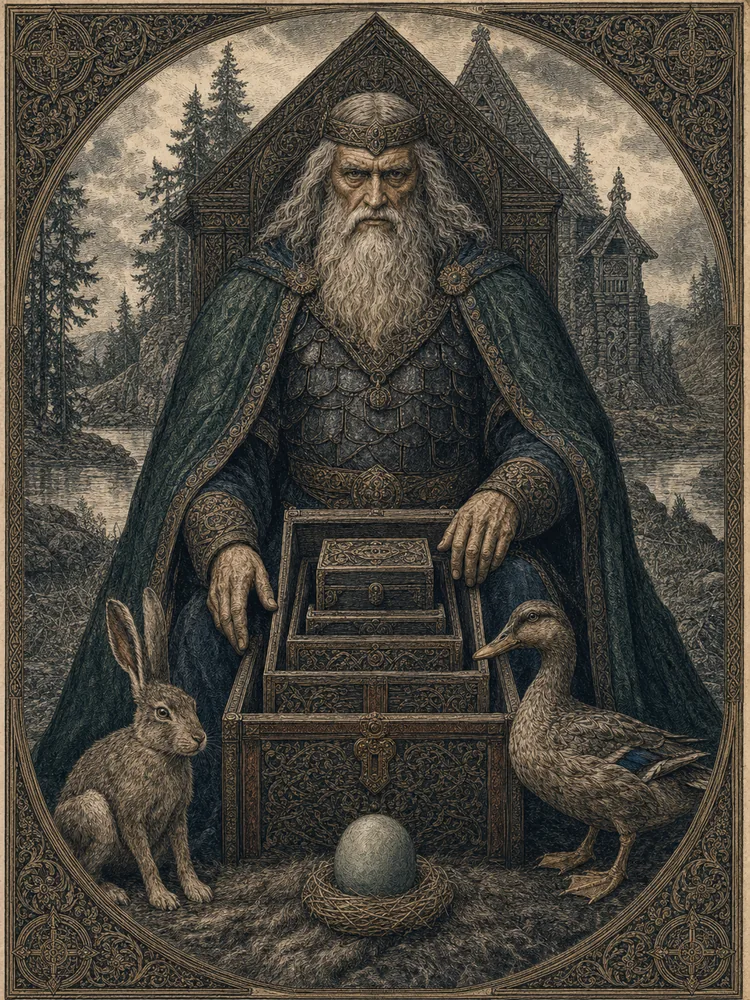
Koschei the Deathless — Koshchei Bessmertny, in the proper Russian — was the great archetypal villain of Russian folktale, a tall thin old man with a long face and great teeth, who carried off the heroines of every story to his iron palace at the world's edge. He could not be killed by any sword or spear; he was deathless. But his deathlessness was only conditional: his death lay outside his body, hidden in a series of nested objects, and if the objects could be found and the death released, Koschei would die.
The form of his hidden death varied somewhat in the tales but in its classic form ran thus: the death was a needle, hidden inside an egg, hidden inside a duck, hidden inside a hare, hidden inside a chest, hidden in the branches of a great oak, on an island in the middle of the ocean. To kill Koschei, the hero must journey to the island, find the oak, take down the chest, release the hare (who at once tries to flee), catch the hare (who is then transformed into the duck, also trying to flee), catch the duck (who lays the egg, which falls into the sea), and find the egg — at which point the hero needs the help of various animals he has shown kindness to earlier in the tale. The egg is recovered, the needle is broken, and Koschei dies.
The figure of Koschei is one of the most distinctive products of Russian folk-imagination, and probably has roots in pre-Christian Slavic religion. Some scholars have argued that he is a Slavic chthonic deity euhemerized into a tale-figure; others see him as a purely folkloric construction without theological background. His name has been etymologized variously — from kost' ("bone," hence "the bony one") and from the Old Russian koshchei (a Turkic loanword meaning "servant, slave") — neither etymology being decisive.