A Compendium of the Ancient Gods
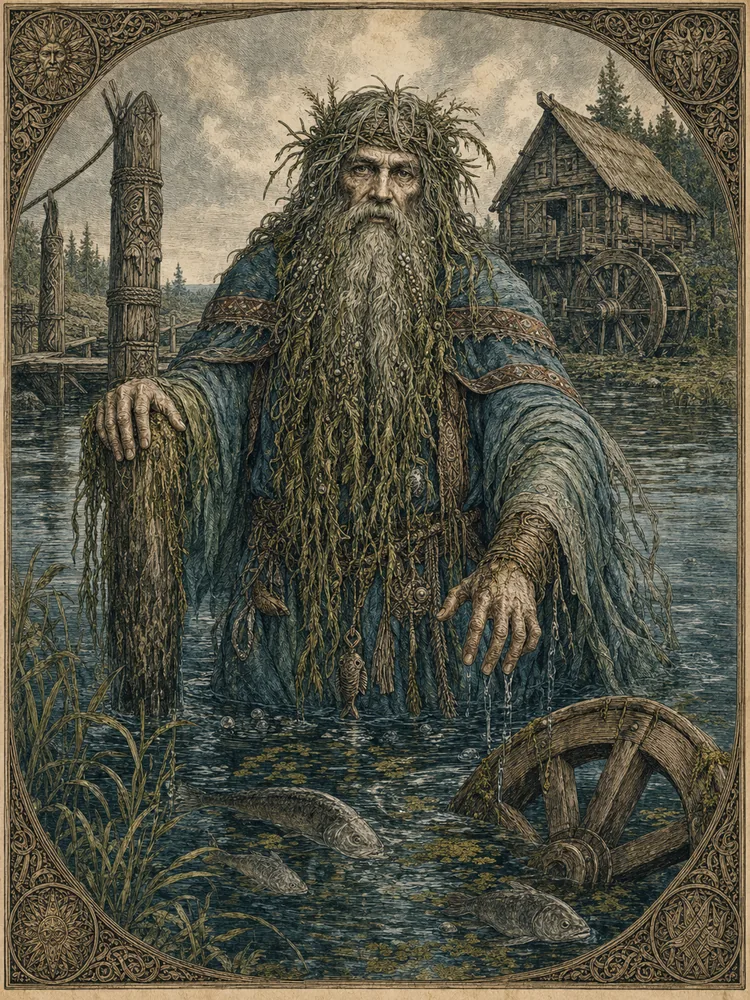
Vodyanoy, plate

Vodyanoy — "the Water One," from the Russian voda — was the male water-spirit of Slavic folk tradition, who lived in lakes, rivers, and millponds, and who was the master of all the fish and water-creatures in his domain. He was depicted as an old man with a long beard of green water-weed, a body covered with scales or with leaves and slime, and bulging froglike eyes; he was paunchy from too much fish, and lived in an underwater palace where he kept the souls of those he had drowned as his servants.

Vodyanoy was the eternal danger for the rural community. Fishermen who failed to make the proper offerings to him risked losing their nets, having their boats overturned, or being drawn down themselves. Bathers who entered the water at noon or midnight, or on certain days unmarked by the village calendar, might be seized by him from below and never seen again. Drowning victims were said to have been taken by Vodyanoy to be his servants in the underwater palace.

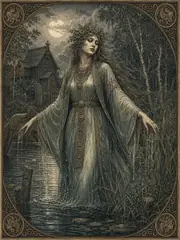
He had wives — drowned women who became his consorts — and could rise from the water in their company on certain nights to dance upon the bank or to lure men into the water by the sight. The Vodyanoy could be propitiated by offerings (a black goat sacrificed and thrown into the water, butter and honey poured into the millpond, a portion of the day's catch returned to him), and the millers in particular maintained relations of careful exchange with him, for the working of the water-mills required his cooperation. The figure persisted in folk practice into the twentieth century in remote Russian villages, and was treated by Anton Chekhov in his short story "The Vodyanoy" and by Antonín Dvořák in his great tone-poem of 1896.
Curator’s note

What the sources say, and what later tradition added. The sources for this bay

Vodyanoy is documented in folk-belief collections from the eighteenth century onward, particularly in Sergei Maximov's Nechistaia, Nevedomaia i Krestnaia Sila (1903) — "Unclean, Unknown, and Holy Power" — the great compendium of Russian folk-demonology. Linda Ivanits's Russian Folk Belief (1989) is the standard English-language treatment. The corresponding female water-spirit is the Rusalka; the two were sometimes paired, though the Rusalka was generally associated with rivers and the Vodyanoy with still water (lakes, ponds, millponds). The Vodyanoy's persistence in modern Russian rural life is documented by ethnographers as late as the 1960s and 1970s.

Kin in the sources

Each tie is quoted from the entry that states it.

When the sources speak

Dated witnesses for The Slavic Gods and Spirits. A date marks when the evidence was written down, not when the belief began. The whole timeline

2nd–1st millennia BCE
Indo-European language dispersals and regional Bronze Age cultures provide a remote comparative background, not a recoverable common canon.
c. 500 BCE–1 CE
Iron Age material culture, names, sanctuaries, and classical ethnography offer early but external evidence for Celtic and Germanic religions.
1st–4th centuries CE
Roman inscriptions and provincial cults preserve many Celtic, Germanic, and local divine names.
4th–8th centuries CE
Migration-period and early medieval conversion transform ritual institutions while heroic traditions continue.
8th–11th centuries CE
Viking Age poetry, runic evidence, archaeology, and Scandinavian conversion form the core context of Norse myth.
9th–12th centuries CE
Slavic, Baltic, and Finnic traditions enter chronicles and missionary accounts, often through hostile observers.
11th–14th centuries CE
Irish, Welsh, and Icelandic manuscripts preserve major narrative corpora in Christian literary environments.
12th–16th centuries CE
Saxo, saga compilers, Baltic chroniclers, and later antiquarians systematize or reinterpret older material.

Floor plan

The rooms follow one another in the order their peoples first appear in the written record.

  1. The Cradle of Citiesc. 3400 BCE to 395 CE. 115 works
  2. The Gift of the Nilec. 4000 BCE to 395 CE. 73 works
  3. The Olympian Orderc. 1600 BCE to 750 CE. 152 works
  4. The Persian Worldc. 2000 BCE to 1010 CE. 30 works
  5. The Levantine Borderlandsc. 1200 BCE to 500 CE. 20 works
  6. The Edges of Empirec. 2000 BCE to 1500 CE. 33 works
  7. The Etruscan Worldc. 900 BCE to 750 CE. 22 works
  8. The Roman Inheritancec. 1200 BCE to 500 CE. 58 works
  9. The Northern Inheritancec. 2000 BCE to 1600 CE. 131 works