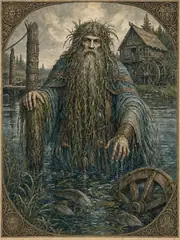
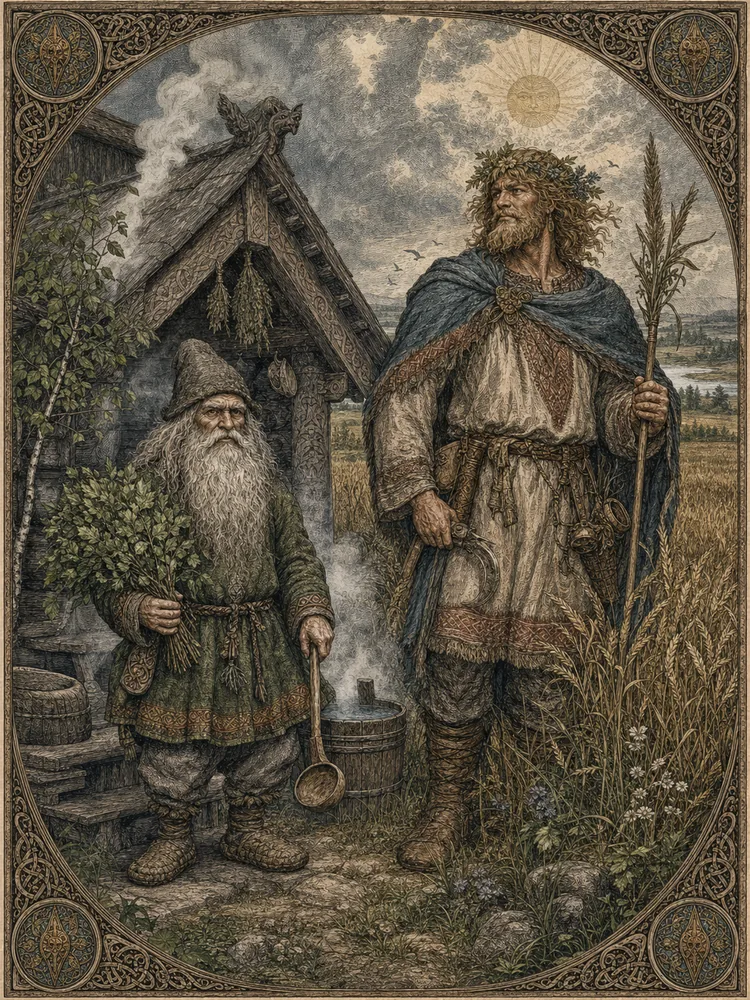
Among the smaller spirits of the Russian household and farm were two of particular importance: Bannik, the spirit of the bath-house, and Polevik, the spirit of the field. They were not gods of the pantheon but local powers, presences attached to specific places, and they were treated with the cautious respect that one gave to forces one could not afford to antagonize.
The bath-house in the traditional Russian village was a separate small building, typically at the edge of the property, where the family bathed in the steam of heated stones. Bannik lived there, an old man (sometimes naked, sometimes hairy), and he had to be propitiated with the proper rites or else he would scald the bather with steam, suffocate him, or overturn the basin. The bath had to be taken always before midnight; the third bath of any session was Bannik's own, and no human was permitted to take it. Brides and grooms were bathed before their wedding to ensure Bannik's good will; corpses were washed in the bath-house, that the spirit might assist their passage. The bath-house was a place of liminal danger, between the household and the wild, between life and death.
Polevik was the spirit of the cultivated field, a dark man (sometimes black-skinned, sometimes earth-colored) with grass for hair, who walked the rows at noon when the sun was hottest. To meet Polevik in the field at noon was dangerous; he might strike one with sunstroke, or send a serpent to bite, or simply lead one astray. Reapers slept always in the shade at the noon hour, both for their own comfort and to avoid disturbing him. He was a keeper of the boundaries of the cultivated land; on the field's edges, the offerings to him (the last sheaf, left uncut and braided as a small effigy) were made at the harvest's end.