
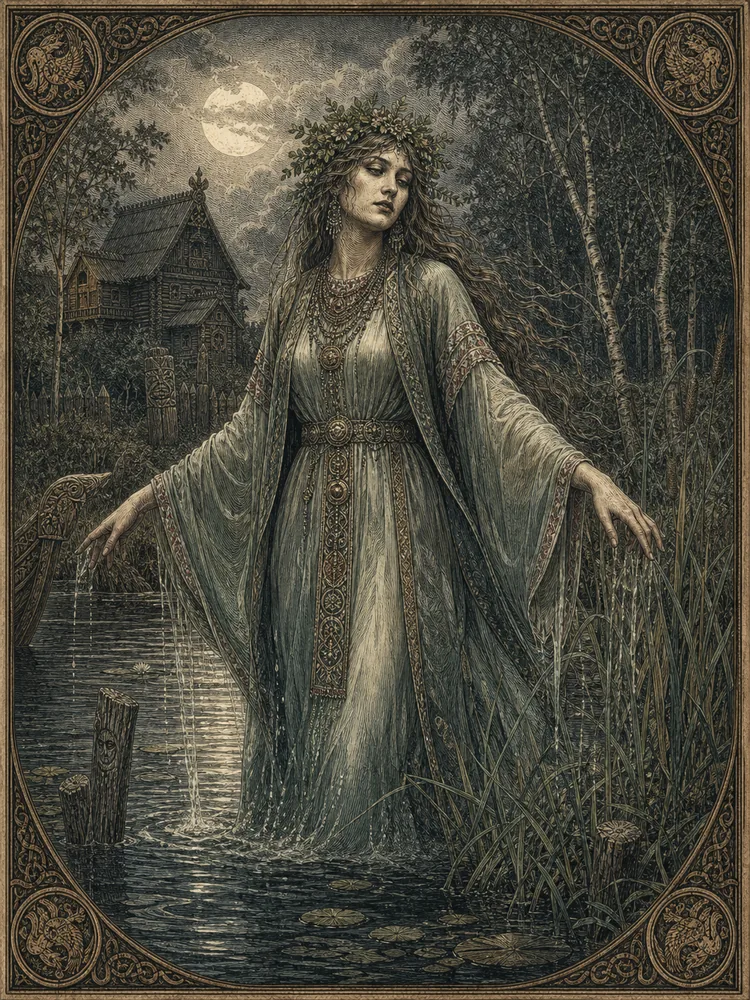
The Rusalka (plural Rusalki) was the female water-spirit of Slavic folk-tradition — the spirit of a young woman who had drowned, often by suicide for unfortunate love, who haunted the rivers, lakes, and ponds where she had died. Rusalki were beautiful, with long pale hair (Russian tradition often green, from the water-weeds), sometimes with the lower body of a fish (in the more mermaid-like Western Slavic versions). They emerged from the water at certain times — particularly during the Rusalka Week (Rusalnaya nedelya) following Easter, when they came out into the meadows and woods, dancing in moonlit clearings, luring young men to follow them and drown.
Their relation to the dead was complex. They were not simply unhappy ghosts; in some traditions they were a class of supernatural being older than human individual deaths, into which drowned women's spirits were absorbed. In other traditions they were specifically the dead, and the Rusalka Week was the period when these particular dead came back to the upper world before returning to their water-kingdoms. Offerings were made to them at the wells and rivers; girls made garlands of flowers and threw them into the water during Rusalka Week as offerings (a ritual that Russian peasant communities preserved into the early 20th century). The figure has had a great modern literary and operatic life — Pushkin's unfinished verse-drama Rusalka, Dvořák's opera of the same name (1901), Tchaikovsky's music for the play, and many lesser instances — making the Rusalka one of the better-known Slavic folkloric figures in Western culture.