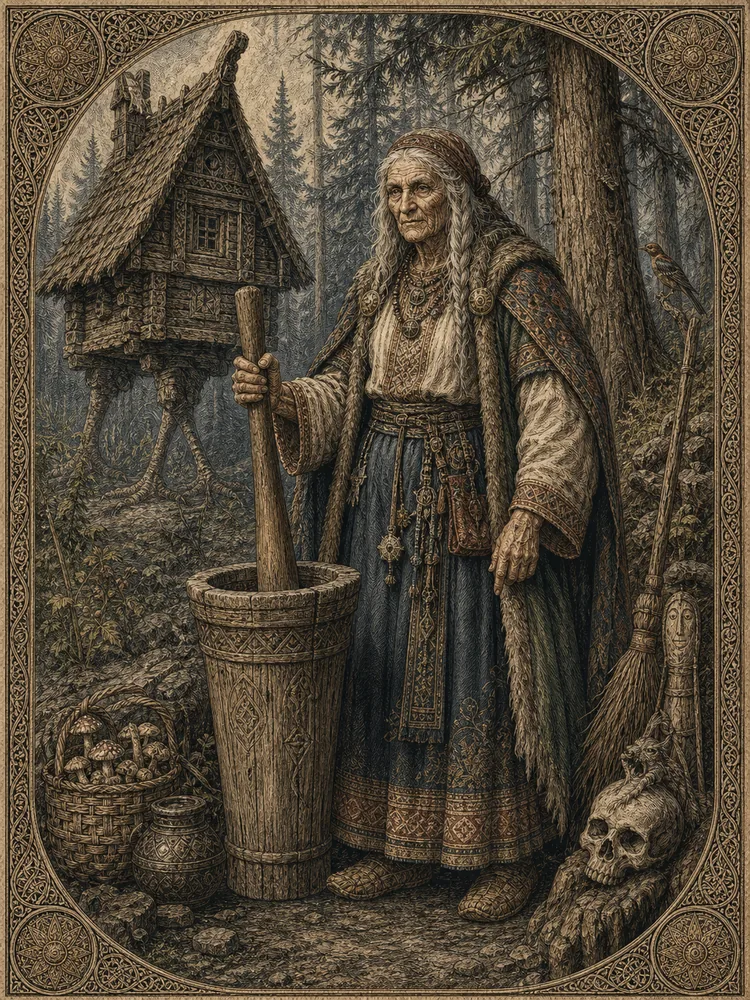

Of all the figures of Slavic folklore, none is more familiar than Baba Yaga — the great witch who lives in the deep forest, in a hut that stands upon chicken legs and turns about at the witch's command. She is depicted as an old woman of monstrous size, with iron teeth and a long sharp nose; she travels in a great mortar, propelling herself with a pestle, sweeping away her tracks behind her with a broom. Around her hut, in many tales, there stands a fence of human bones surmounted with skulls, the skulls' eye-sockets glowing in the dark.
Baba Yaga is ambiguous in her function. Sometimes she is a figure of pure terror, who eats the children who come to her — and the iron teeth and the bone-fence are then the marks of an ogress. But in many tales she serves another function: she is the testing-figure, the threshold-guardian, who provides what the hero needs if the hero passes her trials. In the great folk-tale of Vasilisa the Beautiful, Vasilisa is sent by her cruel stepmother to fetch fire from Baba Yaga's hut; the witch sets her impossible tasks (sorting one grain from another, separating poppy-seed from earth), but Vasilisa accomplishes them with the help of a magical doll her dead mother had given her, and is rewarded with fire (carried in a skull whose eyes burn) — and the fire, brought home, kills the wicked stepmother in punishment.
Baba Yaga's house is a passage between worlds. To enter it, one must speak the formula "Hut, hut, turn your back to the forest and your front to me"; once inside, one is no longer in the ordinary world. Whether one will leave alive depends on one's conduct. The figure unites in herself the dangerous and the protective aspects of the wilderness — the forest as the place that consumes the unwary and as the place that grants gifts to the brave. She is a survival of pre-Christian Slavic religion adapted into folktale, and probably has roots in older Indo-European traditions of the forest-dwelling crone (compare the Cailleach above, and the Greek Hecate).