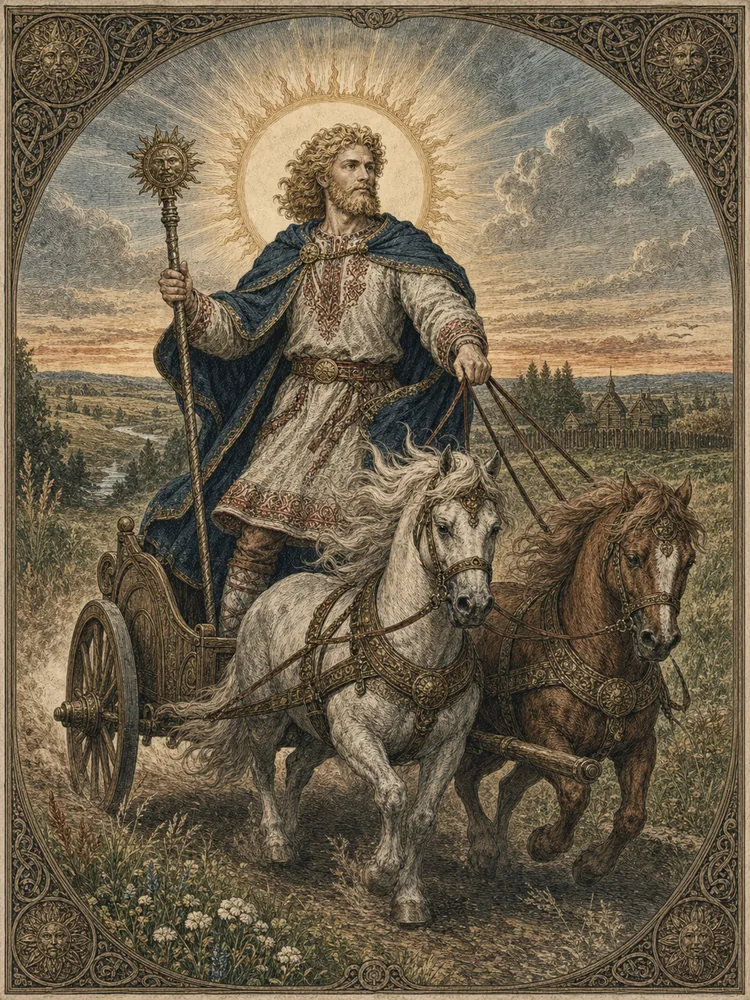
Dazhbog ("the giving god," or "god of giving," the etymology derived from dažǐ + bog) was the Slavic solar deity — the sun considered as the giver of life, warmth, and wealth. He was a son of Svarog (whence sometimes Svarozhich, "son of Svarog"). The Tale of Igor's Campaign (the great medieval Russian epic, 12th c.) calls the Russian people "the grandchildren of Dazhbog" — a striking line that suggests his role as ancestral solar deity of the Eastern Slavs. The Primary Chronicle lists him among the gods of Vladimir's pre-Christian pantheon at Kiev. He is otherwise not extensively attested; his iconography and his particular myths are not preserved.
 Before thisSvarog
 Next on the wallStribog
Curator’s note
What the sources say, and what later tradition added. The sources for this bay
The principal sources are the Russian Primary Chronicle (entry for 980); the Hypatian Chronicle (12th c.); the Tale of Igor's Campaign. The etymology dažǐ + bog ("giving + god") is generally accepted. The Slovenian and Serbian counterpart Dabog (a chthonic figure) suggests the same name has had divergent regional developments.
Kin in the sources
Each tie is quoted from the entry that states it.
- Child ofSvarog
He was a son of Svarog (whence sometimes Svarozhich, "son of Svarog")
 Parent ofThe Zoryas
They were the daughters (in some versions) of Dazhbog the sun-god
When the sources speak
Dated witnesses for The Slavic Gods and Spirits. A date marks when the evidence was written down, not when the belief began. The whole timeline
- 2nd–1st millennia BCE
- Indo-European language dispersals and regional Bronze Age cultures provide a remote comparative background, not a recoverable common canon.
- c. 500 BCE–1 CE
- Iron Age material culture, names, sanctuaries, and classical ethnography offer early but external evidence for Celtic and Germanic religions.
- 1st–4th centuries CE
- Roman inscriptions and provincial cults preserve many Celtic, Germanic, and local divine names.
- 4th–8th centuries CE
- Migration-period and early medieval conversion transform ritual institutions while heroic traditions continue.
- 8th–11th centuries CE
- Viking Age poetry, runic evidence, archaeology, and Scandinavian conversion form the core context of Norse myth.
- 9th–12th centuries CE
- Slavic, Baltic, and Finnic traditions enter chronicles and missionary accounts, often through hostile observers.
- 11th–14th centuries CE
- Irish, Welsh, and Icelandic manuscripts preserve major narrative corpora in Christian literary environments.
- 12th–16th centuries CE
- Saxo, saga compilers, Baltic chroniclers, and later antiquarians systematize or reinterpret older material.