A Compendium of the Ancient Gods
The Graeae, plate

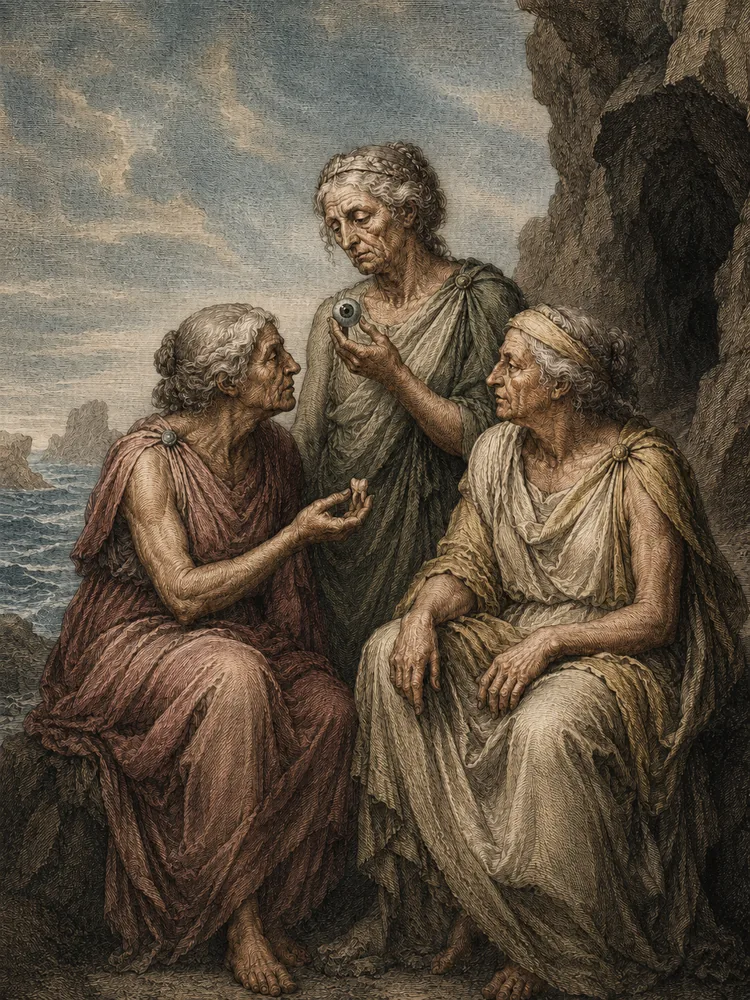
Daughters of Phorcys the old man of the sea and of Ceto his sister, sister therefore to the Gorgons and the Hesperides, the Graeae were three: Deino the Dread, Enyo the Warlike, and Pemphredo the Wasp. They were called the Gray Sisters because they were born already old, with white hair upon their heads and the wrinkled faces of crones; they had never been young. Among the three of them they had one eye and one tooth, which they shared in turn — when one wished to see, the others were blind; when one wished to eat, the others could not.

The Graeae kept guard over the road that led to their younger sisters the Gorgons, in the far west beyond the Ocean stream. None could pass them without their consent. So when Perseus was sent by Polydectes to fetch the head of Medusa, he was instructed by Hermes and Athena to seek out the Graeae first; and when he came upon them, he watched and waited until the moment when the eye and the tooth were being passed from one sister to another, and then he snatched both away, and held them, and would not return them until the Graeae had told him the way to the Nymphs of the North, who alone knew the path to the Gorgons. So the sisters told him, and he gave them back their eye and their tooth, and went on his way.

The Graeae afterward took no further part in the heroic legend. They remained in their place at the world's edge, three old women keeping watch over a road that few would ever wish to travel.
Curator’s note

What the sources say, and what later tradition added. The sources for this bay

The Graeae are introduced by Hesiod (Theogony 270-273), where their names are Pemphredo and Enyo (only two; the third, Deino, appears in later mythography). The Pseudo-Apollodoran Bibliotheca (2.4.2) gives three sisters and is the primary source for the Perseus episode. Pseudo-Aeschylus's Phorcides was a satyr-play on this theme, of which only fragments survive. The shared eye is the iconic detail and is depicted in vase-painting from the fifth century BCE. The Graeae's name (Greek graiai, 'old women') has become a generic term in later European literature for any company of three old crones — the witches of Macbeth, for instance, descend mythographically from this Greek lineage.

Kin in the sources

Each tie is quoted from the entry that states it.

When the sources speak

Dated witnesses for The Margins and the Monsters. A date marks when the evidence was written down, not when the belief began. The whole timeline

c. 1600–1100 BCE
Mycenaean palace tablets in Linear B record offerings and divine names, but little continuous myth.
c. 1100–800 BCE
Post-palatial oral traditions and changing cult landscapes precede the surviving alphabetic epics.
late 8th–7th centuries BCE
The Iliad, Odyssey, Hesiodic Theogony and Works and Days give influential but non-exclusive divine orders.
7th–6th centuries BCE
Homeric Hymns, lyric poetry, colonization, and local sanctuary traditions multiply regional narratives.
6th–5th centuries BCE
Orphic, Pythagorean, and mystery materials develop alternative cosmogonies and afterlife doctrines.
5th century BCE
Athenian tragedy and comedy recast heroic houses and divine justice for civic audiences.
4th century BCE
Philosophers, antiquarians, and local historians interpret or criticize inherited myth.
323–31 BCE
Hellenistic poets and scholars systematize variants across an enlarged Greek world.

Floor plan

The rooms follow one another in the order their peoples first appear in the written record.

  1. The Cradle of Citiesc. 3400 BCE to 395 CE. 115 works
  2. The Gift of the Nilec. 4000 BCE to 395 CE. 73 works
  3. The Olympian Orderc. 1600 BCE to 750 CE. 152 works
  4. The Persian Worldc. 2000 BCE to 1010 CE. 30 works
  5. The Levantine Borderlandsc. 1200 BCE to 500 CE. 20 works
  6. The Edges of Empirec. 2000 BCE to 1500 CE. 33 works
  7. The Etruscan Worldc. 900 BCE to 750 CE. 22 works
  8. The Roman Inheritancec. 1200 BCE to 500 CE. 58 works
  9. The Northern Inheritancec. 2000 BCE to 1600 CE. 131 works