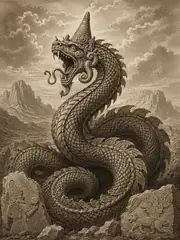
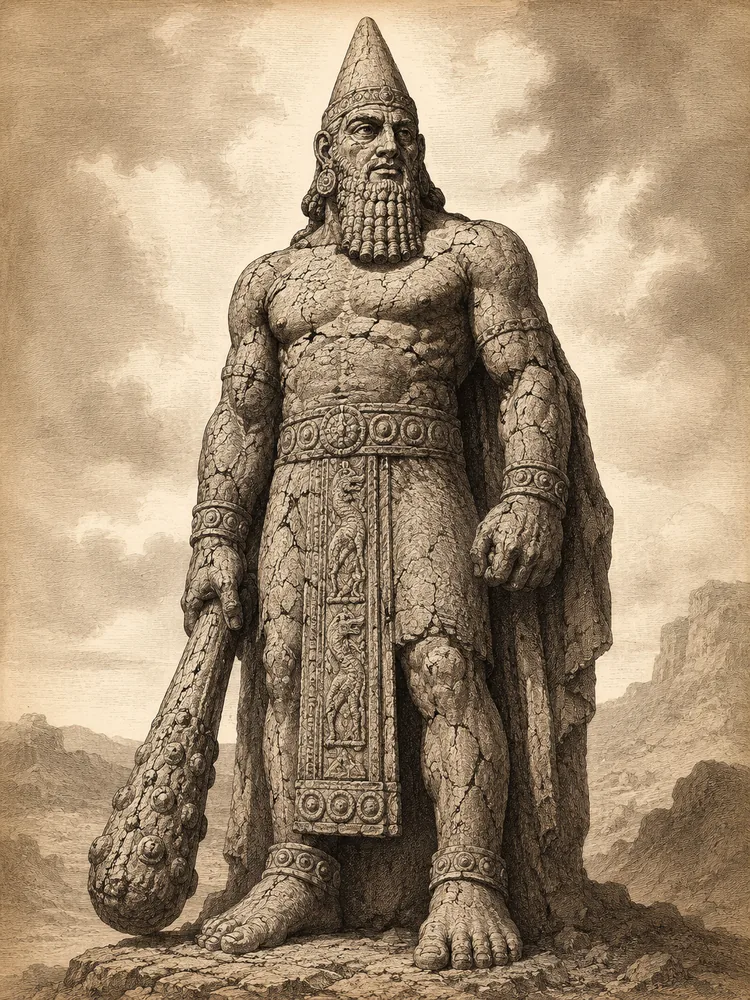
Of all the rebellions which Kumarbi raised against his son Teshub the storm-king, the most ambitious was the rebellion he launched not in his own person but in the person of a champion he begot for the purpose: a being of stone, deaf and blind by nature, immune to the persuasions and the wounds of the gods, who would grow without limit and without distraction until he overtopped the heavens. This was Ullikummi.
Kumarbi conceived him by lying with a great rock; the rock bore a stone child; the child was set upon the right shoulder of the giant Upelluri, who held the world upon his shoulders at the bottom of the sea, and who was so vast that he did not notice the stone giant growing upon him. Ullikummi grew at a prodigious rate; he reached the surface of the sea; he reached the heavens; he came upon the gates of Teshub's palace and prepared to overturn them.
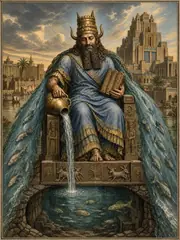
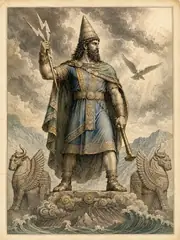
The gods were terrified. Teshub, with his brother Tashmishu, climbed the high mountain and looked upon the rising stone, and Teshub wept for fear of him. The Sun-God, the Moon-God, all the powers of the divine assembly were paralyzed. It was Ea, the wise god of the deep waters — that same Ea whom in Mesopotamia we know as Enki — who at last found the answer. Ea descended to the place where Heaven had once been parted from Earth at the beginning of things, and recovered the great copper saw with which that primordial separation had been made. With this ancient instrument, Ea cut Ullikummi off at his base, severing him from Upelluri's shoulder; the giant crashed down; the gods rallied; Teshub recovered his throne and slew the fallen Ullikummi.
Curator’s note
What the sources say, and what later tradition added. The sources for this bay
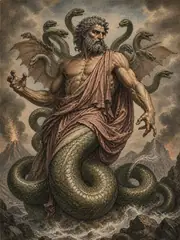
The Song of Ullikummi (CTH 345) is the principal poem of the Kumarbi Cycle, preserved in extensive Hittite fragments excavated at Hattusa. It has been a particular focus of comparative mythological study since the 1940s, when its parallels to Hesiod's account of Typhon were first widely recognized. Hesiod tells of Typhon (Theogony 820-868), a monstrous offspring of Earth and Tartarus who challenges Zeus's rule and is defeated only with great difficulty; a number of details — the rising of the monster, the terror of the gods, the use of an ancient instrument or weapon — have been seen as too specific to be coincidental. The Hurrian-Hittite material is now generally seen as standing behind, and being mediated to, the Greek Hesiodic tradition. The figure of Upelluri, who holds the world and does not feel even continents growing upon him, is among the more imaginative ancient images of vast scale.
When the sources speak
Dated witnesses for Anatolia. A date marks when the evidence was written down, not when the belief began. The whole timeline
- c. 3400–3000 BCE
- Uruk-period writing and monumental temple economies create the earliest recoverable administrative setting for named divine institutions.
- c. 2900–2350 BCE
- Early Dynastic city-states preserve local cults, hymns, royal inscriptions, and god lists; later copies often transmit older compositions.
- c. 2334–2154 BCE
- The Akkadian Empire expands bilingual and imperial patterns of divine identification without erasing local cult titles.
- c. 2112–2004 BCE
- Ur III administration and scribal schooling standardize many Sumerian literary and liturgical forms.
- c. 2000–1600 BCE
- Old Babylonian schools copy major myths, laments, hymns, debates, and heroic narratives in the form most often used by modern editors.
- c. 1650–1200 BCE
- Hittite and Hurrian archives at Hattusa transmit Anatolian myths, imported Syrian materials, and ritual compositions.
- c. 1400–1190 BCE
- The tablets of Ugarit preserve the Baal Cycle, Kirta, Aqhat, ritual lists, and a dense Late Bronze Age West Semitic pantheon.
- c. 1000–612 BCE
- Neo-Assyrian and Neo-Babylonian empires collect, revise, and politically reinterpret older learned traditions.