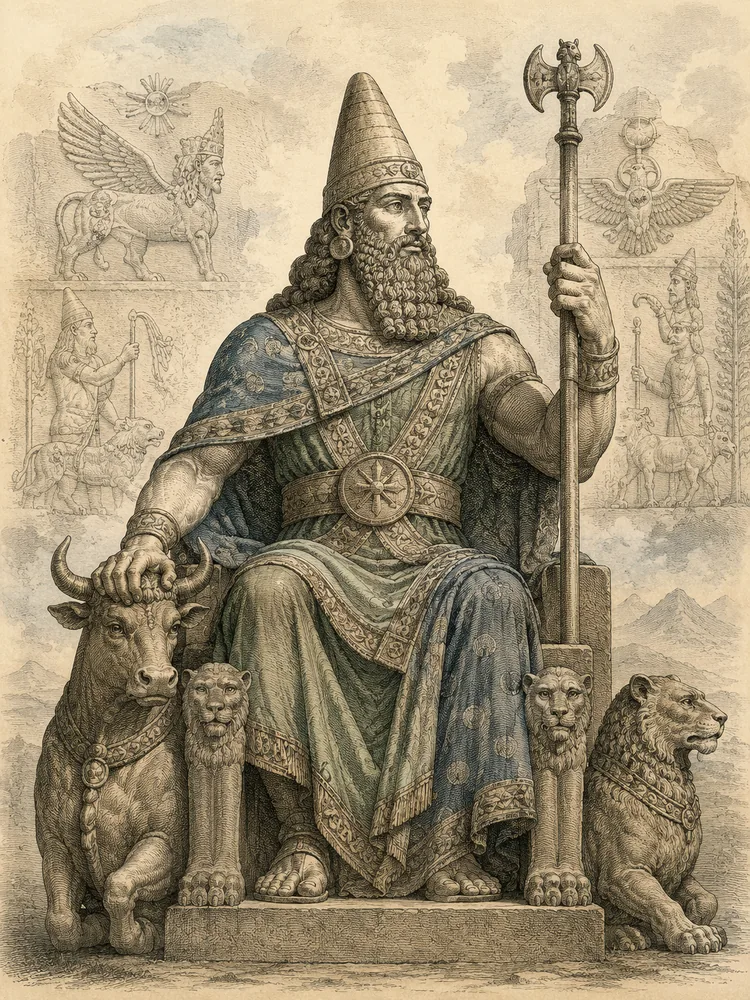
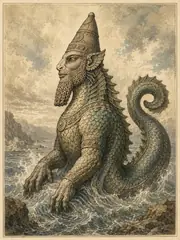
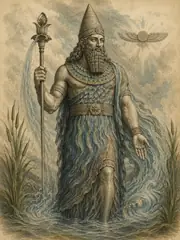
Kumarbi was the great elder god of the Hurrians, and his is one of the most striking succession-myths in the literature of the ancient world. In the beginning, the heavens were ruled by Alalu, who was overthrown by Anu and driven down into the earth. Anu reigned in his stead, but Kumarbi rose against him, and seized him as he fled to the heavens, and bit off his loins, and swallowed his seed; but the seed within Kumarbi's body began to germinate, and Anu cried up at him in a terrible voice from within his belly, mocking him: "Rejoice not at what thou hast swallowed, Kumarbi: for in thy belly thou bearest my children, who will rise up and conquer thee." Then Kumarbi was filled with foreboding. After certain months he gave birth — through what aperture is variously rendered — to the storm-god Tessub, and to the river Tigris, and to certain other gods. And Tessub in time arose, and made war upon his father, and overthrew him, and seized the kingship of heaven. So the third generation displaced the second, as the second had displaced the first.
But Kumarbi was not so easily put down. He sought a champion to overthrow Tessub, and went down to the seashore, and lay with the great rock; and from the rock was born Ullikummi, a being of diorite stone, blind and deaf and altogether mute, who grew upon the back of the giant Ubelluri (the Hurrian Atlas), and rose higher and higher into the sky, blocking out the sun. The gods were terrified, for no weapon could harm him; he had no eyes to fear, no ears to hear cursing, no mouth to bargain with. At last Ea was sent down to the great below, and brought up the ancient copper saw with which heaven and earth had been first divided in the beginning; with this saw the gods cut Ullikummi loose from his foundation upon Ubelluri, and his power departed. Then Tessub fought him, and overcame him; and the kingship was secure.
Curator’s note
What the sources say, and what later tradition added. The sources for this bay
The Kumarbi cycle is preserved on cuneiform tablets from Hattusa (modern Boğazkale, Turkey), in both Hurrian and Hittite versions; the Hittite versions are translations or adaptations of the Hurrian originals. The principal compositions are the Song of Going Forth (sometimes called the Song of Kumarbi), the Song of LAMMA, the Song of Silver, the Song of Ḫedammu, and the Song of Ullikummi. They date from the empire period (c. 1400–1200 BCE), with the Hurrian originals presumably older. The succession-by-castration motif (Anu, then Kumarbi, then Tessub) stands behind the Greek succession myth recorded by Hesiod (Uranus, then Cronus, then Zeus), and the literary dependence — the Greek tale presumably mediated through Phoenician or other intermediaries during the Late Bronze Age or the early Iron Age — is now generally accepted by classical scholarship. The story of Ullikummi the stone giant has been compared with the Greek story of Typhon, with similar plausibility.
When the sources speak
Dated witnesses for Anatolia. A date marks when the evidence was written down, not when the belief began. The whole timeline
- c. 3400–3000 BCE
- Uruk-period writing and monumental temple economies create the earliest recoverable administrative setting for named divine institutions.
- c. 2900–2350 BCE
- Early Dynastic city-states preserve local cults, hymns, royal inscriptions, and god lists; later copies often transmit older compositions.
- c. 2334–2154 BCE
- The Akkadian Empire expands bilingual and imperial patterns of divine identification without erasing local cult titles.
- c. 2112–2004 BCE
- Ur III administration and scribal schooling standardize many Sumerian literary and liturgical forms.
- c. 2000–1600 BCE
- Old Babylonian schools copy major myths, laments, hymns, debates, and heroic narratives in the form most often used by modern editors.
- c. 1650–1200 BCE
- Hittite and Hurrian archives at Hattusa transmit Anatolian myths, imported Syrian materials, and ritual compositions.
- c. 1400–1190 BCE
- The tablets of Ugarit preserve the Baal Cycle, Kirta, Aqhat, ritual lists, and a dense Late Bronze Age West Semitic pantheon.
- c. 1000–612 BCE
- Neo-Assyrian and Neo-Babylonian empires collect, revise, and politically reinterpret older learned traditions.