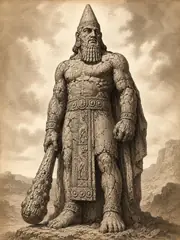
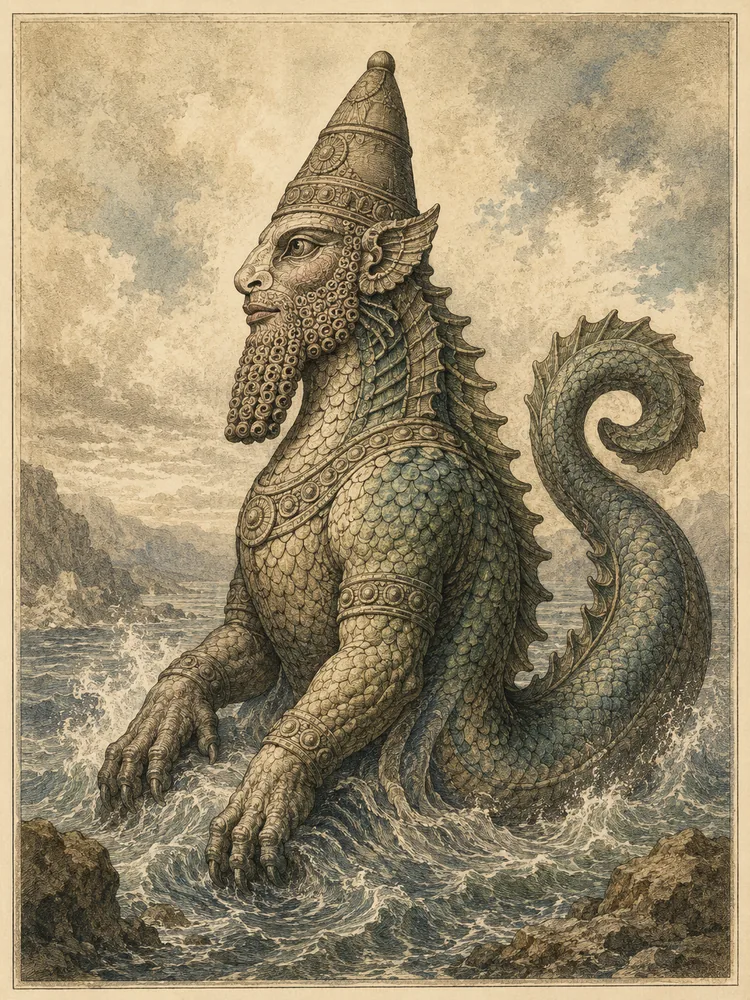
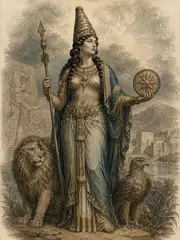
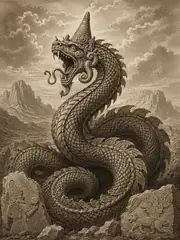
Before Kumarbi sent Ullikummi against the storm-king, he had already attempted one earlier rebellion through a champion of similar character but watery rather than stony. This was Hedammu — a sea-monster of insatiable hunger, born of Kumarbi by a daughter of the sea-god, dwelling in the deep places along the coast.
Hedammu's chief threat was not strength of arms but appetite: he devoured everything in his vicinity, cattle and sheep and men, in such quantities that the world's stocks were threatened and the human race itself in danger. The gods, in council, sent the goddess Shaushka — Ishtar in her Hurrian form — to deal with him. Shaushka stood by the sea-shore and bared her body, and sang, and made herself drunkenly delightful; Hedammu, drawn from his depths, came up and was overcome with his own desire and with the wine the goddess offered. The text, here, breaks off; the resolution is lost.
Curator’s note
What the sources say, and what later tradition added. The sources for this bay
The Song of Hedammu (CTH 348) is preserved only in fragments, and the conclusion of the story — presumably some form of Hedammu's destruction or binding — is not extant. The seduction-of-the-monster-by-a-goddess pattern recurs in the Hittite material (compare Inara's similar handling of Illuyanka), and seems to have been a recognized type-scene of Anatolian narrative. The deeper question — whether such episodes were widely understood as comic, erotic, religiously significant, or all three — is hard to settle from fragments alone. Shaushka, whose name in Hurrian means "Great One," is in Anatolia what Ishtar is in Mesopotamia, and the deployment of her as monster-tamer is consistent with her Mesopotamian profile.
When the sources speak
Dated witnesses for Anatolia. A date marks when the evidence was written down, not when the belief began. The whole timeline
- c. 3400–3000 BCE
- Uruk-period writing and monumental temple economies create the earliest recoverable administrative setting for named divine institutions.
- c. 2900–2350 BCE
- Early Dynastic city-states preserve local cults, hymns, royal inscriptions, and god lists; later copies often transmit older compositions.
- c. 2334–2154 BCE
- The Akkadian Empire expands bilingual and imperial patterns of divine identification without erasing local cult titles.
- c. 2112–2004 BCE
- Ur III administration and scribal schooling standardize many Sumerian literary and liturgical forms.
- c. 2000–1600 BCE
- Old Babylonian schools copy major myths, laments, hymns, debates, and heroic narratives in the form most often used by modern editors.
- c. 1650–1200 BCE
- Hittite and Hurrian archives at Hattusa transmit Anatolian myths, imported Syrian materials, and ritual compositions.
- c. 1400–1190 BCE
- The tablets of Ugarit preserve the Baal Cycle, Kirta, Aqhat, ritual lists, and a dense Late Bronze Age West Semitic pantheon.
- c. 1000–612 BCE
- Neo-Assyrian and Neo-Babylonian empires collect, revise, and politically reinterpret older learned traditions.