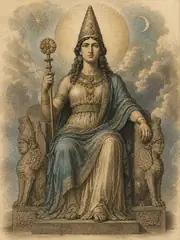
Among the divine children of Teshub the storm-king and Hebat his queen was the god Sharruma — "the King of the Mountain" — who became, in the late Hittite period, one of the principal protector-gods of the Hittite royal house. He was depicted as a young god riding upon the back of a panther or lion, his small form contrasting with the great cat that bore him.
His most famous representation, and that by which he is now best known, is found at the great rock-sanctuary of Yazılıkaya, beside the Hittite capital Hattusa. There, on the wall of a cleft chamber that may have served as a royal mausoleum or memorial-shrine, the god Sharruma is shown embracing his royal protégé, the Hittite king Tudhaliya IV: the god's left arm thrown across the king's shoulders, the king cradled into his side, in a posture of intimate divine protection. It is among the most personal representations of the relationship between a god and a mortal king to survive from Bronze Age Anatolia, and stands in striking contrast to the formal court-scenes more typical of Hittite art.
Curator’s note
What the sources say, and what later tradition added. The sources for this bay
Sharruma is well-attested in Hittite ritual texts, treaty-curses, and votive inscriptions of the Empire period (c. 1400-1180 BCE). His Yazılıkaya relief, in Chamber B of the rock-sanctuary, is dated to the reign of Tudhaliya IV (c. 1237-1209 BCE) and is among the most photographed monuments of Hittite art. The young-god-on-panther iconography is distinctive; it survives in seals, small bronzes, and rock-relief tradition. After the fall of the Hittite Empire, Sharruma's cult continued in the Neo-Hittite successor-states of southeastern Anatolia and northern Syria into the early first millennium BCE, where his name appears in royal inscriptions as far afield as Carchemish and Malatya.
When the sources speak
Dated witnesses for Anatolia. A date marks when the evidence was written down, not when the belief began. The whole timeline
- c. 3400–3000 BCE
- Uruk-period writing and monumental temple economies create the earliest recoverable administrative setting for named divine institutions.
- c. 2900–2350 BCE
- Early Dynastic city-states preserve local cults, hymns, royal inscriptions, and god lists; later copies often transmit older compositions.
- c. 2334–2154 BCE
- The Akkadian Empire expands bilingual and imperial patterns of divine identification without erasing local cult titles.
- c. 2112–2004 BCE
- Ur III administration and scribal schooling standardize many Sumerian literary and liturgical forms.
- c. 2000–1600 BCE
- Old Babylonian schools copy major myths, laments, hymns, debates, and heroic narratives in the form most often used by modern editors.
- c. 1650–1200 BCE
- Hittite and Hurrian archives at Hattusa transmit Anatolian myths, imported Syrian materials, and ritual compositions.
- c. 1400–1190 BCE
- The tablets of Ugarit preserve the Baal Cycle, Kirta, Aqhat, ritual lists, and a dense Late Bronze Age West Semitic pantheon.
- c. 1000–612 BCE
- Neo-Assyrian and Neo-Babylonian empires collect, revise, and politically reinterpret older learned traditions.