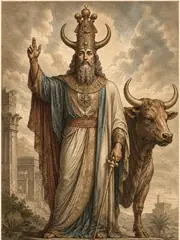
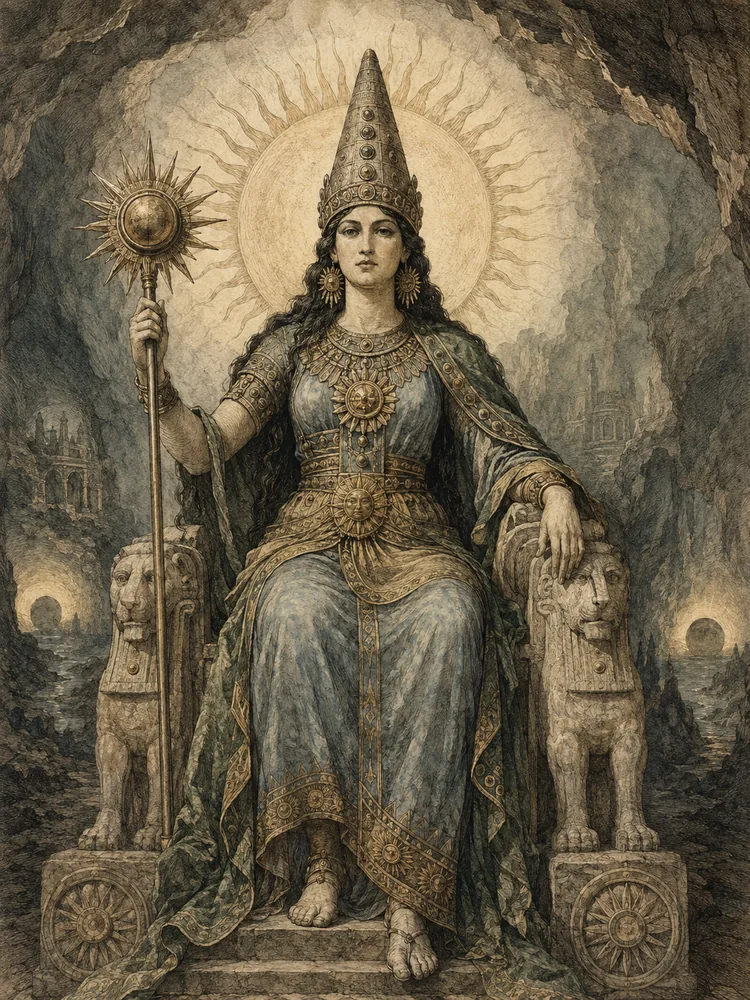
There was, in older Hittite religion, a god of the underworld called Lelwani — male in his earliest attestations — who received the offerings due to the dead and presided over the dark places beneath the earth. Over the course of Hittite religious history, however, this male underworld-god was supplanted by a female version of himself: Lelwani came to be known as the Sun-Goddess of the Earth, the dark counterpart of the Sun-Goddess of Arinna who lit the day above. The change of gender is documented in the texts and is one of the more curious developments of Hittite theology.
To Lelwani in her female form belonged the royal substitution-rituals of the late Hittite period — among the most extraordinary documents of ancient religion. When the king fell ill, or when omens warned of his coming death, a substitute (sometimes a prisoner of war, sometimes a paid volunteer) was crowned as king, given the royal regalia, and sent to the underworld in the actual king's place. The substitute was killed; Lelwani received him; the actual king lived on. The texts of these rituals preserve the exact prayers and the exact formulas of substitution, with a clinical precision that is the more chilling for the matter-of-factness of its language.
Curator’s note
What the sources say, and what later tradition added. The sources for this bay
Lelwani is documented in Hittite ritual texts from the Old Kingdom onward, with the gender-shift from male to female occurring during the Empire period. The royal substitution-rituals are preserved chiefly in the texts known as CTH 419 and related compositions, edited by H.M. Kümmel and others. They are among the principal documents of late Hittite religious thought, and bear on broader questions about substitutionary ritual in the ancient Near East: the Mesopotamian "substitute king" rituals, performed when astronomers warned of a royal death, are functionally similar, and may share a common heritage with the Hittite practice. The identification of Lelwani with Mesopotamian Allatum (queen of the underworld) is a late Hittite theological move, parallel to the broader assimilation of Anatolian and Mesopotamian deities in the cosmopolitan late Bronze Age.
When the sources speak
Dated witnesses for Anatolia. A date marks when the evidence was written down, not when the belief began. The whole timeline
- c. 3400–3000 BCE
- Uruk-period writing and monumental temple economies create the earliest recoverable administrative setting for named divine institutions.
- c. 2900–2350 BCE
- Early Dynastic city-states preserve local cults, hymns, royal inscriptions, and god lists; later copies often transmit older compositions.
- c. 2334–2154 BCE
- The Akkadian Empire expands bilingual and imperial patterns of divine identification without erasing local cult titles.
- c. 2112–2004 BCE
- Ur III administration and scribal schooling standardize many Sumerian literary and liturgical forms.
- c. 2000–1600 BCE
- Old Babylonian schools copy major myths, laments, hymns, debates, and heroic narratives in the form most often used by modern editors.
- c. 1650–1200 BCE
- Hittite and Hurrian archives at Hattusa transmit Anatolian myths, imported Syrian materials, and ritual compositions.
- c. 1400–1190 BCE
- The tablets of Ugarit preserve the Baal Cycle, Kirta, Aqhat, ritual lists, and a dense Late Bronze Age West Semitic pantheon.
- c. 1000–612 BCE
- Neo-Assyrian and Neo-Babylonian empires collect, revise, and politically reinterpret older learned traditions.