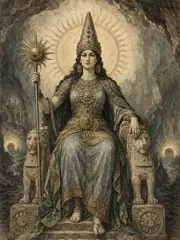
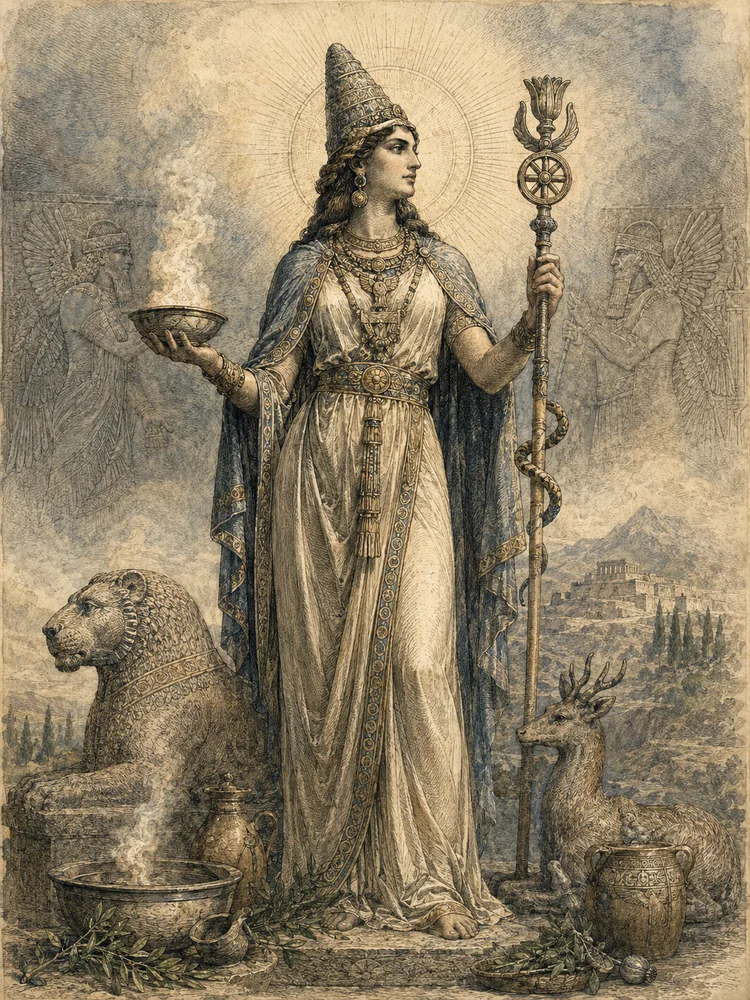
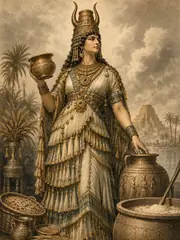
When the Hittites required a god to undo what evil words and evil glances had done — to lift a curse from a household, to heal a king's restlessness, to soothe an angry deity back into the proper functioning of the world — they prayed to Kamrusepa, mistress of magic and patroness of healing. Her name, Hattic in origin (where she was Katahzipuri), is woven through hundreds of Hittite ritual texts, in passages of incantation and recipe whose precision is the magical equivalent of Ninkasi's brewing-hymn.
It was Kamrusepa who, in the Telepinu Myth, performed the elaborate ritual that finally calmed the angry vanished god and restored him to his throne. She prepared a fire of cedar wood; she placed upon the fire a great cauldron; she invoked the proper divine names; she chanted away Telepinu's anger, in stages — anger like the wind that bends grass, anger like the storm that levels trees, anger like the flood that uproots palaces — until at last the god's anger had been led out from him into the cauldron and bound there, and Telepinu sat down again at his throne, calm.
When the sources speak
Dated witnesses for Anatolia. A date marks when the evidence was written down, not when the belief began. The whole timeline
- c. 3400–3000 BCE
- Uruk-period writing and monumental temple economies create the earliest recoverable administrative setting for named divine institutions.
- c. 2900–2350 BCE
- Early Dynastic city-states preserve local cults, hymns, royal inscriptions, and god lists; later copies often transmit older compositions.
- c. 2334–2154 BCE
- The Akkadian Empire expands bilingual and imperial patterns of divine identification without erasing local cult titles.
- c. 2112–2004 BCE
- Ur III administration and scribal schooling standardize many Sumerian literary and liturgical forms.
- c. 2000–1600 BCE
- Old Babylonian schools copy major myths, laments, hymns, debates, and heroic narratives in the form most often used by modern editors.
- c. 1650–1200 BCE
- Hittite and Hurrian archives at Hattusa transmit Anatolian myths, imported Syrian materials, and ritual compositions.
- c. 1400–1190 BCE
- The tablets of Ugarit preserve the Baal Cycle, Kirta, Aqhat, ritual lists, and a dense Late Bronze Age West Semitic pantheon.
- c. 1000–612 BCE
- Neo-Assyrian and Neo-Babylonian empires collect, revise, and politically reinterpret older learned traditions.