A Compendium of the Ancient Gods
Telepinu, plate

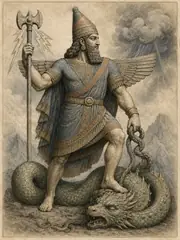
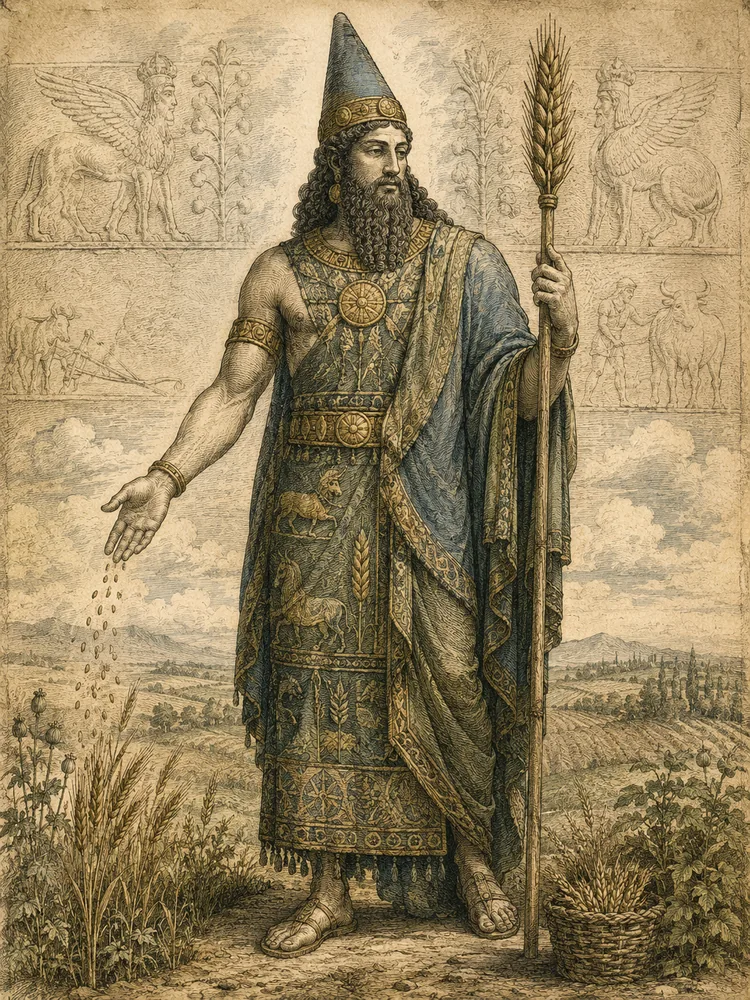
Telepinu was a son of Tarhunt, a god of agriculture and of the prosperity of the land. He was a god of mild and ordinary functions, and would have remained one — but he had a temper. Once, the surviving tablet relates, Telepinu was angry; the cause is broken away in the tablet's lacuna, but its effect is plain. He put his right shoe on his left foot and his left shoe on his right; he stamped out of his house in fury; he disappeared into the moor and lost himself among the marsh-grass and fell asleep.

And then, the tablet says, the world died. The barley would not grow; the ewes refused their lambs; the cows refused their calves; the bee gave no honey; and famine settled upon the land. The gods sought him: the Sun-God sent the eagle to find him, and the eagle searched the high mountains and the deep valleys and the blue sea, and could not find him. The Storm-God himself searched, and could not find him. At last the Mother-Goddess sent the bee — "the bee, who is small" — and the bee searched, and the bee found him asleep in the moor, and stung him on his hands and feet to wake him.

Telepinu woke; but his anger was not assuaged — indeed, being stung by a bee did not improve his temper, and he lashed out the more terribly. Then the goddess Kamrusepa, lady of magic, was summoned; and she devised a long ritual to soothe him, with twelve rams and twelve ewes, with sweet oil and with the eagle's wing-feathers and with such-and-such incantations; and at last Telepinu was calmed, and returned to his proper place, and the world began to live again.
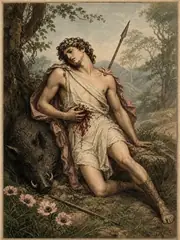
Curator’s note

What the sources say, and what later tradition added. The sources for this bay

The Telepinu Myth is preserved in several Hittite versions, with one Palaic and possibly one Hattic precursor; it is among the most fully preserved of Hittite ritual myths. It is best understood not as a free narrative but as the etiological text recited during a particular ritual of agricultural renewal — probably performed at the spring festival, when the dormant fertility of the land had to be coaxed awake. The story-pattern, of a vanishing-and-returning fertility god, has obvious affinities with Inanna/Dumuzi, Demeter/Persephone, and Adonis cycles, but the Hittite version is distinguished by the emphasis on the god's anger as the cause of his absence — a theological move that locates the failure of fertility in divine pique rather than in the regular cycle of the seasons.

Kin in the sources

Each tie is quoted from the entry that states it.

When the sources speak

Dated witnesses for Anatolia. A date marks when the evidence was written down, not when the belief began. The whole timeline

c. 3400–3000 BCE
Uruk-period writing and monumental temple economies create the earliest recoverable administrative setting for named divine institutions.
c. 2900–2350 BCE
Early Dynastic city-states preserve local cults, hymns, royal inscriptions, and god lists; later copies often transmit older compositions.
c. 2334–2154 BCE
The Akkadian Empire expands bilingual and imperial patterns of divine identification without erasing local cult titles.
c. 2112–2004 BCE
Ur III administration and scribal schooling standardize many Sumerian literary and liturgical forms.
c. 2000–1600 BCE
Old Babylonian schools copy major myths, laments, hymns, debates, and heroic narratives in the form most often used by modern editors.
c. 1650–1200 BCE
Hittite and Hurrian archives at Hattusa transmit Anatolian myths, imported Syrian materials, and ritual compositions.
c. 1400–1190 BCE
The tablets of Ugarit preserve the Baal Cycle, Kirta, Aqhat, ritual lists, and a dense Late Bronze Age West Semitic pantheon.
c. 1000–612 BCE
Neo-Assyrian and Neo-Babylonian empires collect, revise, and politically reinterpret older learned traditions.

Floor plan

The rooms follow one another in the order their peoples first appear in the written record.

  1. The Cradle of Citiesc. 3400 BCE to 395 CE. 115 works
  2. The Gift of the Nilec. 4000 BCE to 395 CE. 73 works
  3. The Olympian Orderc. 1600 BCE to 750 CE. 152 works
  4. The Persian Worldc. 2000 BCE to 1010 CE. 30 works
  5. The Levantine Borderlandsc. 1200 BCE to 500 CE. 20 works
  6. The Edges of Empirec. 2000 BCE to 1500 CE. 33 works
  7. The Etruscan Worldc. 900 BCE to 750 CE. 22 works
  8. The Roman Inheritancec. 1200 BCE to 500 CE. 58 works
  9. The Northern Inheritancec. 2000 BCE to 1600 CE. 131 works