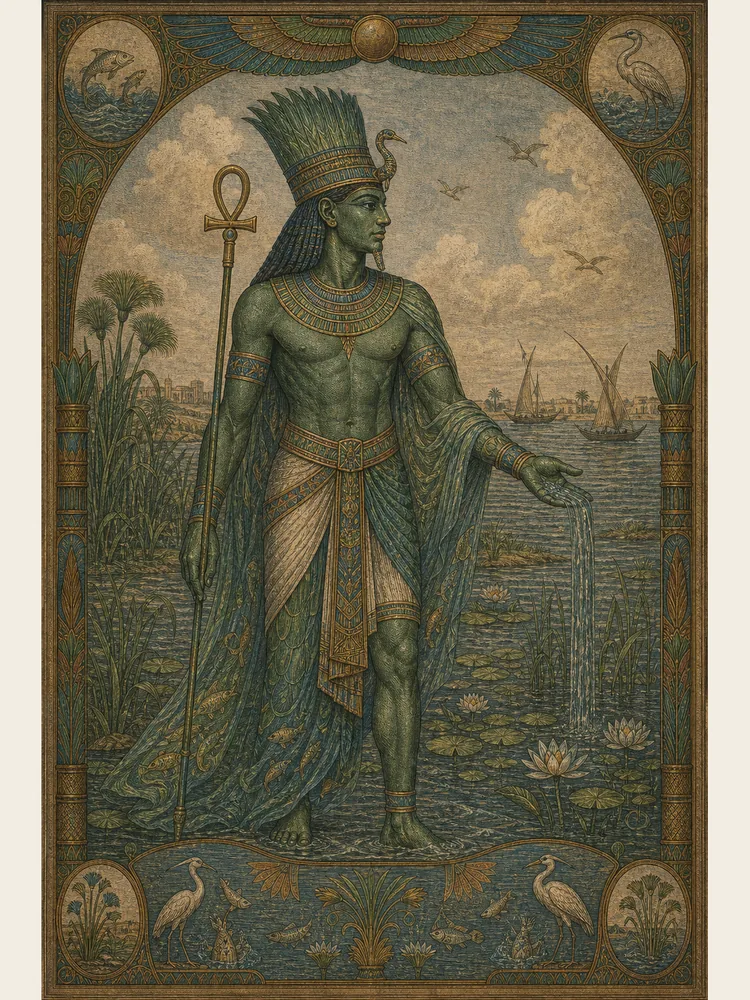
He was the god of the Mediterranean and of the great lakes of the northern Delta, and his name meant simply 'the Great Green' — for the Egyptians named the sea by its color, as they named so many things by their visible quality rather than by an abstract noun. He was depicted as a man whose body was painted green or blue-green, with wavy lines crossing his torso to indicate water, and he carried a fish in one hand or sometimes a stalk of papyrus.
He was an old god and a quite simple one. He had no developed mythology, no marriages, no contests with the other gods; he was the personified element of the sea, as the Nile-god Hapi was the personified element of the river. The Egyptians, whose civilization faced inland up the Nile rather than outward upon the Mediterranean, had a complicated relationship with the sea: it brought them trade and threat in equal measure, and they did not love it as the Greeks loved their Aegean. Wadj-wer was honored in coastal towns of the Delta, but he was never a great civic god, and his cult was modest.
His clearest visual presence is in the procession-friezes of the great mortuary temples and in royal nome-lists, where the personifications of the various waters and territories of Egypt — the Nile in his Upper and Lower forms, the various canals, the marshlands, the lakes — file past bringing their offerings to the king's altar; and Wadj-wer takes his place among them, a green-bodied figure bearing fish, the Delta lakes and the open sea brought into the same procession with the freshwater of the river.
Curator’s note
What the sources say, and what later tradition added. The sources for this bay
Wadj-wer (Egyptian Wꜣḏ-wr, 'the Great Green') is attested from the Old Kingdom, particularly in pyramid temple reliefs (Sahure, Userkaf, Pepi II) where he features in the offering processions of personified geographical entities. There has been scholarly debate as to whether the term refers exclusively to the Mediterranean Sea or includes also the great lakes of the northern Delta — Lake Burullus, Lake Manzala, and the others — and the linguistic and iconographic evidence suggests the Egyptians did not always distinguish them sharply. The figure has no developed mythology and almost no extant hymnic literature; he is encountered chiefly in lists and processions, where his function is to represent the waters of the north as a single divine entity. The Egyptian relative neglect of the sea, despite Egypt's long Mediterranean coastline, is a noted cultural feature; it stands in contrast to the maritime focus of Phoenician and Greek religion, and reflects the basic agricultural and inland orientation of pharaonic civilization.
When the sources speak
Dated witnesses for The Protectors and the Sages. A date marks when the evidence was written down, not when the belief began. The whole timeline
- c. 4000–3100 BCE
- Predynastic regional symbols, burials, standards, and animal cults provide the deep background to later divine iconography.
- c. 3100–2686 BCE
- Early Dynastic kingship joins royal ideology to local cult centers and establishes many durable divine emblems.
- c. 2686–2181 BCE
- Old Kingdom pyramid complexes and the Pyramid Texts preserve the earliest large religious corpus.
- c. 2181–1650 BCE
- First Intermediate and Middle Kingdom traditions broaden mortuary access; Coffin Texts develop older royal materials.
- c. 1550–1070 BCE
- New Kingdom temple wealth, royal hymns, underworld books, and the Book of Going Forth by Day greatly expand the record.
- c. 1353–1336 BCE
- Akhenaten’s Aten program reorganizes royal cult but does not permanently erase the older divine plurality.
- c. 1070–664 BCE
- Third Intermediate Period priestly and regional powers reshape cult administration and divine kingship.
- 664–332 BCE
- Late Period archaism, animal cults, and temple scholarship preserve and reinterpret older forms.