
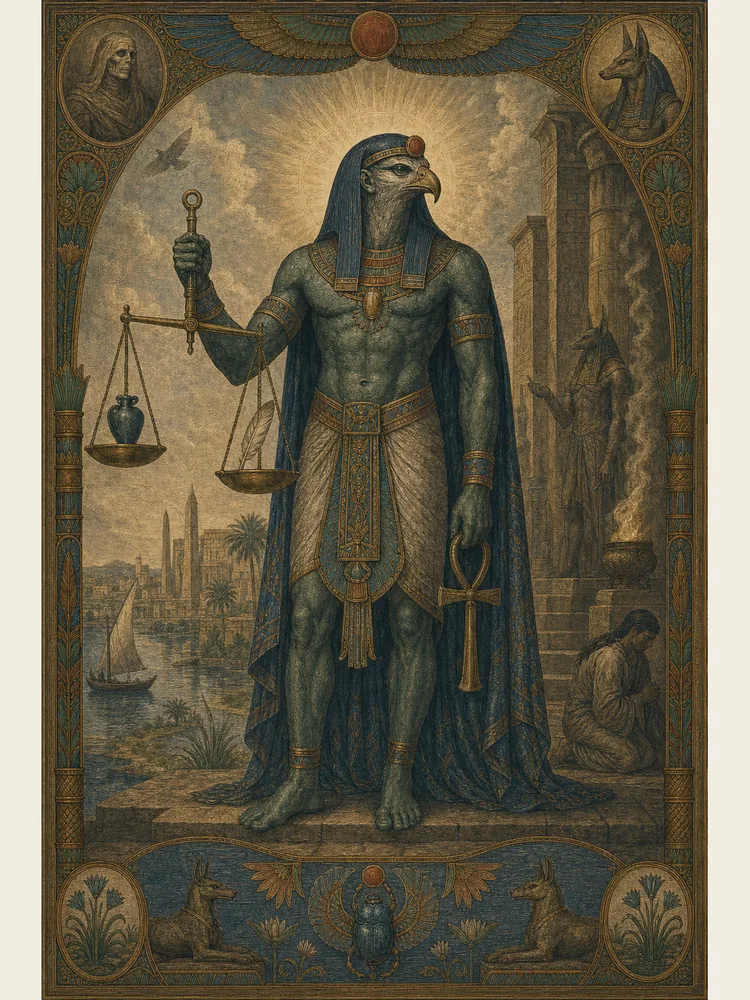
He was a god of the Late Period, who is not attested in the great age of the pyramids or even in the New Kingdom, but who emerges into visibility in the Ptolemaic and Roman centuries as a popular god of common piety. His name is variously interpreted; the simplest reading is 'He Who Returns,' and his function fits that name. He was the god who paid back what was owed: he sent vengeance upon the man who had wronged his neighbor, and he sent recompense upon the man who had been wronged. He was the divine guarantor that no injustice would go unanswered.
He had no place in the great triads or the cosmic cycles. He was a personal god of personal grievances, invoked by ordinary people in their private quarrels and disappointments. The Greeks, when they encountered him in the Egyptian temples of the Late Period, identified him with Kronos in his aspect of stern retribution, or with the Greek Nemesis, the divine indignation that punishes pride. He is depicted on small bronzes and stelae of the Roman period, often in the form of a hawk-headed man holding a balance or a knife, his attributes those of judgment and execution.
His emergence into prominence in the late centuries of Egyptian religion reflects a broader development of the period: a shift toward personal piety, toward the gods who could be addressed directly by individuals in their daily concerns, and away from the great state cults that had been the centerpiece of pharaonic religion. Petbe belongs to that turn, alongside the deified Imhotep, the strict Mertseger, and the minor protective gods whose votive bronzes fill the museum cases of the Roman period.