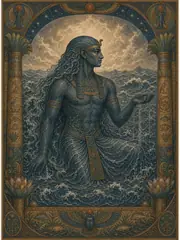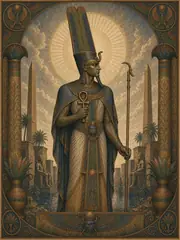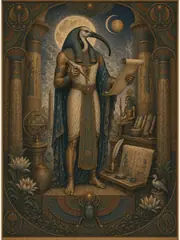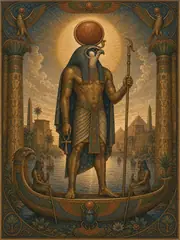
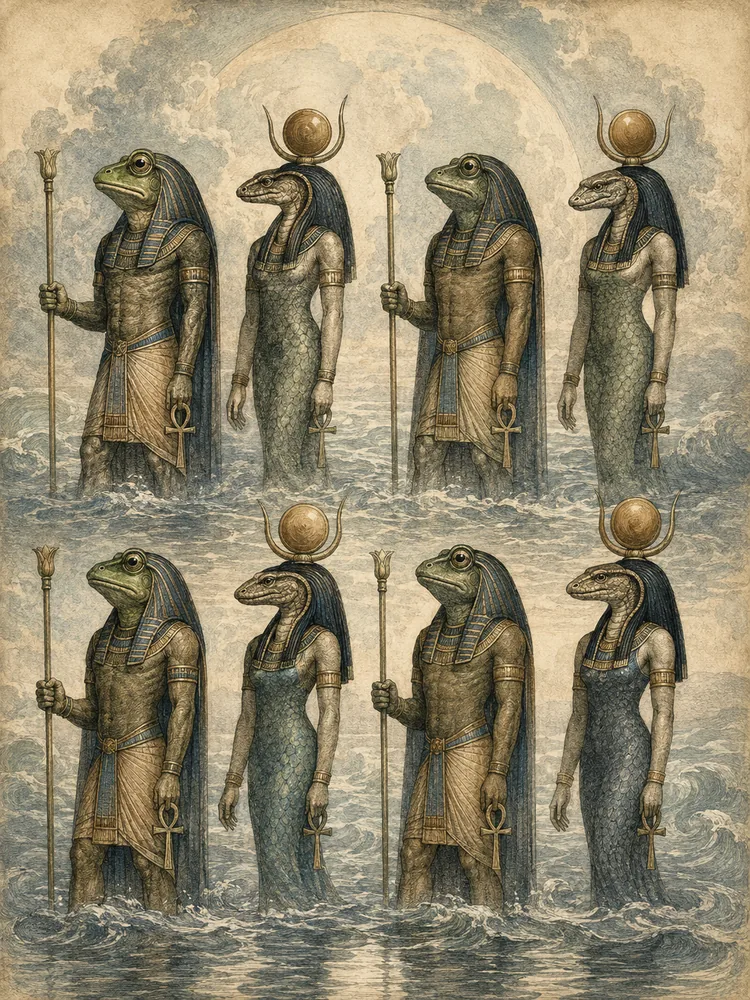
At Khemenu, which the Greeks called Hermopolis, the priests taught a different doctrine of the world's beginning. Before there was earth or sky, before any temple stood or any god was named, there existed the eight: four pairs of cosmic powers that were neither persons nor places but the great qualities of the formless deep. They were imagined as frogs (the male principles, creatures of the silent waters) and as serpents (the female principles, of the riverbank reeds), and they swam together in the primordial flood without form or speech.
The first pair were Nun and Naunet, the dark waters that lay before all things, of whom the deep is the substance and the abyss the dwelling. The second were Heh and Hauhet, the formlessness of infinity — the unmeasured, the boundless, what cannot be told in any number of years. The third were Kek and Kauket, the darkness before light, the obscurity in which no eye could see and no shape declare itself. The fourth were Amun and Amaunet, the hiddenness — that which is concealed even from the gods, the unknowable depth from which the world would arise.
These eight, by their commingling, generated the egg from which the sun was hatched at the first morning; or, in another tradition, they raised up the lotus from the waters and the sun-child opened its petals and shone forth upon them. The cult of the Ogdoad was already venerable in the Old Kingdom and remained the proud particular doctrine of Hermopolis through the Roman period; the city's necropolis at Tuna el-Gebel preserved the burials of sacred ibises in vast underground catacombs, for the ibis was the bird of Thoth, who had become master of Hermopolis and patron of its scribes.