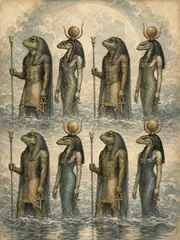
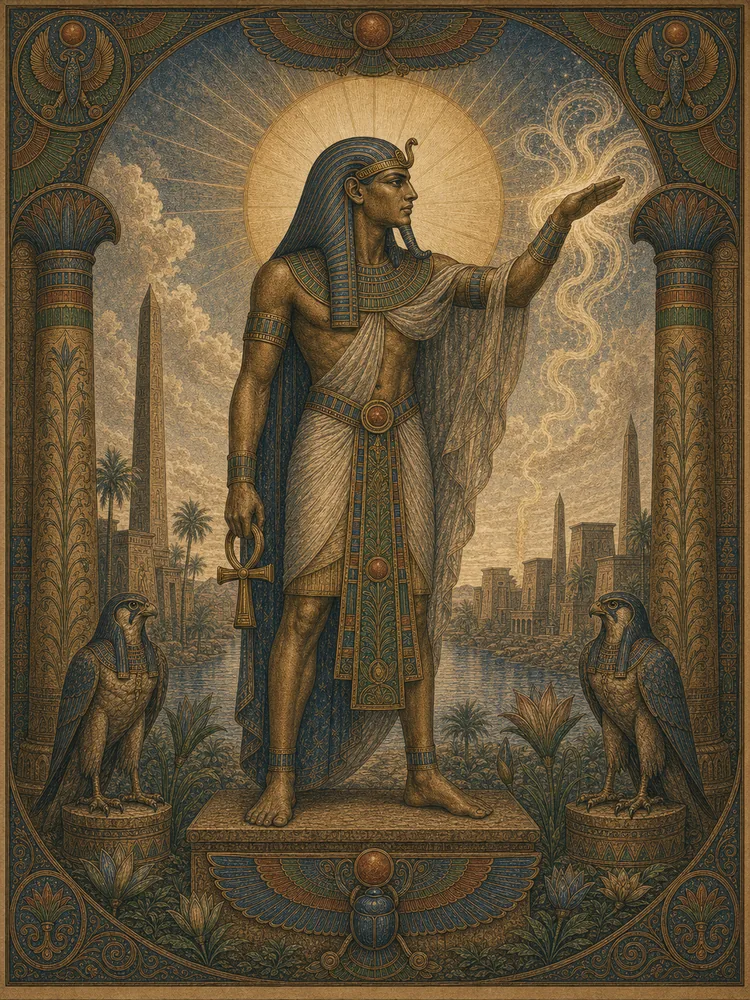
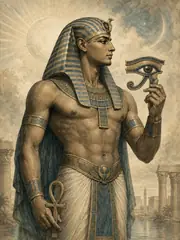
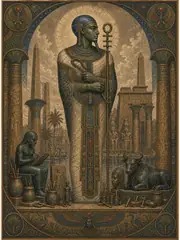
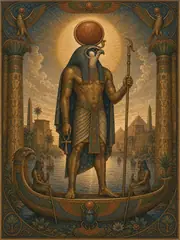
When the gods would create or destroy, when a king would issue a decree that the very earth must obey, what passed from the lips and took effect in the world was Hu. He was the personification of authoritative speech: not ordinary words, but the kind of utterance whose pronouncement makes a thing be. The Egyptians believed deeply in the creative power of the spoken name; to name a thing was to summon it, to speak its destiny was to fix it. Hu was this power made into a god.
In the Pyramid Texts, the dead king is said to seize Hu and to wield him alongside Sia, the divine perception, so that the king commands as the gods command. In later cosmogonies, especially that of Memphis, Hu is the instrument by which Ptah brings the world into being: Ptah conceives all things in his heart, and what his tongue articulates as Hu, that comes into being. Hu therefore stands close to the throne of Ra in the solar bark, and travels with the sun across the sky, that the god's word may reach into every quarter of creation.
Curator’s note
What the sources say, and what later tradition added. The sources for this bay
Hu (Egyptian Ḥw) appears already in the Pyramid Texts (notably Spells 251, 254, 309) as one of the powers seized by the ascended king and recurs throughout the Coffin Texts and the Book of the Dead. The Memphite Theology preserved on the Shabaka Stone (now in the British Museum) makes the most theologically developed use of the figure, presenting Hu as the spoken-word component of Ptah's creative act, whose paired faculty is Sia (the conceiving thought of the heart). The Egyptians did not separate language from action so strictly as we do; the king's word, the priest's invocation, and the god's name carried a real and effective power, and the deification of authoritative speech as Hu is a natural consequence of that worldview. The figure has no developed mythology in the ordinary sense; he is rather the god of a category, like Maat or Heka.
When the sources speak
Dated witnesses for The Cosmogonies. A date marks when the evidence was written down, not when the belief began. The whole timeline
- c. 4000–3100 BCE
- Predynastic regional symbols, burials, standards, and animal cults provide the deep background to later divine iconography.
- c. 3100–2686 BCE
- Early Dynastic kingship joins royal ideology to local cult centers and establishes many durable divine emblems.
- c. 2686–2181 BCE
- Old Kingdom pyramid complexes and the Pyramid Texts preserve the earliest large religious corpus.
- c. 2181–1650 BCE
- First Intermediate and Middle Kingdom traditions broaden mortuary access; Coffin Texts develop older royal materials.
- c. 1550–1070 BCE
- New Kingdom temple wealth, royal hymns, underworld books, and the Book of Going Forth by Day greatly expand the record.
- c. 1353–1336 BCE
- Akhenaten’s Aten program reorganizes royal cult but does not permanently erase the older divine plurality.
- c. 1070–664 BCE
- Third Intermediate Period priestly and regional powers reshape cult administration and divine kingship.
- 664–332 BCE
- Late Period archaism, animal cults, and temple scholarship preserve and reinterpret older forms.