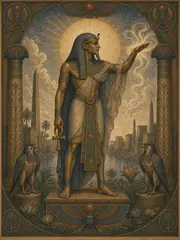
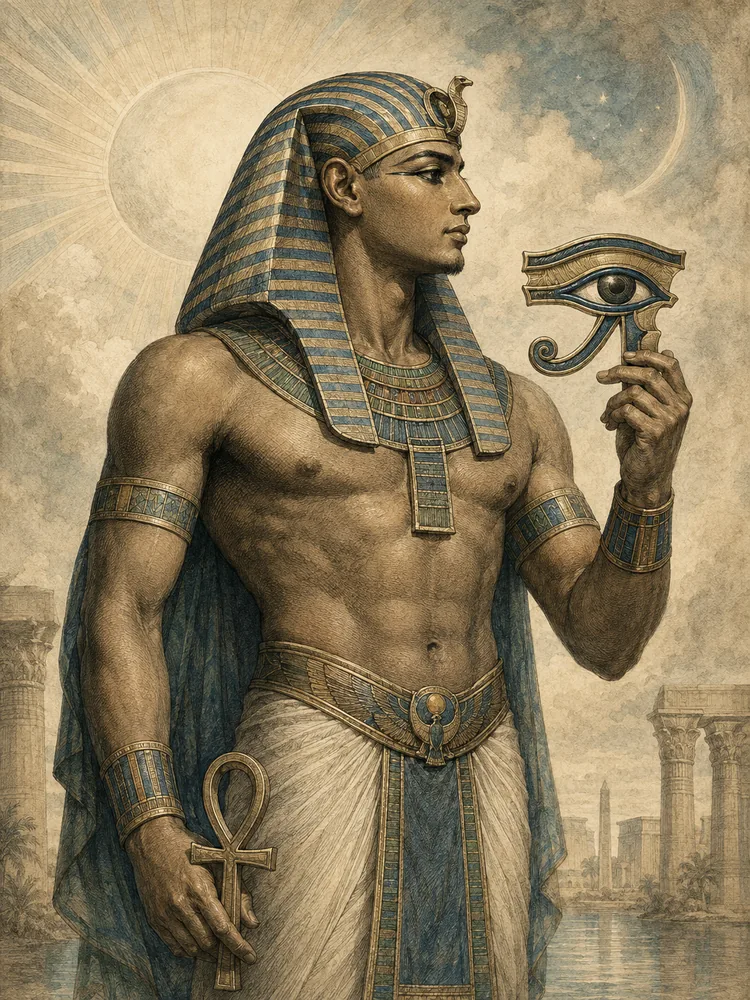
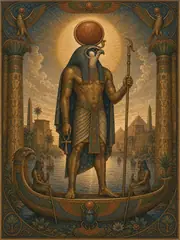
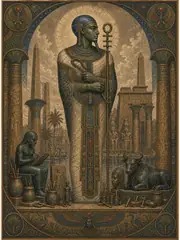
If Hu was the spoken word that brought a thing into being, Sia was the conceiving mind that knew beforehand what should be. He was the personification of insight, of penetrating perception, of the intelligence by which a god looks upon a question and sees its answer in a single instant. The Egyptians located the seat of the mind not in the brain but in the heart, and Sia was the divine principle of that heart's understanding.
In the daily voyage of the sun across the sky, Sia was said to stand at the prow of the solar bark, scanning the horizon, while Hu stood at the stern and uttered the commands that drove the bark forward. Together they were the eyes and the mouth of Ra, and through them the sun governed the cosmos. In the Memphite theology, Sia was likewise paired with Hu as the two arms of Ptah's creating: Ptah's heart conceived as Sia and his tongue spoke as Hu, and what was so conceived and so spoken came forth into the world. Hu and Sia therefore stand together as the two great instruments of divine government.
When the sources speak
Dated witnesses for The Cosmogonies. A date marks when the evidence was written down, not when the belief began. The whole timeline
- c. 4000–3100 BCE
- Predynastic regional symbols, burials, standards, and animal cults provide the deep background to later divine iconography.
- c. 3100–2686 BCE
- Early Dynastic kingship joins royal ideology to local cult centers and establishes many durable divine emblems.
- c. 2686–2181 BCE
- Old Kingdom pyramid complexes and the Pyramid Texts preserve the earliest large religious corpus.
- c. 2181–1650 BCE
- First Intermediate and Middle Kingdom traditions broaden mortuary access; Coffin Texts develop older royal materials.
- c. 1550–1070 BCE
- New Kingdom temple wealth, royal hymns, underworld books, and the Book of Going Forth by Day greatly expand the record.
- c. 1353–1336 BCE
- Akhenaten’s Aten program reorganizes royal cult but does not permanently erase the older divine plurality.
- c. 1070–664 BCE
- Third Intermediate Period priestly and regional powers reshape cult administration and divine kingship.
- 664–332 BCE
- Late Period archaism, animal cults, and temple scholarship preserve and reinterpret older forms.