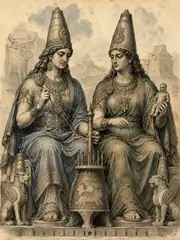
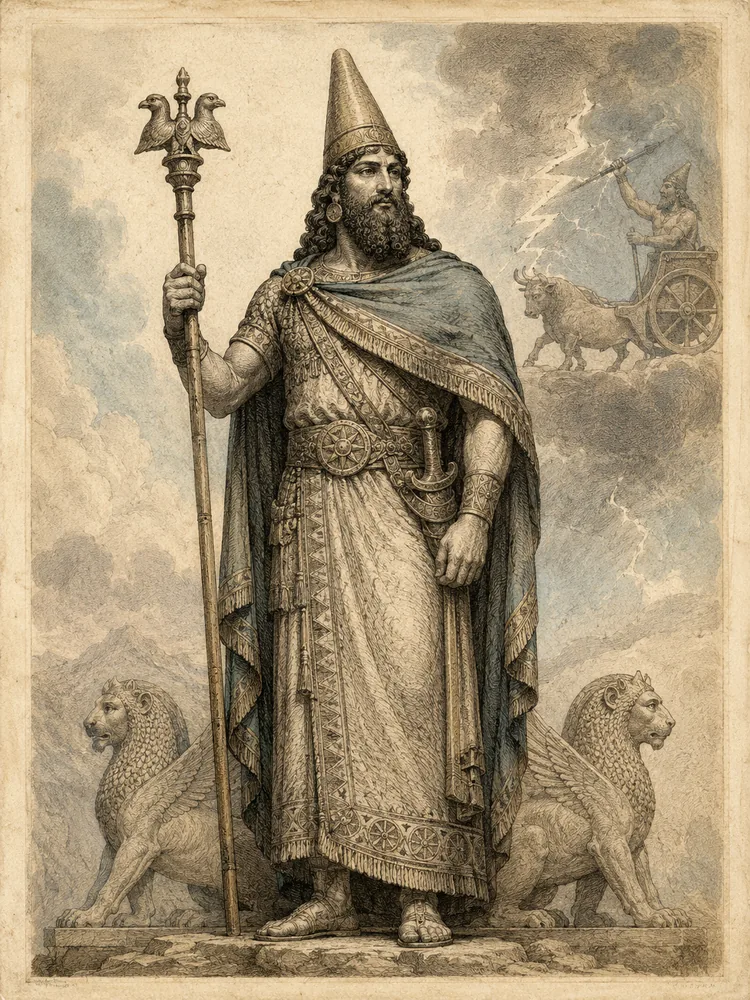
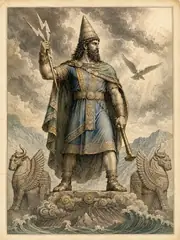
Throughout the Kumarbi Cycle, beside Teshub the storm-king walks his brother Tashmishu — the steady second figure, who counsels Teshub when Teshub is about to act rashly, who supports him in battle when his strength flags, who serves as the brother-vizier of the storm-king's house. He is, in his quieter way, one of the more fully drawn supporting figures in Hurrian-Hittite mythology.
It was Tashmishu who, in the Song of Ullikummi, climbed the high mountain with Teshub and looked upon the rising stone giant; it was Tashmishu who stood by Teshub through the despair that followed; it was Tashmishu who, when Ea brought the saw and the giant fell, helped his brother to recover his throne. He has no great solo myth attached to him, no separate cult of grandeur. But within the narrative, he is the figure whose presence makes Teshub's heroism possible by giving Teshub a brother to whom he need not pretend invulnerability.
When the sources speak
Dated witnesses for Anatolia. A date marks when the evidence was written down, not when the belief began. The whole timeline
- c. 3400–3000 BCE
- Uruk-period writing and monumental temple economies create the earliest recoverable administrative setting for named divine institutions.
- c. 2900–2350 BCE
- Early Dynastic city-states preserve local cults, hymns, royal inscriptions, and god lists; later copies often transmit older compositions.
- c. 2334–2154 BCE
- The Akkadian Empire expands bilingual and imperial patterns of divine identification without erasing local cult titles.
- c. 2112–2004 BCE
- Ur III administration and scribal schooling standardize many Sumerian literary and liturgical forms.
- c. 2000–1600 BCE
- Old Babylonian schools copy major myths, laments, hymns, debates, and heroic narratives in the form most often used by modern editors.
- c. 1650–1200 BCE
- Hittite and Hurrian archives at Hattusa transmit Anatolian myths, imported Syrian materials, and ritual compositions.
- c. 1400–1190 BCE
- The tablets of Ugarit preserve the Baal Cycle, Kirta, Aqhat, ritual lists, and a dense Late Bronze Age West Semitic pantheon.
- c. 1000–612 BCE
- Neo-Assyrian and Neo-Babylonian empires collect, revise, and politically reinterpret older learned traditions.