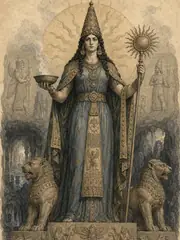
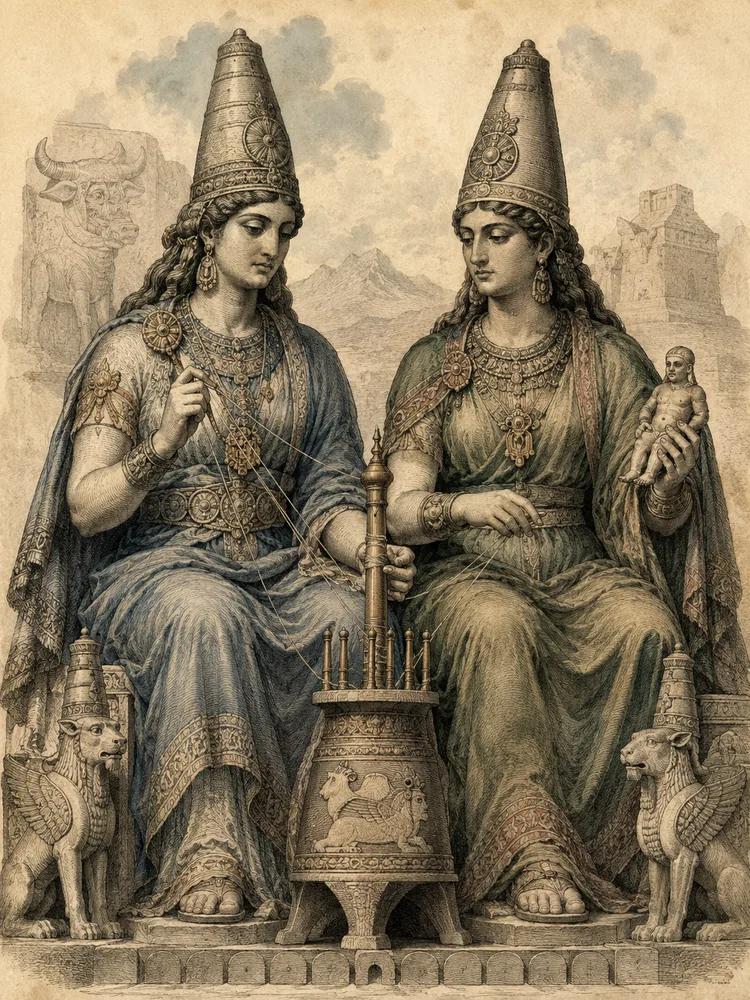
Among the Hurrian goddesses present at every Hurrian birth — invoked in the rituals of midwifery, named in the lullabies sung over cradles — were a pair (sometimes a group) called Hutena and Hutellura. They were the determiners of fate, the goddesses who at the moment of a child's birth assigned to that child its measure of years, its allotment of fortunes, its predisposition to honor or to shame.
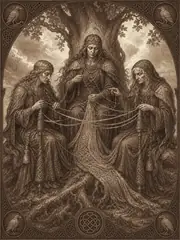
They are not, in surviving Hurrian texts, given extensive narrative treatment; what we know of them is largely formulaic, the mention of their names in invocations and the description of their function in ritual instructions. But their structural role in Hurrian religion is clear, and the parallel to Greek and Roman fate-goddesses — the Moirai, the Parcae — is striking enough that comparative mythologists have long taken these Anatolian fate-figures as evidence for an ancient Indo-European-and-broader pattern of female fate-spinners attendant upon birth.
Curator’s note
What the sources say, and what later tradition added. The sources for this bay
The Hutena-and-Hutellura formula appears in Hurrian and Hittite ritual texts of the Empire period, particularly those concerning birth, naming, and the determination of destinies. The exact relationship between the two named figures, and whether they should be understood as a pair, a triad, or a larger group, is uncertain; the pluralizing endings in some texts suggest more than two. The structural parallel to the Greek Moirai (Clotho, Lachesis, Atropos), the Roman Parcae, the Norse Norns, and the Slavic and Baltic fate-women has been remarked since Frazer's day. Whether the parallel rests on common Indo-European inheritance, on Bronze Age cultural diffusion, or on universal patterns of human birth-ritual cannot now be settled; the Hutena-and-Hutellura pair is one of the data points for any answer.
When the sources speak
Dated witnesses for Anatolia. A date marks when the evidence was written down, not when the belief began. The whole timeline
- c. 3400–3000 BCE
- Uruk-period writing and monumental temple economies create the earliest recoverable administrative setting for named divine institutions.
- c. 2900–2350 BCE
- Early Dynastic city-states preserve local cults, hymns, royal inscriptions, and god lists; later copies often transmit older compositions.
- c. 2334–2154 BCE
- The Akkadian Empire expands bilingual and imperial patterns of divine identification without erasing local cult titles.
- c. 2112–2004 BCE
- Ur III administration and scribal schooling standardize many Sumerian literary and liturgical forms.
- c. 2000–1600 BCE
- Old Babylonian schools copy major myths, laments, hymns, debates, and heroic narratives in the form most often used by modern editors.
- c. 1650–1200 BCE
- Hittite and Hurrian archives at Hattusa transmit Anatolian myths, imported Syrian materials, and ritual compositions.
- c. 1400–1190 BCE
- The tablets of Ugarit preserve the Baal Cycle, Kirta, Aqhat, ritual lists, and a dense Late Bronze Age West Semitic pantheon.
- c. 1000–612 BCE
- Neo-Assyrian and Neo-Babylonian empires collect, revise, and politically reinterpret older learned traditions.