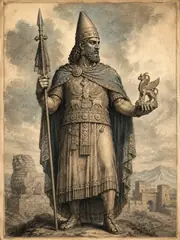
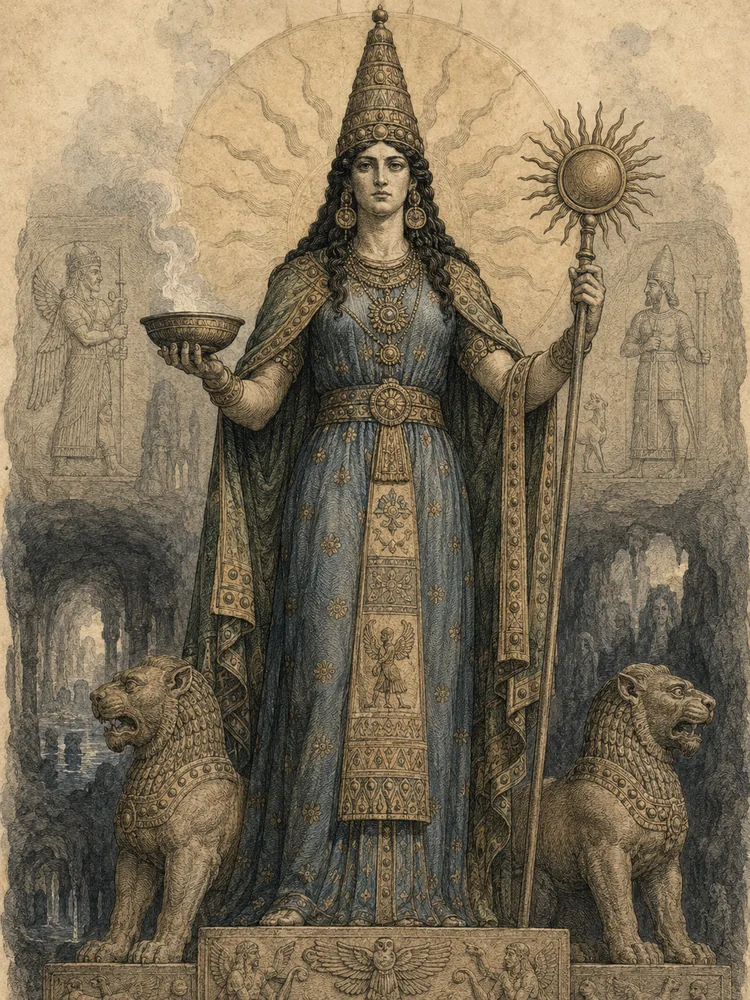
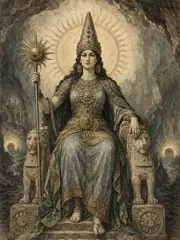
When the Hurrians thought of the underworld, they thought of it as a great hall in which the dead were received and at whose head sat a goddess whom they called Allani — "The Lady" — and who was sometimes given the further title of Sun-Goddess of the Earth, the dark sun who lit the realm beneath the world while the bright sun crossed the upper sky.
It is told in fragmentary Hurrian-Hittite texts that Teshub the storm-god was once entertained by Allani at a great underworld banquet. The full meaning of this episode is lost, since the text breaks at the crucial points; but the suggestion seems to be that even the upper gods could be hosted, on terms, in the goddess's hall. She was guarantor of oaths; she received those who broke their word into her keeping; she was the gatekeeper between the present and the dead.
Through the long traffic between Hurrian and Mesopotamian religion, she became identified with the Mesopotamian Allatum — and indeed her Hurrian name and the Akkadian title appear, in some texts, to be merely orthographic variants of the same word. The chthonic queen of the Anatolian-Mesopotamian frontier was, in different cultic registers, one figure under several spellings.
When the sources speak
Dated witnesses for Anatolia. A date marks when the evidence was written down, not when the belief began. The whole timeline
- c. 3400–3000 BCE
- Uruk-period writing and monumental temple economies create the earliest recoverable administrative setting for named divine institutions.
- c. 2900–2350 BCE
- Early Dynastic city-states preserve local cults, hymns, royal inscriptions, and god lists; later copies often transmit older compositions.
- c. 2334–2154 BCE
- The Akkadian Empire expands bilingual and imperial patterns of divine identification without erasing local cult titles.
- c. 2112–2004 BCE
- Ur III administration and scribal schooling standardize many Sumerian literary and liturgical forms.
- c. 2000–1600 BCE
- Old Babylonian schools copy major myths, laments, hymns, debates, and heroic narratives in the form most often used by modern editors.
- c. 1650–1200 BCE
- Hittite and Hurrian archives at Hattusa transmit Anatolian myths, imported Syrian materials, and ritual compositions.
- c. 1400–1190 BCE
- The tablets of Ugarit preserve the Baal Cycle, Kirta, Aqhat, ritual lists, and a dense Late Bronze Age West Semitic pantheon.
- c. 1000–612 BCE
- Neo-Assyrian and Neo-Babylonian empires collect, revise, and politically reinterpret older learned traditions.