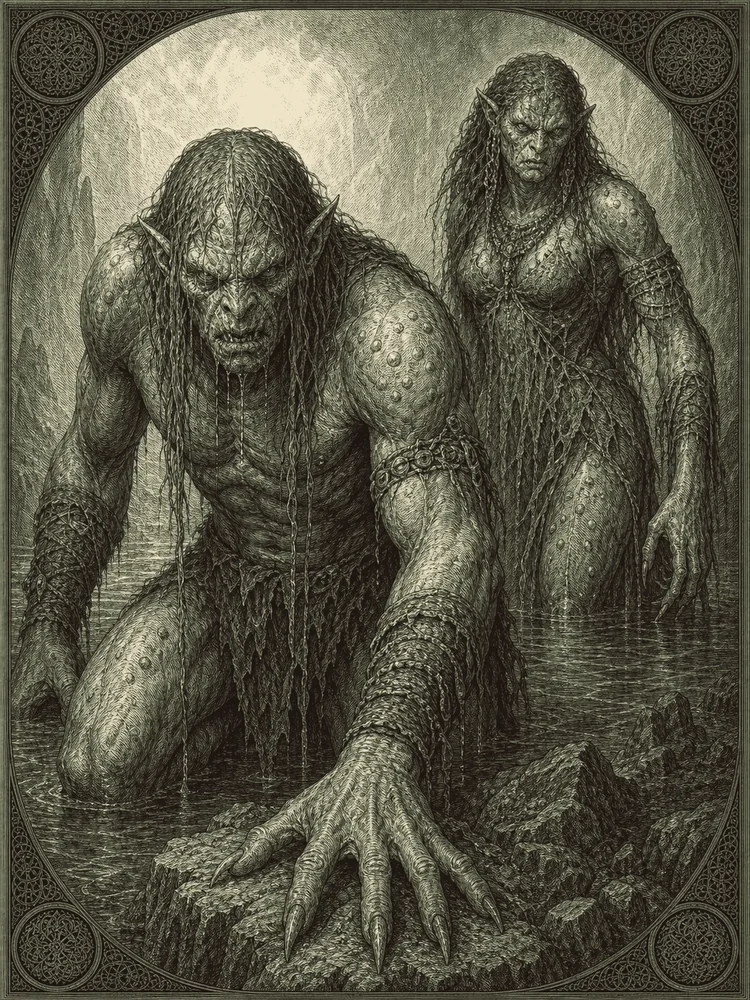
In the great hall of Heorot, the high-roofed mead-hall of King Hroðgar of the Danes, songs were sung and feasts were held; and the songs of joy were heard far across the moor. They were heard in particular by Grendel, who was a creature of the marsh, descended (so the poet of Beowulf tells us) from Cain — that is, from the line of mankind that had been cursed for the first murder, and from which had sprung also the giants and the wicked spirits.
For twelve winters Grendel came against Heorot. He came at night, while the warriors slept on their benches; he tore up door and bolt, dragged thirty men from their beds at a time, and bore them off to his lair to devour. The hall was emptied of its warriors, for none would sleep there; the throne of Hroðgar was unattended; the kingdom of the Danes was made waste by this single creature, whom no weapon could harm — for Grendel was protected by some magic that turned aside iron.
Beowulf the Geat heard the news in his own country and came across the sea with fourteen companions to offer his help. That night in the hall he wrestled with Grendel, hand to hand without weapons, and tore the monster's arm from its shoulder. Grendel fled to his marsh and there died of the wound. The arm was hung from the rafters of Heorot in token of the victory.
But the next night Grendel's mother came up out of the marsh — a creature more terrible than her son, as the poet says — and bore away one of Hroðgar's councillors in revenge for her son's death. Beowulf followed her down into the haunted mere, dove into the dark water (where the surface itself was scummed with blood), and at the bottom of the lake found her hall. There he wrestled with her and at last killed her with a giant-made sword that he found hanging in her hall; and he took also Grendel's head, which lay there, and brought it back to Heorot in token of the second victory.