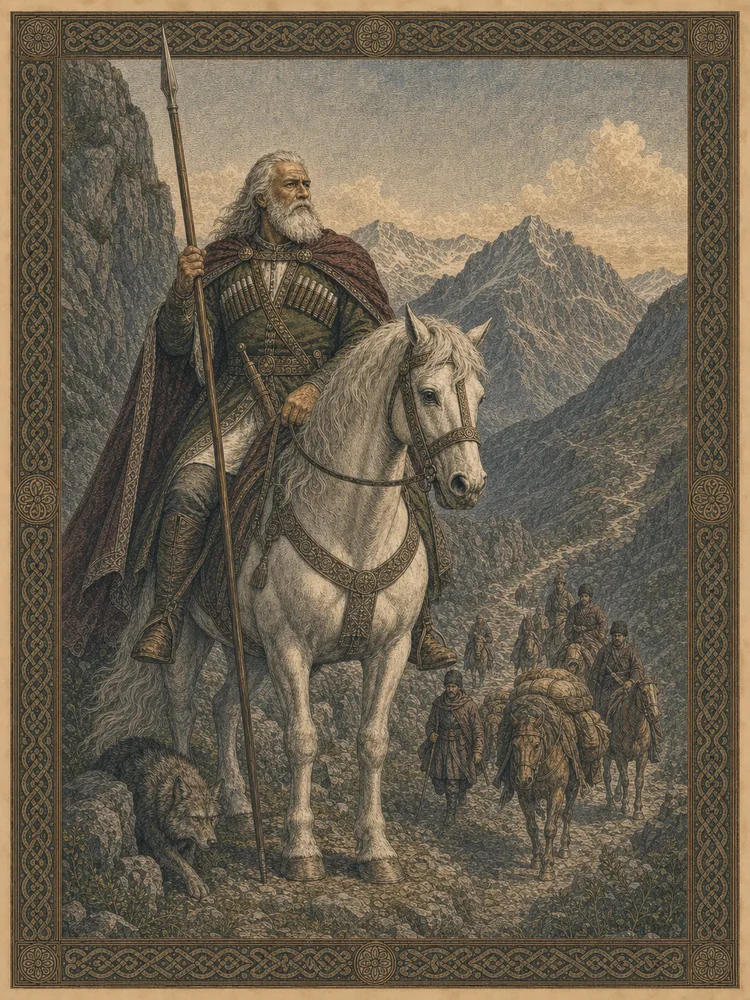
Uastyrdzhi — 'Saint George,' from the Christianized Ossetian form of the saint's name — was the patron of warriors, of wayfarers, of men in their characteristic occupations and dangers. He was depicted as a great mounted warrior in the typical Saint George iconography (a horseman with a long lance, often slaying a dragon or a wild beast), and his Christianized name reflects the late absorption of an indigenous Ossetian deity into the Saint George cult — but the underlying figure was older than Christianity in the Caucasus and preserved many pre-Christian features.
His distinctive characteristic in Ossetian religious tradition was that he was a god of men exclusively. Women were forbidden to speak his name (they referred to him by a circumlocution, 'Lægty Dzuar,' 'the Patron of Men'), to enter his sanctuaries, or to participate in the rites that men dedicated to him. The taboo was strict and was preserved in modern Ossetian folk-religion until well into the twentieth century; women who violated it were held to invite divine punishment, and the public ritual life of Uastyrdzhi-worship was wholly male.
The chief festival was the Dzhioraguba — kept in late November, with horsemen riding through the villages bearing torches, processions to the sacred groves and stones dedicated to Uastyrdzhi, and the slaughter of bulls and rams in his honor. The festival has continued in modern Ossetia, with the Christian veneer of Saint George's day intermixed with the pre-Christian rites; the modern celebrations are an unusually clear case of religious-cultural continuity.
Uastyrdzhi's male-only character and his patronage of warriors and wayfarers connect him with the broader Indo-European warrior-divinity pattern. Georges Dumézil and his school have argued that Uastyrdzhi preserves elements of the proto-Indo-European 'second function' divinity (the warrior-class god, in Dumézil's tripartite scheme), with material going back to the Sarmatian and Scythian periods. The Christianization onto Saint George provided the public religious vocabulary for a continuing indigenous cult, with the deeper structures of belief and practice preserved through the Christian transition. The figure stands as one of the most distinctive and best-preserved of the Caucasian religious traditions.