A Compendium of the Ancient Gods
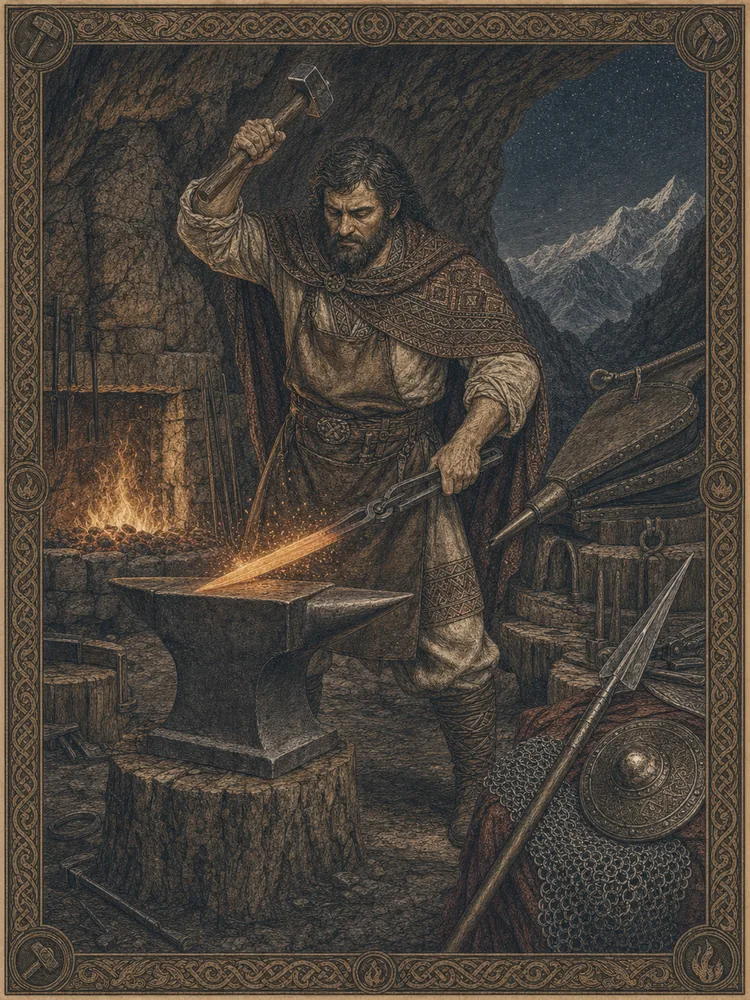
Wærhag, plate

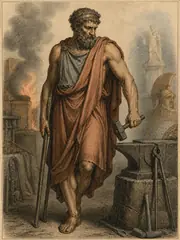
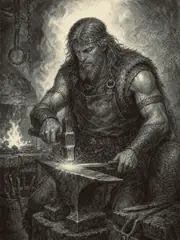
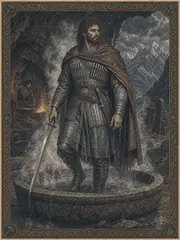
Wærhag (sometimes Wærxæg or Kurdalægon in some variants) was the smith-god of the Nart corpus, the divine forger of the magical weapons that the great Nart heroes wielded. He worked at his anvil in a celestial smithy — sometimes located in the heavens, sometimes in the underworld, sometimes at the bottom of the sea — and from his forge came the swords, spears, axes, and armor that gave the Narts their supernatural prowess in battle.

His most famous works were the weapons of the great heroes: the steel sword of Batraz (treated below), tempered to indestructibility in the magical waters of the cosmic sea; the bow of Soslan, made of star-iron and capable of striking targets that no mortal weapon could reach; the arrows of Sosryko, fletched with feathers from the wings of supernatural birds. Each of these weapons had a story of its forging in the Nart corpus, and Wærhag was the central figure of these forging-narratives — the master smith whose craft produced the implements of heroic action.

He had the typical features of the Indo-European smith-god: lameness (a feature shared with the Greek Hephaestus, the Norse Wayland, the Roman Vulcan), exceptional craftsmanship, isolation from ordinary divine society, and the working of magical forge-metals. The lameness has been variously interpreted in comparative mythology — as a sign of the smith's chthonic association (a sky-god lacks no limb; a chthonic god has marks of his earthly origin); as a sign of the smith's dependence on the forge-fire (which lames those who work it); as a symbolic mark of the craft-isolation that the smith requires.

Wærhag's cult survived in Ossetian folk-religion as the patron of smiths and metalworkers. The smithy-rites — the rituals performed when a new forge was lit, when a particularly important weapon was being made, when a smith took on an apprentice — were under his patronage, with offerings of bread and wine made at the forge. The cult was extinguished as a public religious institution by the Soviet-era industrialization of the Caucasus (which transformed the artisanal smith into the industrial worker), but elements survived in the modern ethnographic record and in the literary preservation of the Nart corpus.
Curator’s note

What the sources say, and what later tradition added. The sources for this bay

Wærhag is documented in the Nart corpus. The standard references are Colarusso's Nart Sagas and Dumézil's Le livre des héros. The wider Indo-European smith-god pattern is treated in Dumézil's works and in Bruce Lincoln's Death, War, and Sacrifice (1991); the smith-god in comparative mythology is the subject of considerable scholarly literature, including Mircea Eliade's The Forge and the Crucible (1956, English ed. 1962). The lameness motif is discussed in many comparative-mythological works.

Kin in the sources

Each tie is quoted from the entry that states it.

When the sources speak

Dated witnesses for The Ossetian Nart Pantheon. A date marks when the evidence was written down, not when the belief began. The whole timeline

2nd–1st millennia BCE
Bronze and Iron Age regional cultures establish the archaeological backgrounds later labeled Thracian, Illyrian, Iberian, Caucasian, and Libyan.
8th–6th centuries BCE
Greek and Phoenician colonization creates new inscriptional, artistic, and commercial contact zones.
6th–4th centuries BCE
Classical authors begin describing frontier peoples and translating local gods into Greek categories.
3rd–1st centuries BCE
Hellenistic kingdoms, Carthage, and Rome intensify political and cultic exchange.
1st century BCE–3rd century CE
Roman provincial rule produces dedications, coins, reliefs, and interpretive equations across the Balkans, Iberia, Caucasus, and North Africa.
4th–7th centuries CE
Christianization and imperial change end or transform many public cult institutions while names persist in texts and places.
medieval period
Georgian chronicles and epic traditions, Iberian memory, and North African historical sources reshape pre-Christian inheritances.
1st millennium BCE–early CE
Iranian-speaking steppe cultures provide a distant linguistic and comparative background.

Floor plan

The rooms follow one another in the order their peoples first appear in the written record.

  1. The Cradle of Citiesc. 3400 BCE to 395 CE. 115 works
  2. The Gift of the Nilec. 4000 BCE to 395 CE. 73 works
  3. The Olympian Orderc. 1600 BCE to 750 CE. 152 works
  4. The Persian Worldc. 2000 BCE to 1010 CE. 30 works
  5. The Levantine Borderlandsc. 1200 BCE to 500 CE. 20 works
  6. The Edges of Empirec. 2000 BCE to 1500 CE. 33 works
  7. The Etruscan Worldc. 900 BCE to 750 CE. 22 works
  8. The Roman Inheritancec. 1200 BCE to 500 CE. 58 works
  9. The Northern Inheritancec. 2000 BCE to 1600 CE. 131 works