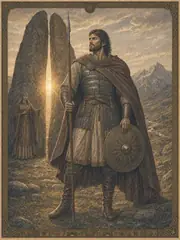
Sosryko (called Sasrykwa in some variants) was the trickster-hero of the Nart corpus, a figure of cunning rather than pure force, whose narratives are among the most beloved of the entire tradition. Where Batraz was steel and Soslan was sun-and-cunning, Sosryko was pure trickery — a hero whose victories came from outsmarting his opponents, often opponents whom no warrior could defeat in straight combat.
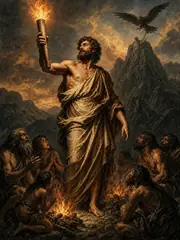
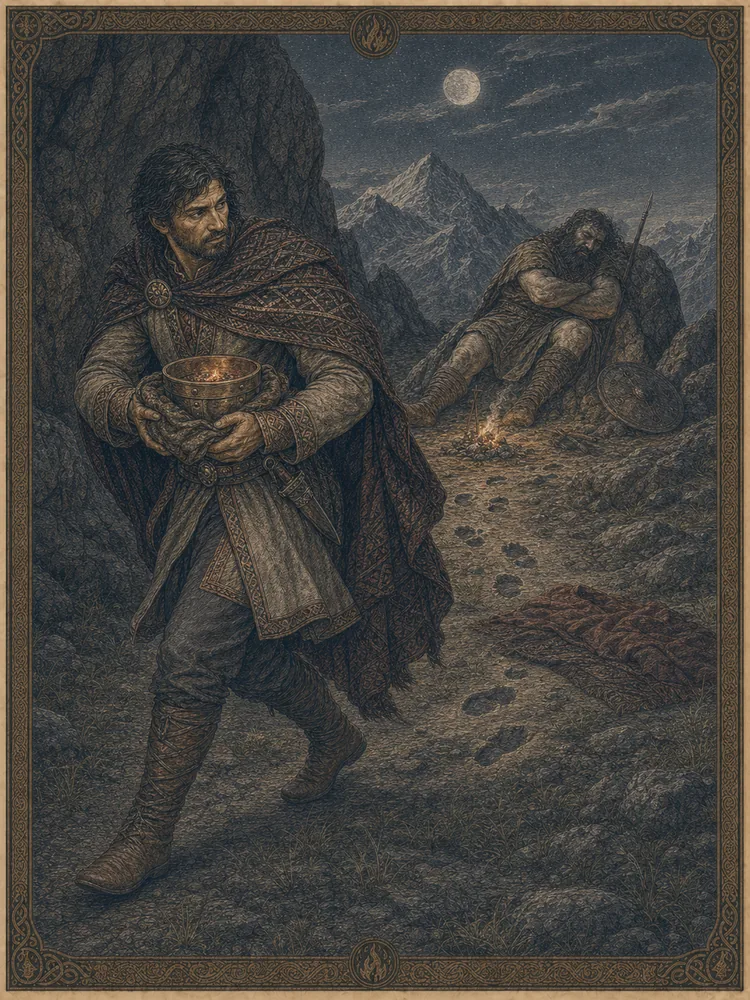
His most famous adventure was the bringing of fire to the Narts. The Narts had lost their fire (in some versions to the sky-cold, in others to a great giant who had stolen it), and were freezing through a long winter. Sosryko set out to retrieve it. He went to the giants' camp, used a series of clever ruses to gain entry, tricked the giants into giving him a torch, and escaped with the fire while the giants slept (or, in some versions, while they were occupied with a feast that Sosryko had himself helped them to prepare, the better to distract them). The fire-bringing has obvious parallels with the Greek Prometheus, with the Vedic Mātariśvan, and with the various other Indo-European fire-bringer narratives; Sosryko represents the Caucasian-Iranian articulation of the type.
His other famous narratives involved his defeats of various giants, monsters, and supernatural opponents — always by stratagem rather than force. He killed the great giant Tutyr by tricking him into looking at his own reflection in a poisoned pool; he won the magical sword of Æmbalon by entering the giant's tomb and stealing it during the giant's sleep; he defeated the supernatural archer Khamits by a complex ruse involving disguised arrows. Each narrative shows Sosryko as the figure of cunning intelligence — the hero whom the Narts called upon when straightforward warfare would not suffice.
His death, like the deaths of the other major Nart heroes, was inevitable and tragic. In some versions, Sosryko was killed by the same Wheel of Balsag that had killed Soslan (the two figures sometimes conflated in the corpus); in others, he was poisoned by his own mother through a trick that he had himself devised, in a final reversal of the hero's characteristic mode. The figure stands as one of the great trickster-heroes of Indo-European epic, with material that may go back to the Scythian period and that preserves a distinctive Iranian-Caucasian articulation of the trickster-pattern.