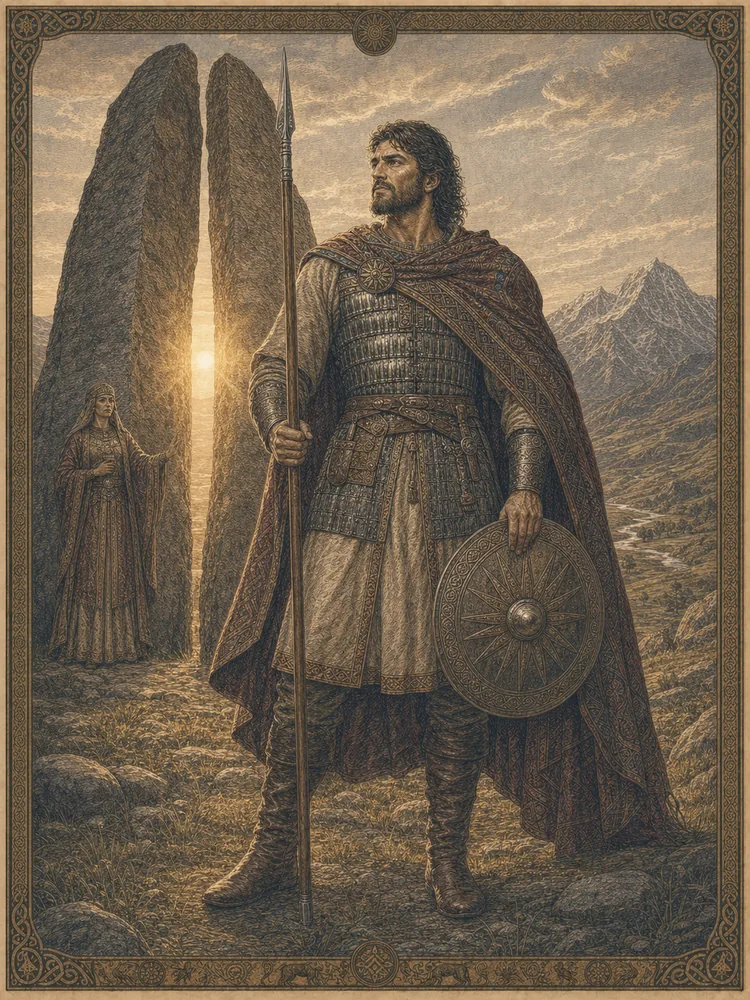
Soslan was another of the great Nart heroes, distinguished by his solar associations and by the extraordinary circumstances of his birth. According to the corpus, his mother was a magical stone that had been impregnated by the sun's reflection; the stone was opened by Satana (the great Nart matriarch, treated above) and Soslan was born from it, a child of supernatural radiance and exceptional strength.
He was, like Batraz, a warrior of formidable powers, and the corpus contains many narratives of his exploits. He was distinguished particularly by his cunning and resourcefulness in addition to his strength — where Batraz was the warrior of pure force, Soslan was the warrior who combined force with stratagem, defeating opponents through clever ruses and unexpected tactics. His most famous adventure was his journey to the underworld in pursuit of the cattle of the Narts, which had been stolen by the giant Mukara; Soslan recovered the cattle, defeated the giant, and returned to the upper world with both his physical and his moral victory.
His death was caused by the Wheel of Balsag — a great solar wheel of metal that rolled across the earth and that Soslan, who had himself been born from solar power, was unable to escape. The wheel ran over his thighs, mortally wounding him; he died slowly, attended by the other Narts. The story has been read as a solar-myth-allegory: the solar hero, born from the sun, is finally destroyed by the sun in the form of the cosmic wheel, completing the cycle of his nature.
Soslan's solar associations, his cunning, and his death by the cosmic wheel place him in the wider Indo-European pattern of solar-trickster heroes (the Greek Heracles, the Indian Indra, the Norse Thor in some aspects) — figures whose extraordinary powers come from the sun and whose narratives involve quests, defeats of giants, and complex relations with the other divinities. The Ossetian articulation is distinctive in its preservation of the cosmic wheel as the agent of the hero's death; the motif has parallels in some other Indo-European traditions but is most clearly preserved here.