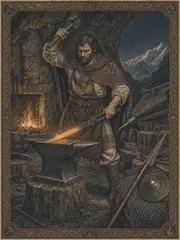
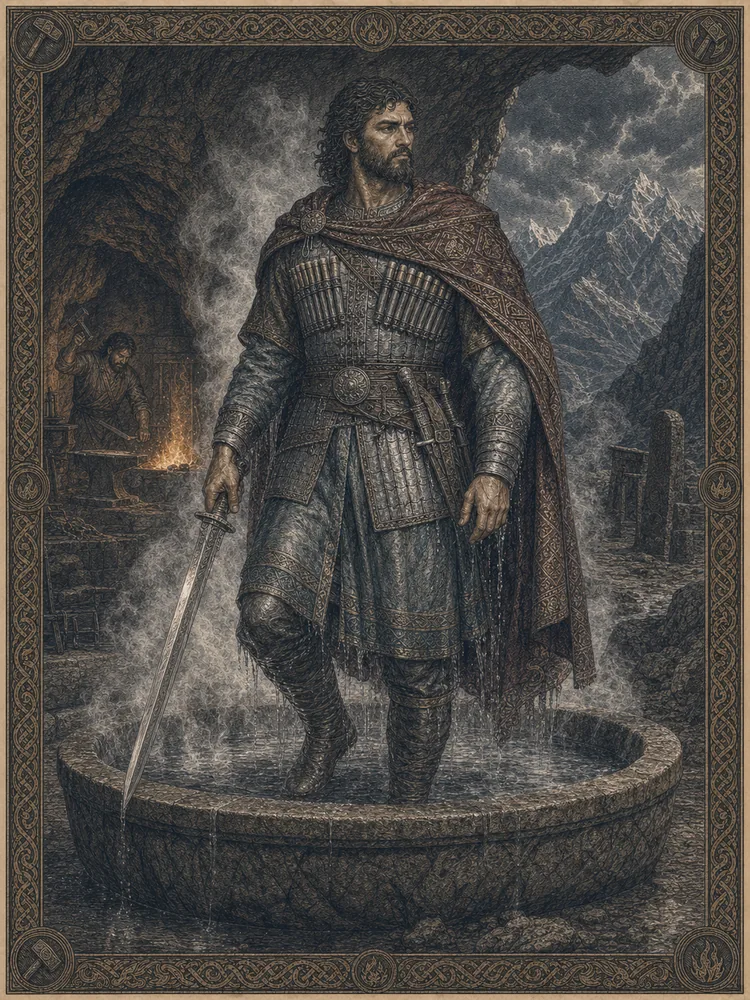
Batraz was one of the greatest of the Nart heroes — the steel-bodied warrior whose extraordinary qualities arose from the circumstances of his forging. According to the Nart corpus, his mother was Donbettyr's daughter (a water-supernatural in her own right) and his father was the Nart Khamyts. Khamyts had concealed his pregnant wife by means of a magical ring; when the ring was discovered and his wife was killed, the unborn child Batraz emerged from his mother's body and was placed by Wærhag (the smith-god, treated above) in the great cosmic forge, where he was tempered to a supernatural hardness and emerged as a being of pure steel.
He was an exceptional warrior even by Nart standards. His steel body was invulnerable to ordinary weapons; his supernatural strength enabled him to defeat opponents whom no other Nart could face; his temper, however, was as hard as his body, and he was prone to fits of rage that brought destruction on friend and foe alike. The Nart corpus contains many narratives of his exploits — his slaying of the giant Saynæg-Ældar, his recovery of the magical hide that protected the Nart cattle, his vengeance against those who had wronged the clan — each told with the elaborate detail and the rhythmic-poetic quality of mature oral epic.
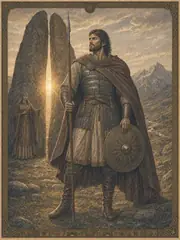
His death was as remarkable as his life. After many adventures, Batraz finally became overconfident in his invulnerability, challenged the gods themselves to combat, and was struck down by them. His body, made of supernatural steel, would not yield to corruption — it stood upright on the field where he had fallen, leaning on his great sword, refusing to lie down even in death. The gods were forced to perform special rites to permit the body to dissolve; only then could the soul of Batraz pass to its destined place, and the Nart era began to come to an end with his death.
The figure has been read in Indo-European comparative mythology as a representative of the warrior-function in Dumézil's tripartite scheme — the figure who embodies the heroic-military aspect of the divine, in tension with the priestly (Satana, in the Nart context) and the producer (the various agricultural-and-craft figures). His steel-tempering and supernatural character distinguish him from ordinary heroes and link him to the wider pattern of Indo-European warrior-deities and demigod heroes.