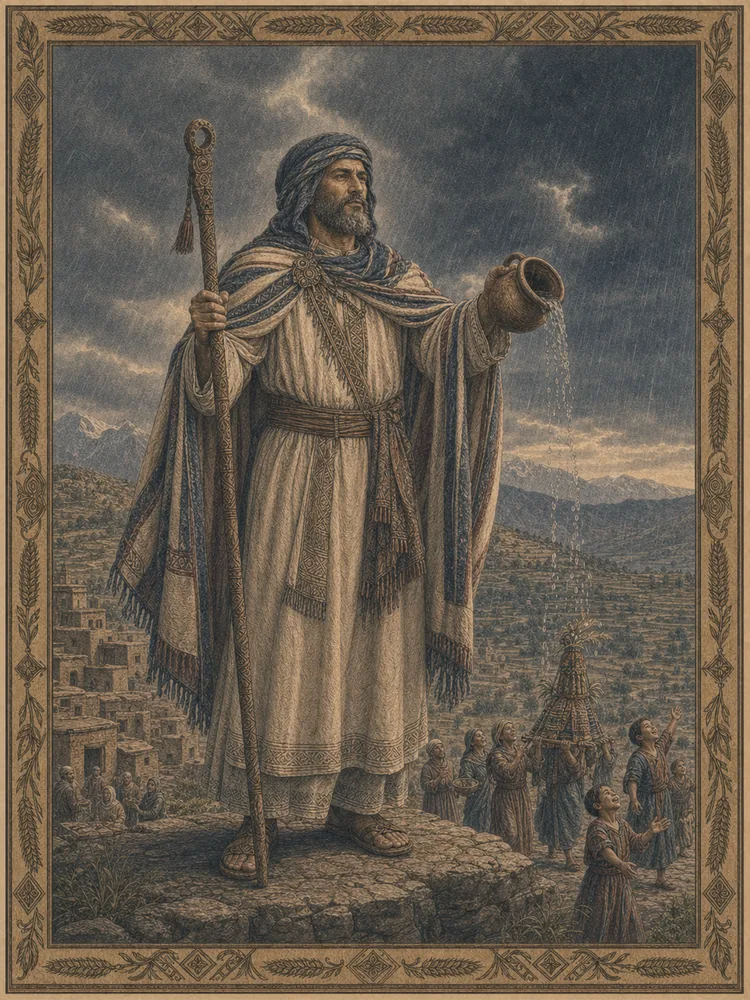
Anzar was the rain-god of the Berbers, particularly venerated among the Berber-speaking populations of the High Atlas, the Anti-Atlas, and the Kabyle regions. He was the divinity who brought the seasonal rains essential to the survival of the populations of the semi-arid Maghreb, and his cult was the focus of the most important of all Berber rural rites — the rain-procession, performed in time of drought, in which the entire village would carry a doll or effigy through the streets, dousing it (and themselves) with water, while singing prayers for rain.
The Anzar-rite has been preserved in modern Berber folk-tradition with remarkable fidelity. The procession is led by a young woman of marriageable age, dressed as the bride of Anzar; she is accompanied by other women and children, with the men following at a distance (though the men's role increases at certain points in the rite). The procession passes through the village, with each household contributing water, grain, oil, and other gifts; the bride-figure is then ritually 'married' to Anzar at a sacred site (often a particular tree or rock), and the union of the rain-god with his bride is held to bring the rain.
The rite combines multiple elements: a sacred procession, a sympathetic-magical performance (the dousing simulates the desired rain), a marriage-rite (sacred marriage as fertility-rite, parallel to the various sacred-marriage traditions of the ancient Mediterranean), and a community-binding ceremony (the entire village participates). The structural complexity is one of the clearest cases of pre-Islamic Berber religious survival into the modern period; the Islamic veneer (with prayers to Allah and various saints integrated into the older formulas) has not displaced the deeper structure of the rite.
Anzar himself is not depicted iconographically in the traditional Berber religion (the iconoclastic tendency of post-conquest Berber Islam has reinforced an older Berber preference for aniconic divinity); he is invoked rather than represented. His name is preserved in modern Tamazight as the standard word for rain itself (anẓar), and his cult is preserved in the rain-procession that bears his name. The figure stands as one of the clearest cases of religious continuity from pre-Islamic Berber tradition into modern folk-Islam, with the deity's name surviving as a common noun even where the explicit cult has receded.