A Compendium of the Ancient Gods
Gurzil, plate

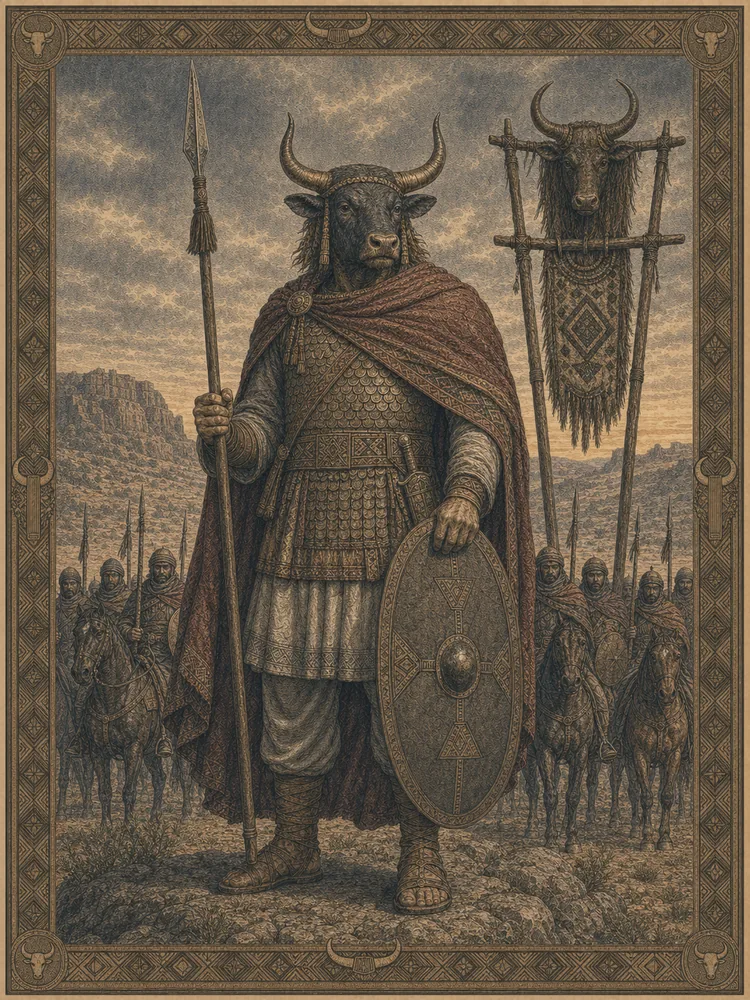
Gurzil was the war-god of certain Berber tribes of North Africa, particularly attested among the Laguatan and related peoples of the Tripolitanian and Cyrenaican frontier in the late Roman and Byzantine periods. He was depicted as a bull (or as a bull-headed warrior), and his cult-image — a sacred bull, kept at the tribal sanctuary, which the warriors carried with them into battle as their divine standard — was the central religious institution of the warrior tribal life.

He is documented chiefly through the Latin epic poem Iohannis of Corippus, written in the mid-sixth century of our era, which describes the wars between the Byzantine general John Troglita and the Berber tribes of North Africa in 546-548 CE. Corippus describes the Laguatan carrying Gurzil's bull-image into battle, performing rites before its presence, and being demoralized when the image was captured by the Byzantines (the capture of the cult-image being equivalent, in the religious sensibility of the tribe, to the loss of divine protection). The poem is one of the few sources for late-ancient Berber religion and is the chief witness to Gurzil.

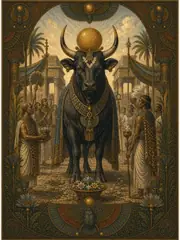
His bull-iconography places him in the broader pattern of bull-cult in North African religion. The Carthaginian-Phoenician Baal-Hammon, whose cult had been transmitted to Berber populations during the Carthaginian period, also had bull-associations; the Egyptian Apis-cult on the eastern frontier of the Berber region; the Punic-period sacrifice of bulls in the Tophet rites — all contribute to a regional religious sensibility in which the bull was a primary divine animal. Gurzil's articulation of this pattern was distinctively Berber in its fusion of warrior-function with bull-cult.

The cult declined with the Byzantine reconquest of North Africa (Justinian's recovery of the region from the Vandals, 533-534, and subsequent campaigns) and was extinguished by the Arab Islamic conquest of the seventh century, which converted the Berber tribes to Islam over the following several centuries. Gurzil disappears from the historical record after Corippus; the figure is preserved chiefly in his single literary attestation, but stands as one of the most clearly described pre-Islamic Berber deities.
Curator’s note

What the sources say, and what later tradition added. The sources for this bay

Gurzil is documented chiefly in Corippus's Iohannis (especially Books 2, 4, and 8). The standard text is the Cambridge edition (Diggle and Goodyear, 1970); the standard scholarly study is Andrew H. Merrills's various publications and the contributions to the volumes on late-ancient North Africa. The wider context of Berber religion in this period is treated in Yves Modéran's Les Maures et l'Afrique romaine, IVe-VIIe siècle (2003) and in the works of David Mattingly. The bull-cult comparative material is in many works on Mediterranean religion.

Kin in the sources

Each tie is quoted from the entry that states it.

When the sources speak

Dated witnesses for The Berber Amazigh Pantheon. A date marks when the evidence was written down, not when the belief began. The whole timeline

2nd–1st millennia BCE
Bronze and Iron Age regional cultures establish the archaeological backgrounds later labeled Thracian, Illyrian, Iberian, Caucasian, and Libyan.
8th–6th centuries BCE
Greek and Phoenician colonization creates new inscriptional, artistic, and commercial contact zones.
6th–4th centuries BCE
Classical authors begin describing frontier peoples and translating local gods into Greek categories.
3rd–1st centuries BCE
Hellenistic kingdoms, Carthage, and Rome intensify political and cultic exchange.
1st century BCE–3rd century CE
Roman provincial rule produces dedications, coins, reliefs, and interpretive equations across the Balkans, Iberia, Caucasus, and North Africa.
4th–7th centuries CE
Christianization and imperial change end or transform many public cult institutions while names persist in texts and places.
medieval period
Georgian chronicles and epic traditions, Iberian memory, and North African historical sources reshape pre-Christian inheritances.
2nd–1st millennia BCE
Libyan groups appear in Egyptian records and regional archaeology.

Floor plan

The rooms follow one another in the order their peoples first appear in the written record.

  1. The Cradle of Citiesc. 3400 BCE to 395 CE. 115 works
  2. The Gift of the Nilec. 4000 BCE to 395 CE. 73 works
  3. The Olympian Orderc. 1600 BCE to 750 CE. 152 works
  4. The Persian Worldc. 2000 BCE to 1010 CE. 30 works
  5. The Levantine Borderlandsc. 1200 BCE to 500 CE. 20 works
  6. The Edges of Empirec. 2000 BCE to 1500 CE. 33 works
  7. The Etruscan Worldc. 900 BCE to 750 CE. 22 works
  8. The Roman Inheritancec. 1200 BCE to 500 CE. 58 works
  9. The Northern Inheritancec. 2000 BCE to 1600 CE. 131 works