A Compendium of the Ancient Gods
Ifri, plate

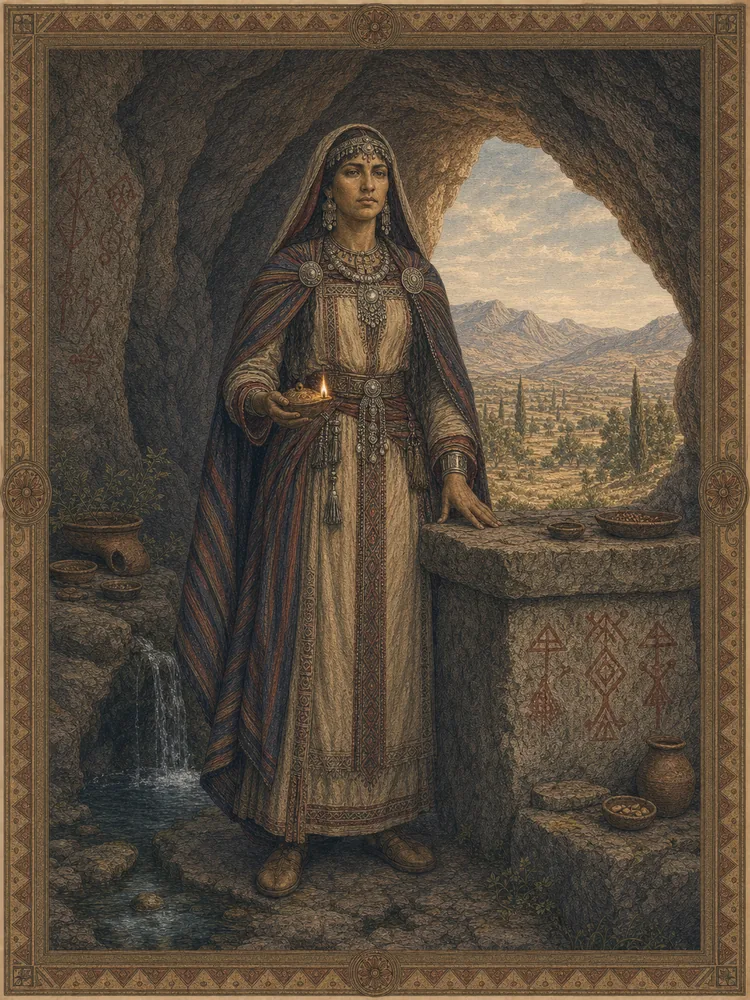
Ifri (or Ifri-Tha, with the feminine article) was a Berber deity, or perhaps a class of Berber deities, associated with sacred caves. The word ifri in Tamazight means 'cave,' and the divine name was either an epithet for the goddess of any particular cave-sanctuary or a generic title for the cave-spirit class. Both interpretations are defensible from the surviving evidence; the Berber pattern of multiple local divinities (parallel to the Iberian Bandua-pattern, treated in Book III above) makes the multiplication of cave-goddesses across the region plausible.

The cave-cult was an important element of pre-Islamic Berber religion. Many natural caves throughout the Maghreb served as sanctuaries — the visitor would descend into the cave, perform offerings at the inner wall (often a small pool or spring), receive oracular response or healing, and emerge with the marks of having visited the sacred place. The practice has parallels with the cave-cults of the Mediterranean (the Greek and Cretan cave-sanctuaries, the Etruscan underworld-cult sites) and probably represents an indigenous tradition deeply rooted in the Maghreb landscape.

Ifri was depicted (when she was depicted at all — the iconographic tradition was sparse) as a young woman, sometimes seated within the cave-mouth, sometimes naked, sometimes accompanied by serpents (the cave's typical inhabitants) or by torches (for the necessary illumination of the underground sanctuary). Her cult was particularly developed in the Aurès region of eastern Algeria and in the High Atlas of southern Morocco, with a number of cave-sanctuaries known archaeologically.

The cave-cult was syncretized in the Islamic period with the cult of certain marabouts whose tombs were located in or near caves. The Berber folk-tradition of pilgrimages to cave-shrines preserves elements of the older Ifri-veneration, transferred onto the framework of the Islamic saint-cult. The continuity is real but indirect; the explicit name Ifri has receded, but the cave-as-sacred-site sensibility has persisted into the modern period in Berber popular religion.
Curator’s note

What the sources say, and what later tradition added. The sources for this bay

Ifri is documented chiefly in modern ethnographic studies of Berber religion and through the Latin and Punic inscriptions of the Roman provincial period (where divine names with the Ifri- element appear in some dedications). The standard treatments are in the various works of Gabriel Camps (especially his Les Berbères: Mémoire et identité, 1980, the foundational synthesis) and in the volumes of the Encyclopédie berbère. The cave-cult comparative material is in many places; Yulia Ustinova's Caves and the Ancient Greek Mind (2009) treats the wider Mediterranean pattern.

Kin in the sources

Each tie is quoted from the entry that states it.

When the sources speak

Dated witnesses for The Berber Amazigh Pantheon. A date marks when the evidence was written down, not when the belief began. The whole timeline

2nd–1st millennia BCE
Bronze and Iron Age regional cultures establish the archaeological backgrounds later labeled Thracian, Illyrian, Iberian, Caucasian, and Libyan.
8th–6th centuries BCE
Greek and Phoenician colonization creates new inscriptional, artistic, and commercial contact zones.
6th–4th centuries BCE
Classical authors begin describing frontier peoples and translating local gods into Greek categories.
3rd–1st centuries BCE
Hellenistic kingdoms, Carthage, and Rome intensify political and cultic exchange.
1st century BCE–3rd century CE
Roman provincial rule produces dedications, coins, reliefs, and interpretive equations across the Balkans, Iberia, Caucasus, and North Africa.
4th–7th centuries CE
Christianization and imperial change end or transform many public cult institutions while names persist in texts and places.
medieval period
Georgian chronicles and epic traditions, Iberian memory, and North African historical sources reshape pre-Christian inheritances.
2nd–1st millennia BCE
Libyan groups appear in Egyptian records and regional archaeology.

Floor plan

The rooms follow one another in the order their peoples first appear in the written record.

  1. The Cradle of Citiesc. 3400 BCE to 395 CE. 115 works
  2. The Gift of the Nilec. 4000 BCE to 395 CE. 73 works
  3. The Olympian Orderc. 1600 BCE to 750 CE. 152 works
  4. The Persian Worldc. 2000 BCE to 1010 CE. 30 works
  5. The Levantine Borderlandsc. 1200 BCE to 500 CE. 20 works
  6. The Edges of Empirec. 2000 BCE to 1500 CE. 33 works
  7. The Etruscan Worldc. 900 BCE to 750 CE. 22 works
  8. The Roman Inheritancec. 1200 BCE to 500 CE. 58 works
  9. The Northern Inheritancec. 2000 BCE to 1600 CE. 131 works