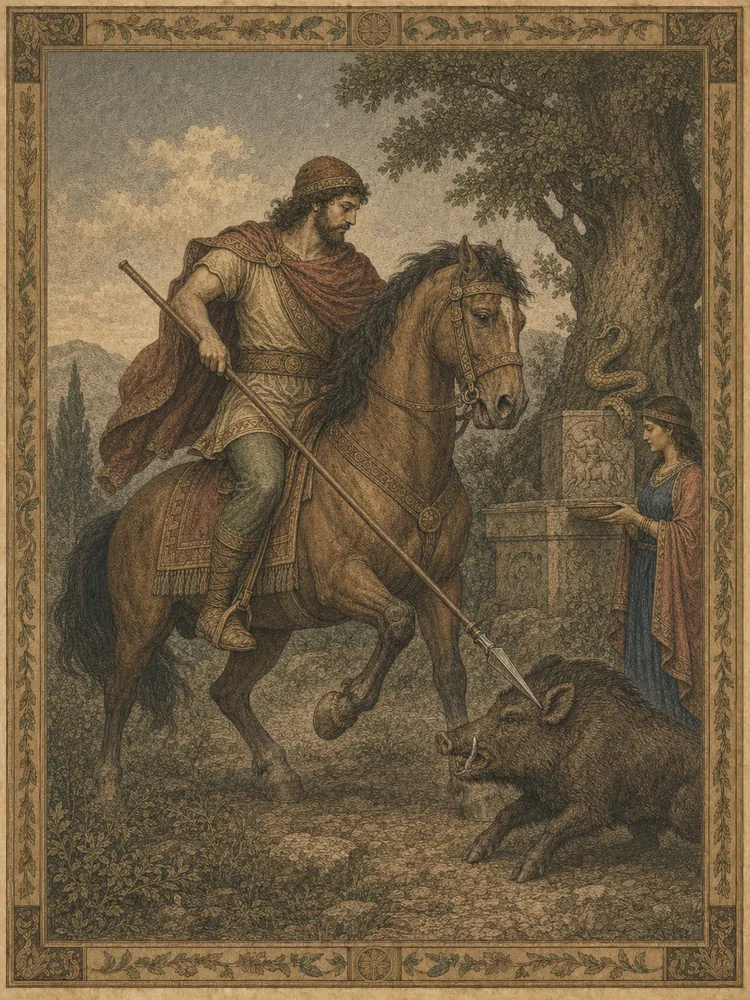
Of all the Thracian religious figures, none is more abundantly attested in the surviving record than the Thracian Horseman — called simply Heros (Greek: 'Hero'), or sometimes by various local epithets (Heros Karabasmos, Heros Aularchenos, and many others), depicted on hundreds of votive reliefs from across the Thracian-Greek-Roman frontier. The reliefs almost invariably show a single horseman, riding to the right (less often to the left), often spearing a wild boar or other game, sometimes accompanied by a dog or a tree or a snake-altar. He wears a short tunic and a flowing cloak; his horse is depicted in the conventional rearing or trotting pose; the scene is set in an idealized hunting-landscape.
The figure represents the Thracian conception of the divine hero — the deified ancestor of the tribe or family, often a real historical chieftain whose tomb had become a sanctuary, who was venerated as a tutelary protector of his descendants and his territory. Each local Heros was thus distinct, with his own local epithet and his own particular sanctuary; but the type was uniform throughout the Thracian world, and the votive reliefs are mass-produced in standardized workshops over centuries, with only the inscribed names changing.
The hero-cult was the most pervasive Thracian religious institution. Where the great gods (Bendis, Kotys, Derzelas, Pleistoros) had their major sanctuaries in the cities or at the great rural cult-centers, the Heros-cult was distributed across the landscape — every village, every estate, every minor sanctuary had its local Heros, with reliefs commissioned by individual or family worshippers and dedicated at the appropriate shrine. The accumulation of these dedications over the Hellenistic and Roman periods produced the great archaeological corpus we now have, with thousands of surviving reliefs catalogued in the standard publications.
The transition from the Thracian Horseman to the Christian iconography of warrior saints was direct. Saint George the dragon-slayer, in particular, took over much of the visual vocabulary of the Heros-reliefs (the horseman, the spear, the slain monster — the dragon replacing the boar), and the Christianization of the Thracian region in the fourth and fifth centuries of our era proceeded in part through the substitution of warrior-saint iconography for the older hero-iconography at the same sanctuaries. The continuity is one of the clearest cases of pagan-Christian iconographic descent in the late ancient Mediterranean.