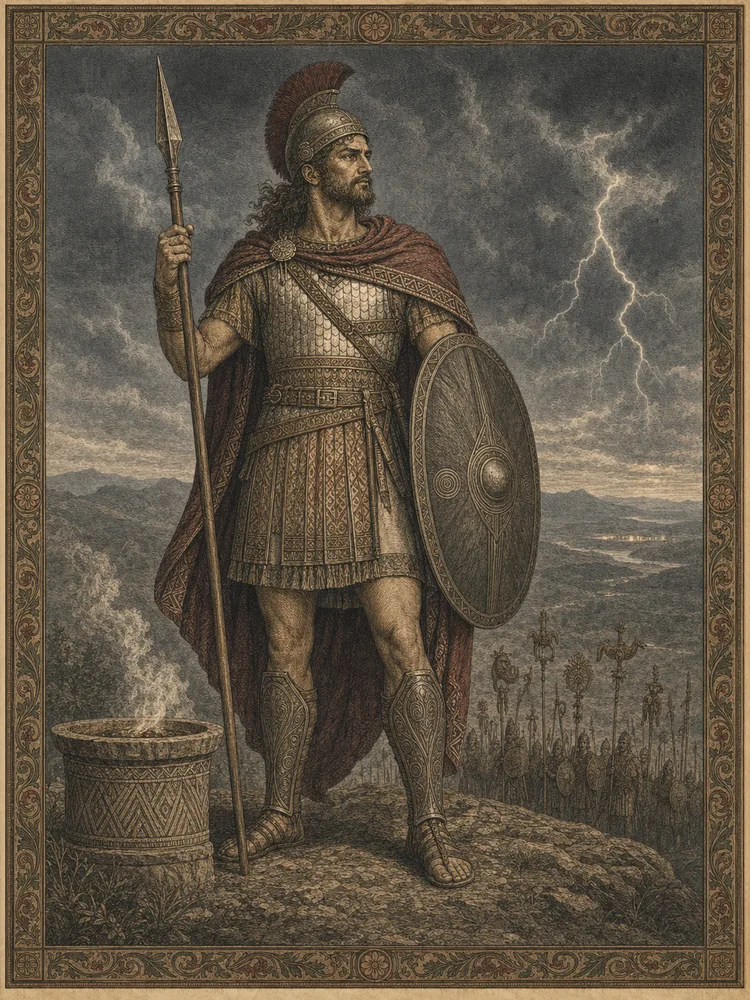
Pleistoros (sometimes Pleistorus) was a Thracian war-god, particularly of the tribe of the Apsinthii in southern Thrace, to whom Herodotus attributes a remarkable rite. After the Greek-Persian Wars of 480-479 before our era, the Persian general Oeobazus, fleeing through Thrace, was captured by the Apsinthii and sacrificed to Pleistoros — burnt alive in the ritual manner, to give the war-god the prisoner's life-force as the recompense for victory. The sacrifice is one of the few clear cases of human sacrifice attested in the Greek-Mediterranean cultural sphere of the classical period (most surrounding cultures had abandoned the practice by then or had never had it), and Herodotus reports it without comment, as one of the noteworthy customs of the Thracians.
Pleistoros as a war-god is otherwise scarcely attested. His name appears in a few inscriptions from the Thracian regions (the etymology is uncertain — some scholars connect it with a Thracian root meaning 'glittering' or 'lightning,' with the war-god as a divinity of the gleam of arms and the flash of battle), and he was probably a regional manifestation of a wider Thracian war-deity tradition that included other figures (Kandaon, Plistoros's variant, mentioned by Polyaenus in his Strategems). The various Thracian war-gods seem to have been local manifestations of a common type rather than distinct deities; the proliferation of names probably reflects the political fragmentation of the Thracian world rather than a developed pantheon of distinct war-divinities.
The human sacrifice of Oeobazus is the chief surviving narrative associated with Pleistoros. The rite — burning the prisoner alive, with proper invocations to the god and proper division of the offerings among the priests — was one of the most archaic forms of warfare-religion in the Indo-European world; comparable practices are attested in the Norse pre-Christian period (with the bog-bodies sometimes interpreted as such sacrifices), in the Celtic pre-Roman period (with the wicker-man rites described by Caesar), and elsewhere. The Greek shock at the practice in the early fifth century before our era is itself a measure of how thoroughly the Mediterranean world had moved away from such rites by that period.
After the absorption of Thrace into the Macedonian and then Roman political systems, the war-god cults declined and were largely replaced by the worship of the Greek-Roman war-gods (Ares, Mars). Pleistoros disappears from the inscriptions of the imperial period; his name is preserved chiefly through Herodotus's single mention.