A Compendium of the Ancient Gods
Derzelas, plate

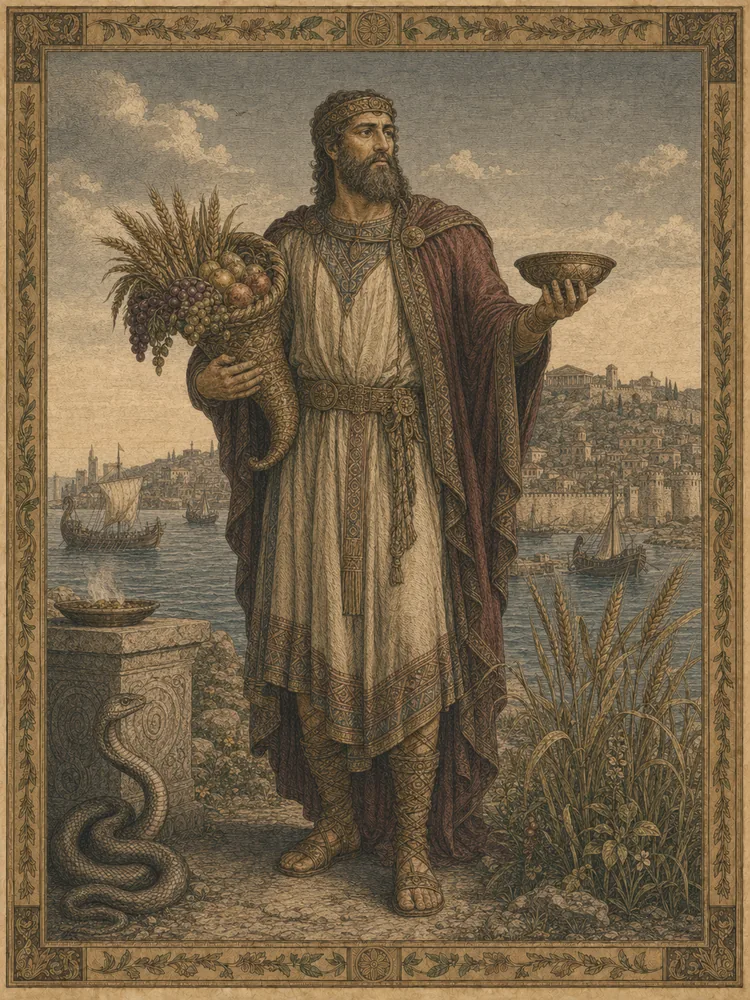
Derzelas (variant Darzalas) was a great deity of the Thracian-Greek city of Odessos (modern Varna on the Bulgarian Black Sea coast), where his cult was the central religious institution of the city through the Hellenistic and Roman periods. Odessos had been founded as a Greek colony in the seventh century before our era, but the local Thracian religion was incorporated into the city's religious life, and Derzelas — under that name in Greek inscriptions — became the city's chief deity, identified by the Greeks variously with Zeus, with Pluto, and with the broader category of the Great Gods of Samothrace.

His functions overlapped those of several Greek deities: he was a god of health (as Pluto could be in his chthonic aspect, and as Asclepius was), of life-force and vitality (as Zeus was in his aspect of preserver), and of the connection between the living and the dead (as the chthonic gods generally). His cult image, preserved on Odessan coins, depicted him as a bearded man holding a cornucopia in one hand and a phiale (libation-bowl) in the other — a benevolent and prosperous figure, the divine guarantor of the city's well-being.

The cult of Derzelas was syncretistic and absorptive. As Odessos developed under Greek and then Roman rule, the cult took on characteristics from various sources: the Phoenician-Aramaean Bel through the trading connections with the eastern Mediterranean; the Egyptian Sarapis through the Hellenistic religious koine; the Greek Pluto-Hades through the chthonic functions; the Roman Genius of the city under the imperial administration. The composite figure was distinctively Odessan rather than narrowly Thracian or Greek, and he was the patron of a citizen-body that mixed Thracian, Greek, and Roman inhabitants in changing proportions through the centuries.

After the Christianization of the eastern Mediterranean, Derzelas's cult was extinguished, but Odessos (under its later Slavic name Varna) preserved some folk-religious traditions that may go back to the Thracian-Hellenistic substratum. The medieval Christian veneration of various Thracian-Bulgarian saints in the region took over some of the older cult-sites, and elements of the iconography (the cornucopia, the libation-bowl, the bearded benefactor) were transposed into the iconography of certain Eastern Orthodox saints. The figure of Derzelas as such, however, was lost by the late ancient period.
Curator’s note

What the sources say, and what later tradition added. The sources for this bay

Derzelas is documented chiefly through Odessan inscriptions and coinage; the standard reference is Dimitar Detschew's Die thrakischen Sprachreste (1957) and the various Bulgarian-language scholarship on Odessan religion. Z. Goceva's articles in Bulgarian and German publications are particularly useful. The site of ancient Odessos is now substantially under modern Varna, with limited archaeological access; the rescue excavations of the late twentieth century have produced important materials.

Kin in the sources

Each tie is quoted from the entry that states it.

When the sources speak

Dated witnesses for The Thracian Pantheon. A date marks when the evidence was written down, not when the belief began. The whole timeline

2nd–1st millennia BCE
Bronze and Iron Age regional cultures establish the archaeological backgrounds later labeled Thracian, Illyrian, Iberian, Caucasian, and Libyan.
8th–6th centuries BCE
Greek and Phoenician colonization creates new inscriptional, artistic, and commercial contact zones.
6th–4th centuries BCE
Classical authors begin describing frontier peoples and translating local gods into Greek categories.
3rd–1st centuries BCE
Hellenistic kingdoms, Carthage, and Rome intensify political and cultic exchange.
1st century BCE–3rd century CE
Roman provincial rule produces dedications, coins, reliefs, and interpretive equations across the Balkans, Iberia, Caucasus, and North Africa.
4th–7th centuries CE
Christianization and imperial change end or transform many public cult institutions while names persist in texts and places.
medieval period
Georgian chronicles and epic traditions, Iberian memory, and North African historical sources reshape pre-Christian inheritances.
5th century BCE
Herodotus and Athenian evidence provide influential descriptions of Thracian gods and rites.

Floor plan

The rooms follow one another in the order their peoples first appear in the written record.

  1. The Cradle of Citiesc. 3400 BCE to 395 CE. 115 works
  2. The Gift of the Nilec. 4000 BCE to 395 CE. 73 works
  3. The Olympian Orderc. 1600 BCE to 750 CE. 152 works
  4. The Persian Worldc. 2000 BCE to 1010 CE. 30 works
  5. The Levantine Borderlandsc. 1200 BCE to 500 CE. 20 works
  6. The Edges of Empirec. 2000 BCE to 1500 CE. 33 works
  7. The Etruscan Worldc. 900 BCE to 750 CE. 22 works
  8. The Roman Inheritancec. 1200 BCE to 500 CE. 58 works
  9. The Northern Inheritancec. 2000 BCE to 1600 CE. 131 works