A Compendium of the Ancient Gods
Awaiting its plate

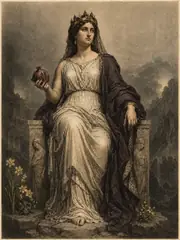
E Bukura e Dheut ("the Beauty of the Earth") was a figure of Albanian folk-tale — a beautiful woman of the underworld who appeared in many of the traditional Albanian tales as the object of heroic quests, the captive princess to be rescued, the magical bride to be won. Her dwelling was beneath the earth (an underground palace where she lived among supernatural beings), and reaching her required descent into the chthonic realm. She was sometimes benevolent, sometimes hostile; her character varied across the tales in ways that suggest she was a class of figure (the underworld beauty) rather than a single deity, with various tale-particulars attaching to her in different versions. Her parallel figure E Bukura e Detit ("the Beauty of the Sea") inhabited an analogous undersea realm.

The figures have been variously interpreted by Albanian and foreign folklorists: as memories of pre-Christian Albanian goddesses (chthonic and aquatic), as parallels to the Greek Persephone (the underworld bride, perhaps surviving in Albanian as a substrate from the ancient Greek-influenced period of the southern Balkans), as fairy-tale formulas without specifically theological content. The truth probably lies somewhere among these; the figures certainly exist in the folk-tradition, but their pre-Christian theological status is harder to recover. With them we close the European volume — at the southeastern margin of the European pagan inheritance, where Indo-European antiquity meets the Mediterranean classical world meets the long Ottoman overlay, and where the folk-tradition has preserved what the documentary record could not.
Curator’s note

What the sources say, and what later tradition added. The sources for this bay

The principal sources are the Albanian folk-tale collections, especially Auguste Dozon's Contes albanais (1881) and the various 20th-century gatherings. Robert Elsie's Albanian Folktales and Legends (1994) is the standard English-language collection. The interpretation is treated in his Dictionary of Albanian Religion, Mythology, and Folk Culture (2001).

Kin in the sources

Each tie is quoted from the entry that states it.

When the sources speak

Dated witnesses for The Finnic, Hungarian and Albanian Traditions. A date marks when the evidence was written down, not when the belief began. The whole timeline

2nd–1st millennia BCE
Indo-European language dispersals and regional Bronze Age cultures provide a remote comparative background, not a recoverable common canon.
c. 500 BCE–1 CE
Iron Age material culture, names, sanctuaries, and classical ethnography offer early but external evidence for Celtic and Germanic religions.
1st–4th centuries CE
Roman inscriptions and provincial cults preserve many Celtic, Germanic, and local divine names.
4th–8th centuries CE
Migration-period and early medieval conversion transform ritual institutions while heroic traditions continue.
8th–11th centuries CE
Viking Age poetry, runic evidence, archaeology, and Scandinavian conversion form the core context of Norse myth.
9th–12th centuries CE
Slavic, Baltic, and Finnic traditions enter chronicles and missionary accounts, often through hostile observers.
11th–14th centuries CE
Irish, Welsh, and Icelandic manuscripts preserve major narrative corpora in Christian literary environments.
12th–16th centuries CE
Saxo, saga compilers, Baltic chroniclers, and later antiquarians systematize or reinterpret older material.

Floor plan

The rooms follow one another in the order their peoples first appear in the written record.

  1. The Cradle of Citiesc. 3400 BCE to 395 CE. 115 works
  2. The Gift of the Nilec. 4000 BCE to 395 CE. 73 works
  3. The Olympian Orderc. 1600 BCE to 750 CE. 152 works
  4. The Persian Worldc. 2000 BCE to 1010 CE. 30 works
  5. The Levantine Borderlandsc. 1200 BCE to 500 CE. 20 works
  6. The Edges of Empirec. 2000 BCE to 1500 CE. 33 works
  7. The Etruscan Worldc. 900 BCE to 750 CE. 22 works
  8. The Roman Inheritancec. 1200 BCE to 500 CE. 58 works
  9. The Northern Inheritancec. 2000 BCE to 1600 CE. 131 works