A Compendium of the Ancient Gods
Awaiting its plate

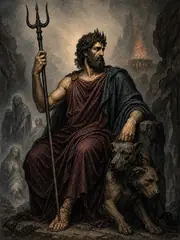
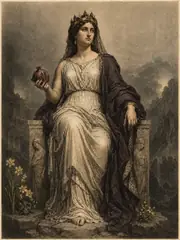
The Finnish underworld was called Tuonela — "the Place of Tuoni" — and its king and queen were Tuoni and Tuonetar, the Lord and the Lady of Death. Tuonela lay across a great dark river, the river Tuoni, that no living person might cross; it was the destination of all souls when they died, and there they remained, ruled by the dread pair, in shadowy halls deep in the earth or far in the cold north.

The figures of Tuoni and Tuonetar were less elaborated than the Greek Hades and Persephone — the Finnish imagination had no marriage-myth, no abduction story, no mythology of the underworld's foundation. They simply were: the rulers of the place where the dead went. Tuonetar in particular played a role in the great epic of the Kalevala, when the hero Väinämöinen journeyed to Tuonela to recover the words of an old spell and was nearly held there by Tuonetar, who served him a bowl of beer in which she had hidden serpents and frogs; only by a counter-charm did he escape.

The river of Tuonela had a black swan upon its waters — the Swan of Tuonela — that swam in slow circles, singing as it went; whoever heard the swan's song understood that he was already across the river, already in the realm of the dead. The hero Lemminkäinen, in another Kalevala episode, attempted to shoot the swan with an arrow, that he might prove his manhood; he was killed for the attempt, his body torn into pieces, and only by the long search of his mother who walked through Tuonela gathering up the pieces and singing them back together was he restored to life.

Tuoni and Tuonetar had children: Tuonen tytti, the daughter of Tuoni, who was sometimes the ferrywoman of the dark river; Loviatar, who in some traditions was Tuonetar's daughter and the mother of the nine diseases; and various other shadowy figures of the underworld. The ensemble forms a less elaborated but recognizable Finnish counterpart to the underworld pantheons of other Indo-European peoples, retained in folk-belief into the modern period.
Curator’s note

What the sources say, and what later tradition added. The sources for this bay

Tuoni and Tuonetar appear extensively in the Kalevala (compiled by Elias Lönnrot, 1835/1849), particularly in Runos 14-15 (Lemminkäinen's death at Tuonela) and Runos 16-17 (Väinämöinen's journey to Tuonela). The original folk-songs from which the Kalevala was constructed have been collected and edited by Lönnrot and his successors; the modern critical edition of the Suomen Kansan Vanhat Runot (Old Songs of the Finnish People) preserves the variant material. Sibelius's tone-poem The Swan of Tuonela (Tuonelan joutsen, 1895) made the figure internationally famous. The structural similarities between Finnish and Indo-European underworld-mythologies have been noted but not reduced to a clear genealogical connection; Finnish, as a Uralic rather than Indo-European language, is not part of the same deep family.

Kin in the sources

Each tie is quoted from the entry that states it.

When the sources speak

Dated witnesses for The Finnic, Hungarian and Albanian Traditions. A date marks when the evidence was written down, not when the belief began. The whole timeline

2nd–1st millennia BCE
Indo-European language dispersals and regional Bronze Age cultures provide a remote comparative background, not a recoverable common canon.
c. 500 BCE–1 CE
Iron Age material culture, names, sanctuaries, and classical ethnography offer early but external evidence for Celtic and Germanic religions.
1st–4th centuries CE
Roman inscriptions and provincial cults preserve many Celtic, Germanic, and local divine names.
4th–8th centuries CE
Migration-period and early medieval conversion transform ritual institutions while heroic traditions continue.
8th–11th centuries CE
Viking Age poetry, runic evidence, archaeology, and Scandinavian conversion form the core context of Norse myth.
9th–12th centuries CE
Slavic, Baltic, and Finnic traditions enter chronicles and missionary accounts, often through hostile observers.
11th–14th centuries CE
Irish, Welsh, and Icelandic manuscripts preserve major narrative corpora in Christian literary environments.
12th–16th centuries CE
Saxo, saga compilers, Baltic chroniclers, and later antiquarians systematize or reinterpret older material.

Floor plan

The rooms follow one another in the order their peoples first appear in the written record.

  1. The Cradle of Citiesc. 3400 BCE to 395 CE. 115 works
  2. The Gift of the Nilec. 4000 BCE to 395 CE. 73 works
  3. The Olympian Orderc. 1600 BCE to 750 CE. 152 works
  4. The Persian Worldc. 2000 BCE to 1010 CE. 30 works
  5. The Levantine Borderlandsc. 1200 BCE to 500 CE. 20 works
  6. The Edges of Empirec. 2000 BCE to 1500 CE. 33 works
  7. The Etruscan Worldc. 900 BCE to 750 CE. 22 works
  8. The Roman Inheritancec. 1200 BCE to 500 CE. 58 works
  9. The Northern Inheritancec. 2000 BCE to 1600 CE. 131 works